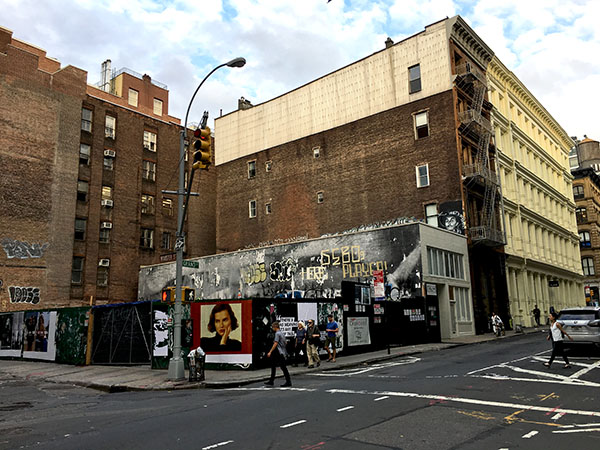
This is a snapshot of the corner of Grand and Wooster, September 14, 2017, looking pretty much as it did in the early 80s, when I was briefly lodged in a Tribeca loft on Duane Street.
This is a snapshot of the corner of Grand and Wooster, September 14, 2017, looking pretty much as it did in the early 80s, when I was briefly lodged in a Tribeca loft on Duane Street.
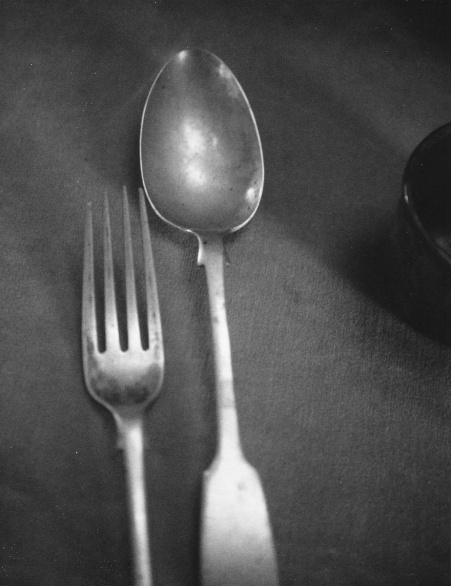
Patti Smith Arthur Rimbaud's utensils n.d.
I came across this photograph by Patti Smith while looking on line at the very few photo images we have of Arthur Rimbaud. My short trip began with the news of Smith's purchase of a house in Roche, in the Ardennes, built near the foundations of the one in which the French poet had grown up (His mother's original farm house had been destroyed in the First World war).
While there may still be so much to be said about Rimbaud, all I'll say in this post is that once again I'm feeling a wee bit closer to him, and it's because of this knife and spoon, which had apparently been used by the great boy: They are virtually identical to some that I've been using for almost half a century.
They're old (nineteenth century), made of a material I know as 'German silver' [nickel silver, or Maillechort in France]. Their shapes are very fine, and they never tarnish. Like Rimbaud.
I now love them all more than ever.

my own couverts
[the image at the top is from The New York Times]

Blood, so much blood.
Did the Syrian civil war begin with George W. Bush?
Who started it? Americans don't like looking back, but when the subject is a war without end and a complete failure to address it, or the damages that continue to mount up internally, the question has a real and present urgency.
All of the wars in the middle east for the past 15 years (and which, by definition of the umbrella 'War on Terror', have no foreseeable end) will forever be the shame of this country. Both political parties, and, apparently, most Americans, have affirmed them and adopted them as their own.
At least to the extent that we have not demonstrated against, or at least vocally opposed these wars from the beginning, and regardless of the fact that we are not the specific, immediate agents of the death and destruction, we are all responsible for their creation, and for their continuing horrors,
This is true also of the formation of ISIS, and the character of the civil war in Syria. The Bush regime's obsession with Iraq, and its decision (with the concurrence and assistance of others inside the country and abroad) to invade that nation, was the fundamental impetus for ISIS, and the continuing civil war in Syria.
In this May, 1915 New Yorker piece, Dexter Filkins makes the connections, but unfortunately he begins with the invasion of Iraq as a given, pretty much absolving the Bush regime of the blame for ISIS and Syrian horrors.
If Bush gets off scot free, then obviously nobody did anything wrong, and nobody is still doing anything wrong.
Shit just happens.
It was conceived as an important visual document, accessible to the public and to institutions, which would describe the faces of a community and a moment whose memory is already fading from our consciousness.
The Kickstarter for the project needs a real boost as it winds down now, with less than three days to go. If the book doesn't get published, I think it will be a genuine loss for activism today.
Of course if it does get published, it won't mean a cure for AIDS. Also, to be sure, "The AIDS activist project: A new book of portraits of AIDS activists from around the globe" is not a vanity project for the artist, Bill Bytsura, or for those members of the historical ACT UP whose beautiful portraits will be a part of it.
Its importance is greater than the authors of the project or the subjects included in the book.
Pictures are important for understanding a past and inspiring a future, but pictures assembled in a context are still more important, and take on a life of their own. ACT UP was a movement which exploded in the late 80s, and burgeoned through half of the next decade, responding creatively, and often heroically, to a life and death crisis which was being ignored by an establishment which appeared to be unmovable.
Its people and the community they formed, along with the AIDS crisis which galvanized them, may be ancient history to a generation struggling today worldwide with an indifference among the powerful arguably even broader in scale - if, perhaps, less deadly. There is much to be gained today from looking at the devices employed, their successes - along with their failures, by a movement which flourished twenty and more years back. There's also the courage and nobility of so many of its members, and the anger and the love which was always a part of the movement.
Bytsura's book would give a face to an entire generation of activists (although in fact people of all ages were included in its membership), and it could serve an entire new generation as both muster to resistance, and powerful inspiration for effective resistance. Please help to breathe life into it, and consider contributing to its publication.
Full disclosure: Billy has been a friend since the days of ACT UP at it peak, and Barry and I have several of his beautiful non-activist photographs in our collection. There is also this portrait of a very young me, at 50, in 1990.
but the shame of sentencing the man to prison, and it endures today
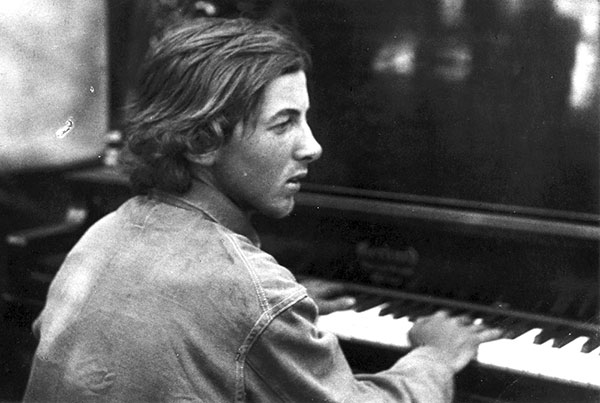
Henry Cowell at the Forest Theater, Carmel, 1913 (we were all once very young)
Henry Cowell, born in the last years of the 19h century, was a brilliant composer, one of the wildest, most original of the 20th century, and his work remains radical today in the 21st. He was also a magnificent pianist, in great demand all over the world while still in his 20s. Two months after his 40th birthday he was arrested in his Menlo Park home on a 'morals' charge, and two months after that he began a 15-year term in San Quentin prison. He was paroled after four, and pardoned two years after that.
Joel Sachs' short 2013 account of Cowell's public martyrdom is essential reading on the subject. The year before Sachs had published a major study of the composer, musician and theorist: "Henry Cowell: A Man Made of Music".
I have not read the book. As someone very much on the outside of musical theory, even outside of musical practice, I'm not likely to, and yet, as a fan and as a queer, I feel very connected to Cowell's story.
I was born the year Cowell's family, friends and many major composers and musicians were finally able to persuade the California authorities to release him early. Unfortunately, for the rest of us the nightmare was still not over. I remember very well the era of entrapment, prison, and violence that continued for another generation, and beyond. Brutal laws and brutish attitudes warped the personalities, aspirations, careers, dreams and loves of millions, when they did not actually physically cripple or murder the victims. I was lucky to have escaped physically, but there was serious internal scarring. Some of my friends were less fortunate.
Sadly, the hatred and the violence continues all over the world, and it has not disappeared in the U.S.
Note: I published this post after hearing a piece by Cowell this morning on the excellent internet station, Counterstream Radio. "Atlantis" was composed for dance; it includes a small ensemble and three singers moaning wordlessly in sexually explicit ways. The mission and the operations of both Counterstream and its parent, New Music USA, are described by their names. Cowell's music lives today; it's still going against the stream and it's still new.
[image from OUPblog]
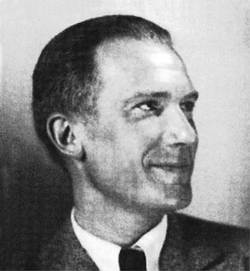
Leo Borchard (b. March 31, 1899, Moscow - d. August 23, 1945, Berlin)
On this day in 1945 the conductor Leo Borchard was killed by an American sentry in occupied Berlin while the musician was being driven home after conducting a concert of the Berlin Philharmonic. His British driver had misinterpreted the sentry's hand signal to stop.*
Three months earlier the artist had been appointed to replace the somewhat-compromised, and now-exiled Wilhelm Fürtwangler as musical director of the orchestra. At the time of Borchard's death he had conducted 22 hugely-welcome and greatly-acclaimed concerts, wining the affections of the traumatized population of the shattered city.
Born in Moscow to an ethnic German family in 1899, Borchard grew up in St. Petersburg, studying there before moving to Berlin, after the Russian Revolution, in 1920. In the German capital he was enjoying an increasingly important conducting career, which included promoting the music of young composers, when he was declared undesirable by the Nazi regime in 1935, for protecting Jewish musicians and for being "politically unreliable".
He remained in the city, hiding his identity, and gave music lessons in his apartment. He also became a member of the German resistance, and, along with his stunningly-beautiful partner, the author Ruth Andreas-Friedrich, formed the humanitarian resistance group, Onkel Emil ("Onkel Emil" was their warning signal), a secret network which committed sabotage, destroyed Nazi propaganda materials and broadcast their own leaflets - and those of the tragic "White Rose". They expertly created fake medical certificates which would enable the bearer to avoid military service. They rescued war resisters, political enemies of the regime and, above all, Jews, finding hiding places, procuring food, supplying false identity cards, and supporting families which would otherwise be without resources or protection..
I first heard about Borchard years ago while reading the memoirs of various members of the Widerstand, some of whom referred to him, always with love and admiration - for both the man and his art. At the time I could find very little information about either. Although even now very little has turned up, there are a precious few recordings, and at least one video.
I've also learned about the two memoirs** written by Andreas-Friedrich, one about her experience during the war, the other about Berlin in the years immediately following. I expect to read them both.
*
Borchard wasn't the only victim of American security forces in Europe that year: Anton Webern was killed three weeks later in Mittersill, near Salzburg, on September 15th. The composer had gone there from Vienna to be safe, but that night, just before the military curfew, when he stepped outside his house in order to smoke a cigar, he was shot by an American Army soldier, in circumstances which are not really clear to this day..
**
"Berlin Underground, 1938-1945", and "Battleground Berlin: Diaries 1945-1948"
[image from Discogs]
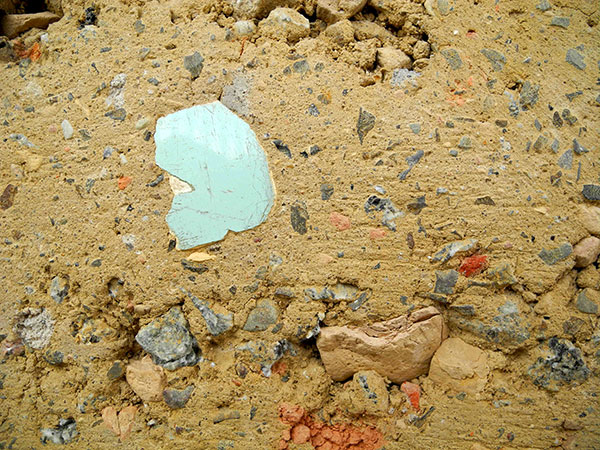
detail of Stampflehmbauweise (rammed-earth process) wall
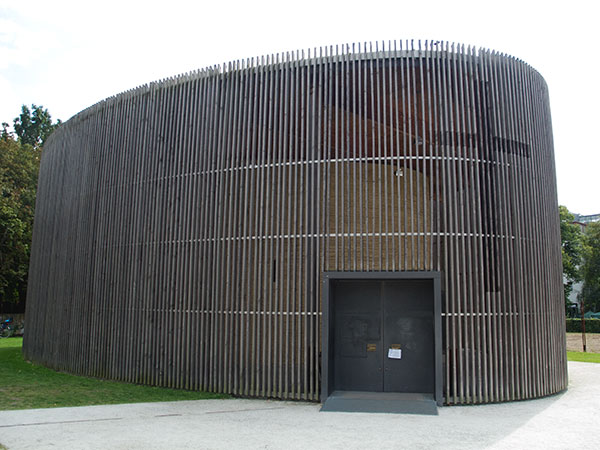
Berlin's Kapelle der Versöhnung (chapel of the reconciliation) was built on the exact site of the Versöhnungskirche, which had survived the Anglo-American bombings of Berlin but not the pathology of the GDR. The 1895 church was destroyed in 1985 in order to improve the security of the wall standing adjacent to it. The history is a little complex, making the story of the new chapel, and its construction, even richer than it might be otherwise.
Today the Kapelle is a part of the Berlin Wall Memorial on Bernauer Strasse.
The image at the top shows pieces of various materials (which here or elsewhere include stone, tile glass) which came from the rubble of the original church.
This is a view of the entire chapel, the rammed-earth wall can be detected behind the vertical square-section raw wood slats:
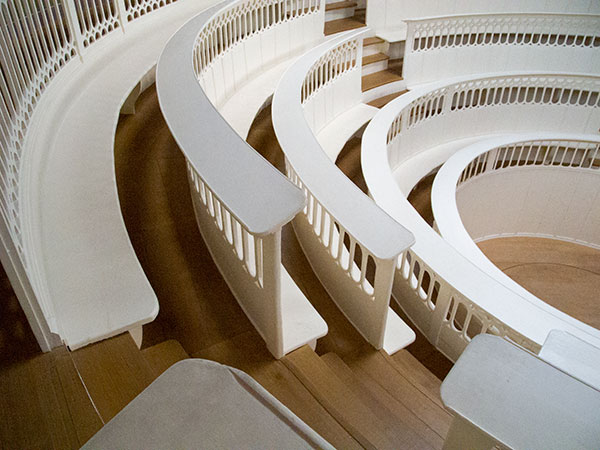
large detail of the seating in the anatomical theater
It was an immense privilege to visit the newly-restored 1789/90 Tieranatomische Theater in Berlin's Humboldt University today. The building, designed by Carl Gotthard Langhans, using Palladio's Villa Rotonda as a model, was commissioned by King Frederick William II to serve as a research centre to control and combat animal and equine diseases.
Barry and I, along with our friend Daniel, were almost alone today while we explored the outer rooms, the staircases, the vault, and especially the remarkable steeply-tiered auditorium where veterinary students learned their profession.
Horses and other large animals were dissected by their teachers on a large round platform which could neatly be raised above and lowered below the floor in the center by the wooden machinery designed by the architect. The didactic which accompanied a working model in the undercroft explained the rational for the device: The route chosen for introducing and removing the bodies to and from the elegant space was intended to minimize both the smell and the mess.
As history and architecture buffs, our own experience in the former royal veterinary faculty was less critical to world betterment, but possibly more exhilarating. And incidentally, the museum attendants could not have been more gracious.
The university will be using the building, restored between 2005 and 2012, for exhibitions and events. The artist Jodie Carey's site-specific piece, "Shroud", was installed in the auditorium in July. I wish we had seen it.
There are more pictures here.
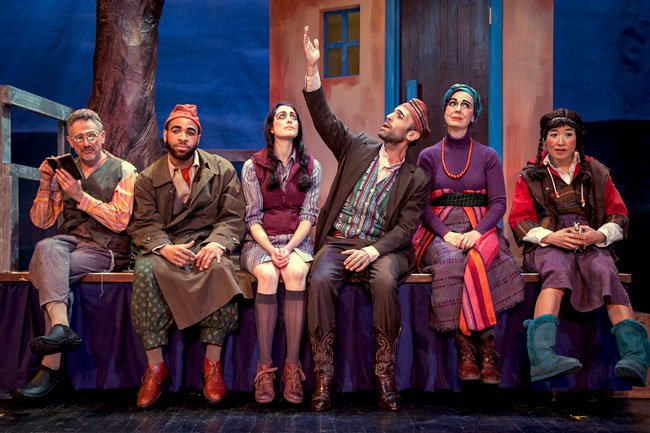
David Greenspan, Ugo Chukwu, Rachel Claire, Amir Darvish, Meg MacCary, & Susan Hyon ("Yiddish Theater for today's players and audience" - from the program notes)
Resembling Edith Sitwell's enormous rings, the colorful bosses were attached at the very top of raw wooden sticks tethered to each other at the ends of the outer seating sections inside the Abrons Art Center. The only thing clear was that the audience was not supposed to take those seats.
So what were those gorgeous, jewel-like ornaments all about?
I never found the answer. When the lights went up after Target Margin Theater's presentation of Peretz Hirschbein's "The ( * ) Inn", Barry and I were so affected by what we had just seen on the stage that neither of us thought to investigate. By the time we had engaged some of the production team in conversation moments later I had forgotten to ask for any enlightenment.
Thinking about it now, I may also have decided, unconsciously or not, to just go along with - can I say it? - the company's accustomed, and famously challenging obstruseness. Also, it's not impossible to imagine TMT's founder and the production's director, David Herskovits, merely wanting to keep the audience's experience intimate, by limiting its size.
The play (in English, although with some Yiddish elements), and the production, were both a revelation, but I also left the theater with a lot of questions, all of them, I think, far more interesting than why the paste jewelry?
Some of my questions relate to my passion for history and for Jewish culture, and some of them are more about how that history and culture relates to that of the ammei ha'aretzot.
I grew up in the Midwest, ignorant of Jewish anything.
I also grew up loving "The Goldbergs", first on radio, and then on TV, but I regret that I had little or no idea of the rich context of the drama of which Gertrude Berg was a part until decades later. I moved to New York in the mid-80's, but it was too late for the classic Yiddish theater scene on Second Avenue. Over the years, I sometimes overhear fragments of the little bit of Yiddish that survived the Holocaust, but it always makes me melancholy, and it made me still sadder that, even with a knowledge of German, I couldn't understand more.
Hirschbein's play was written over 100 years ago, but there are big surprises. Both in the original (as I understand from the program notes) and as adapted & directed by Herskovits for performance on the Lower East Side today it's a remarkable document of the almost-forgotten creativity of experimental Yiddish theater. The company's notes describe their collaboration:
The shtetl turns uncanny in Hirschbein's classic of Yiddish life. You might be expecting the farm life, the chicken-plucking and the arranged marriage, but not the S&M lust and the body-snatching wedding guests. The ( * ) Inn was an early touchstone for experimental theater in Yiddish, a sensation in Vilna, in London and in a 1917 New York production. This play is a perfect example of why we at TMT believe Yiddish drama is as innovative and challenging as any in the world. It's Tevye on drugs. Watch out.
"The ( * ) Inn" is a great treat as theater, as an eyeopener, and - almost uniquely - as pre-WWI expressionist drama which can be experienced live today. I can't say I know all of what Hirschbein and Herskovits mean. As with all good theater, I believe, they leave the audience wanting to know more.
And I still don't know what the ornaments strung along the aisle mean; I'll just imagine those jewels as "runway lights" for the gem being mounted on the boards off Grand Street this month, TMT's tribute to Yiddish theater and to "the Yiddish Maeterlinck".
[image is by Erik Carter, for Target Margin Theater]
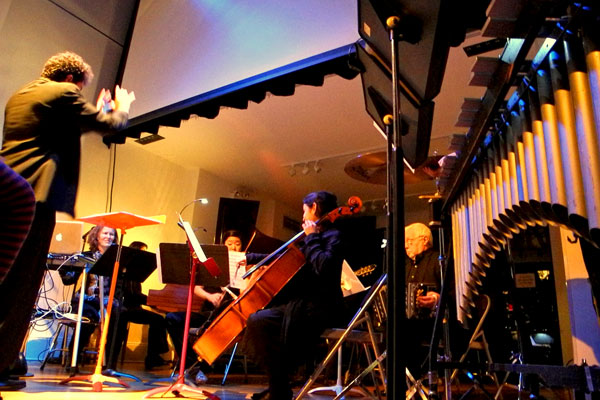
Eduardo Leandro leading members of Ensemble Pi in Kristin Nordeval's "Three Character Studies"
On Saturday Ensemble Pi [Ensemble Π] presented "What Must be Said", its 7th annual Concert for Peace at The Cell, a jewelbox non-profit theater space carved out of the bottom floors of a handsome, early-19th-century Chelsea townhouse. I was delighted to be able to record some images from the concert. By the way, I've decided that the hardest part about photographing performances may be the thing about trying hard not to annoy the rest of the audience.
The evening was one of the most extraordinary and profoundly-moving musical performance events I have ever experienced. The concert was conceived and presented with an intelligence and compassion which intensified the independent merits and beauties of the (seven?) works scheduled. The pieces included were by one writer and three composers all of whose work performed that night, as described by The Cell in its press release, "addresses some of the 'silences' enforced or suggested by governments or the media". All of the works were compelling for their historical and contemporary relevance, brilliant in their composition, and interpreted with consummate elegance by an ensemble which has adopted the most generous of missions.
The collective describes itself as "a socially conscious new music group dedicated to performing the music of living and undiscovered composers", but that description doesn't do justice to the sincerity and bravery of what the group, under its artistic director Idith Meshulam, has been doing for eleven years.
One constant in its programming, perhaps unique among both musical groups and performance venues, is its addressing of serious ideas about which there is not universal consensus even among progressives, and, just as important, the discussion of those ideas. Designed at least partly towards that end are the ensemble's regular collaborations with visual artists, writers, actors, and journalists.
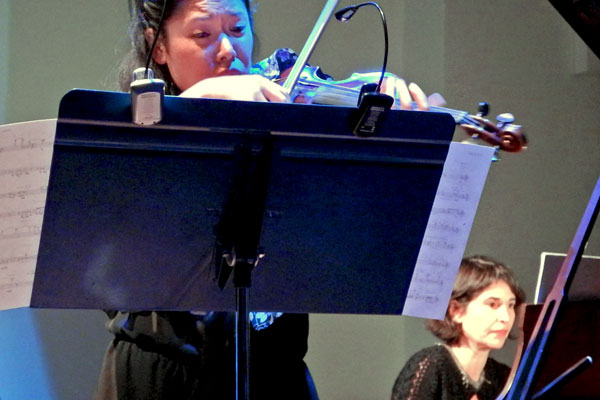
Airi Yoshioka and Idith Meshulam playing Susan Botti's "Fallen City"
On Saturday and Sunday the program began with Susan Botti's "Lament: The Fallen City", for violin and piano, which, the program describes, "reflects upon the fall of Troy as a metaphor for modern cities that have experienced natural or human-made disaster (i.e. Baghdad; New Orleans; Pisco, Peru; or Greensburg, Kansas)". I've never heard some of the kinds of sounds Airi Yoshioka (violin) and Idith Meshulam (piano) were able to produce in this affecting piece, but they were always as eloquent as they were anomalous.
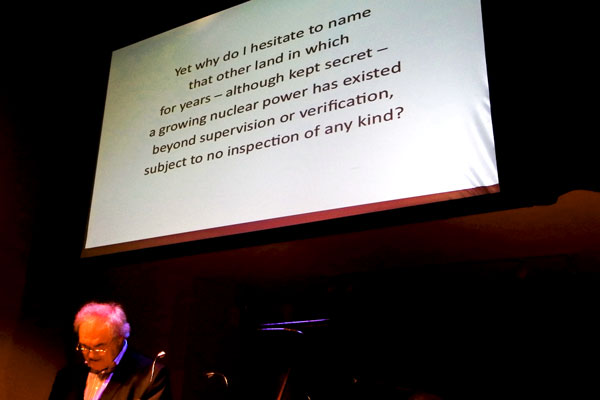
Kai Moser reading Günter Grass' "What Must be Said"
Günter Grass' controversial poem on Israel, Iran and war, "Was gesagt werden muss" [What Must Be Said], from which the evening took its title, was read in German (with an English translation projection) by Kai Moser. Grass has gotten hell for what he wrote, not least because of his earlier, late-life confession that he had been part of an SS tank division (drafted at 17) near the end of the war.
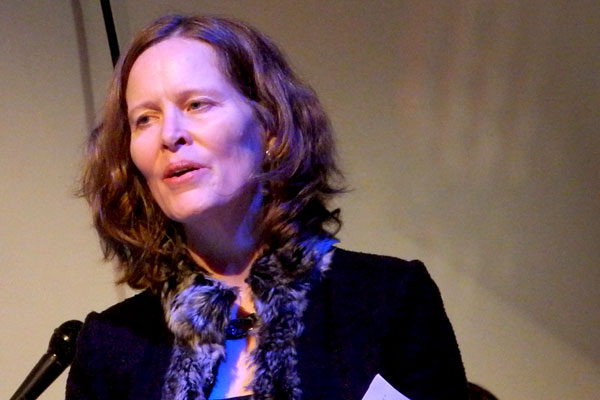
Kristin Nordeval singing "Ask Me", from her "Three Character Studies"
The concert began a transformation into intimate musical theater with the performance of "Three Character Studies", excerpts from composer/soprano Kristin Norderval's opera in progress, "The Trials of Patricia Isasa". Both Emily Donato and Daniel Pincus sang beautifully, Donato in the role of the teenage Isasa, and Daniel Pincus as the federal judge convicted for his role in the torture and kidnapping of many Argentinians, including Isasa. Norderval herself was the superb soloist in the the third section (as the adult Patricia, now a media figure), accompanying herself with some sound processing on her laptop near the end.
This beautiful and very moving piece could be staged as a mini opera on its own right now, and I very much look forward to hearing the completed opera, which will boast a powerful libretto by playwright Naomi Wallace.
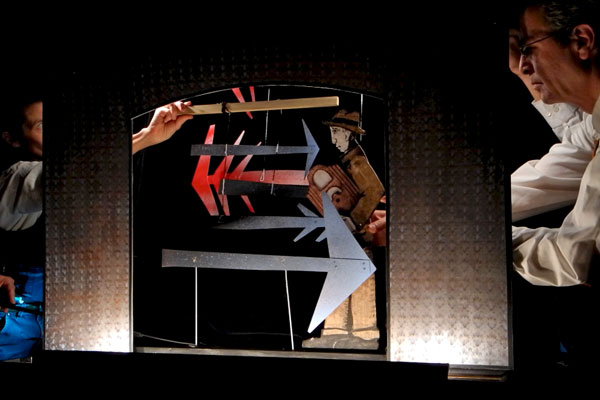
a scene from An den kleinen Radioapparat [to the little radio]
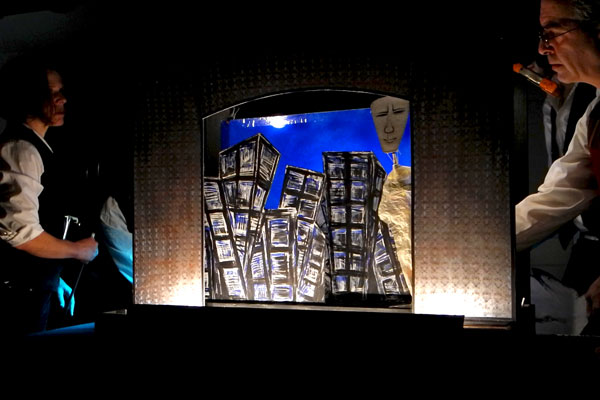
from Und es sind die finstern Zeiten in der fremden Stadt [the times are dark and fearful]
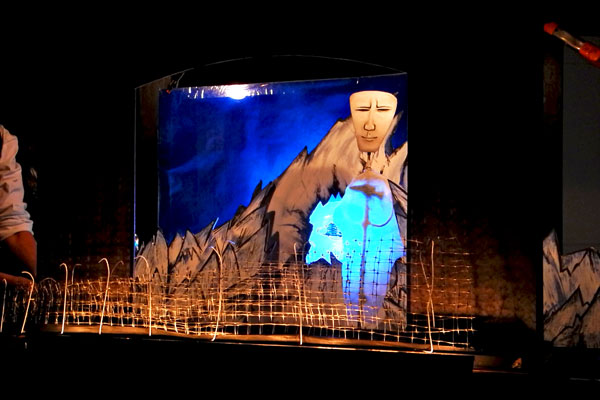
the concluding, concentration camp scene, Harte Menschheit, unbewegt, lang erfror'nem Fischvolk gleich [people hard and impassive, like fishermen long at sea]
The evening continued with the premiere of "Eisler on the Go", a beautiful, animated puppet show by the New York collaborative, Great Small Works, on the life of Hanns Eisler. The composer's studiedly-accessible music, his personality and his loyalties, his proletarian activism, and his sad fate (beginning long before he was expelled from the U.S. as a communist), has been something of an obsession for me ever since I first came across his music and his story a number of years ago; I'm very happy to find lately that his fans are now becoming legion.
The tiny-theater show animated three of the most familiar of Eisler's many songs, each sung by Nordeval. They were: "Song von Angebot und Nachfrage", "An den kleinen Radioapparat", and "Und es sind die finstern Zeiten in der fremden Stadt" [the links are to three awesome videos, with three very different performers; enjoy].
After the Puppenspiel Meshulam played the first movement of the composer's "Piano Sonata No. 3" and his "Klavierstück Op. 32 no V and VI", gently bringing the chamber back from the darkness, the anger and the funk - brilliantly.
The program was repeated the following night.