Recently in Queer Category

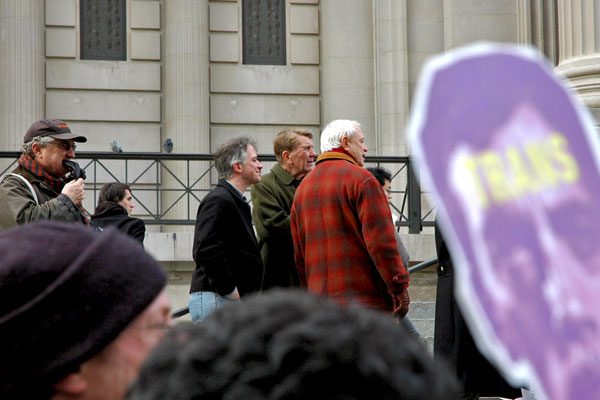
ACT_UP_NIH.jpg
we were never alone*


CORRECTION: I've corrected the text for screening location


ACT UP veteran Deb Levine is viewing the entire ACT UP Oral History Project videos from start to finish in a performance project she calls "ENDURING ACT UP". She is inviting us to join her.

Levine has been working on her PhD. in Performance Studies at NYU and is writing about ACT UP for her dissertation. She says she's focusing on one aspect in particular:

. . . how collectively people took care of each other during meetings, demonstrations, in committees and affinity groups, and especially as members became ill. I am most interested in the ways in which those relationships became an ethical and political practice - a topic that is not often foregrounded in other histories of the organization.

While she has been watching the interviews recorded by the Oral History Project, which was undertaken by Sarah Schulman and Jim Hubbard, and I assume she's been through them all, she says that what she is missing is the opportunity to turn around and discuss what appears on the screen with others who witnessed and were a part of the phenomenon of this remarkable band of AIDS activists in the 80's and 90's.

The screenings began this morning at 10 at 721 Broadway on the 6th floor, room 613. They will continue through June 15. For a complete schedule and more information, go to the project's web site.


*
the image is from the ACT UP protest at the National Institutes of Health [NIH] in May, 1990, when we “stormed the NIH” to protest the slow pace of research; things picked up a bit later (the troublemaker seen in the foreground is Brian Keith Jackson)


[Donna Binder image from NIH library - yes, the NIH!, and the site has much more about medical activism]

pinktriangle.jpg
only part of the story


Berlin's memorial to the thousands of homosexuals who were variously persecuted, tortured or murdered by the Nazi regime was dedicated yesterday. The official name of this German parliament commission, Denkmal für die im Nationalsozialismus verfolgten Homosexuellen [National Memorial for the Homosexual Victims of the Nazi Regime], may be formidable, but the structure itself is incredibly simple and ineffably moving in its sylvan setting within the Tiergarten, Berlin's central park.

Positioned close to the iconic Reichstag Building, not far from the buried ruins of Adolf Hitler's concrete bunker and across the street from the German capital's very different but equally-astonishing Holocaust Memorial, the new memorial was designed by Elmgreen & Dragset, Danish-born Michael Elmgreen and Norwegian-born Ingar Dragset. The artists, who are based in Berlin, used the block shape, gray color and slight tilt of the individual steles of Peter Eisenman's masterpiece for part of its inspiration, but a small video screen embedded in a recess on one side of this somewhat larger slab will portray a one and a half minute film loop by director Thomas Vinterberg of either two men or two women kissing. In the background of the figures in the videos, which were created before construction began, can be seen the same trees which surround the memorial as built.

Near the end of a very short article in the NYTimes today: "On hand for the unveiling was Berlin's openly gay mayor, Klaus Wowereit, but no survivors." The short article goes on to explain that Pierre Seel, who was the last known survivor of the camps, died in 2005.

As a queer man who first heard about this project in the mid-nineties when it was being proposed, and having now seen images of the powerful monument that these two wonderful artists have created, I'm unable to think of this work as a memorial only to the German and European victims of 1933-1945. Many homos who were not murdered but were imprisoned by the Nazis remained incarcerated in the new Germany long after the war. Homosexuality remained illegal in the Bonn Republic until 1969 and was only formally decriminalized in 1994.

Of course queers have been persecuted everywhere on the planet for thousands of years, but especially during the last few decades some societies have managed to grow up. They now recognize and protect the rights of all their members, while nowhere in the Western world do queer men, women and children remain more abused today, both by law and society, than they do in the U.S.

Berlin's newest monument can be a memorial to all homos hunted in the past. Let it also be a foil for those who would hunt us still.


Berlin_homo_victims_monument.jpg
the protective glass in front of the video screen reflects viewers and surroundings


Note, and more: As the ambient landscaping is still immature, I haven't included an image here of the structure or "pavilion" in its environment. This link to the memorial's own site [currently in German only, but with a pretty exhaustive list of links in many languages]; and there's an AP video below, recorded on the grounds of the memorial during grounds cleanup, with a short statement from the artists:


[image at the top from andrejkoymasky; image of memorial's screen by Johannes Eisele from Reuters via Yahoo!]

rauschenberg_bed.jpg
Robert Rauschenberg Bed 1955 mixed mediums 75" x 32" x 8"


Yes, the great man was queer. I had thought I made it pretty clear in my own post on March 14, but today I note that Tyler Green's Modern Art Notes has gone and shoved it down the prissy throats of both members of the "regular" media and the art world's own sophisticated pundits. Almost all of them seem not to have ever noticed, or, much more likely, were convinced it was too shameful a condition with which they could risk frightening the horses - or asses.

Green's post, "Hetero-normalizing Robert Rauschenberg", is totally on target, and bursting with links to his references and sources (there's even a link to his links on the subject).

Bravo, Tyler!


[image from MoMA]

Arthur_Russell_Matt_Wolf_08.jpg

Matt_Wolf_turntable_07.jpg
two stills from "Wild Combination"


I saw the New York premier of Matt Wolf's first feature-length film, "Wild Combination", at the Kitchen last night. It's an amazing documentary on the life and music of Arthur Russell, the innovative downtown musical composer/performer who just couldn't stand still and wouldn't be pinned down, even for his own visions of his art.

Unable to be really understood by most of his contemporaries, perhaps partly because of his own inadequacy with conventional communication, Russel's cross-cultural and cross-disciplinary music never had a large audience, before his early death from AIDS complications in 1992. But twenty years later his music sounds as modern as today - or tomorrow. It now appears to be moving from an honored place in the memory of his fans and collaborators (and on thousands of reels on dusty storage locker shelves) into something like cult status among a new generation of listeners and artists which, like Russell, routinely ignores the false separation of genres and thrives on the offspring of musical cross-fertilization.

Wolf, an artist and filmmaker barely in his mid-twenties now, began his career in 2002 with "Golden Gums". It was the first in a series of three relatively short experimental films, the others being "Smalltown Boys" in 2003 and "I Feel Love" in 2004. Their subjects were, in order, the young auteur's own plaster dental cast offered to boyfriend as love token, a young teenage girl who seems to be the daughter of David Wojnarowicz, and the strange story of Andrew Cunanan's hotel maid's sudden celebrity. Only after "Wild Combination" could I imagine that each of these might be its own unique and perverse twist of the traditional documentary form. I'm not sure however if I might be able to read this into the filmmaker's history only because his latest creation is clearly a documentary. But it's certainly much more; it's an imposing accomplishment and an exceptionally beautiful film in which one artist's demonstrated imagination and fancy is directed toward showing the compelling musical beauty created by another.

But it doesn't really matter, since all of these works do very well standing on their own. I only know for sure that I'll be looking forward to wherever Wolf decides to go next.

"Wild Combination" will be screened elsewhere in New York later this year.

The Kitchen has organized a tribute to the music of Arthur Russell this weekend with performances tonight and tomorrow. The blurb on Time Out New York's site includes this on the performances:

On records such as 1986’s World of Echo and the posthumous Another Thought, Russell married joyous pop to muted, inward reflection. But this “Buddhist bubblegum” (much of which has been reissued this decade by Audika) will make up just a fraction of this three-day program, which also offers a rare chance to hear his large ensemble instrumental pieces played live. On Friday, Russell colleague Bill Ruyle conducts “Tower of Meaning,” a minimalist work for brass and strings. Saturday will find Ruyle, trombonist Peter Zummo and bassist Ernie Brooks participating in “The Singing Tractors,” an ensemble trance work that incorporates improvisation.


Here's an Amazon widget which will let you sample some of his music:


More:

John Schaefer's WNYC Soundcheck program interview with Matt Wolf

Sascha Frere-Jones writing about Russell in The New Yorker in 2004

Andy Beta's piece on Wolf's film in the current The Village Voice

Audika Records Arthur Russell catalog

Amazon's Arthur Russell listings

Schedule of festival screenings


[images, the first from "Terrace of Unintelligibility" by Phil Niblock, courtesy of Audika Records, are both stills from the film and courtesy of Matt Wolf]

bobjap2_2.jpg
Jasper Johns and Robert Rauschenberg (1950's)


Hot.

I couldn't think of anything I might be able to add to the encomiums which have followed Monday's announcement of the death of Robert Rauschenberg. Then this morning I saw and read the NYTimes obituary in the print edition. While growing up, and even for many years later, I remember seeing pictures of a beautiful young man whose work was more than capable of shaking up a post-war art world already conditioned to, maybe even bored by change. the Times, like too many other media sources in the last few days, showed us only pictures of an older artist, and many photographs I've been seeing portrayed a Rauschenberg weakened and partially paralyzed by a stroke.

Although he remained handsome and productive all his life, it was in the early years of his career that he produced most of the innovations for which he is now known and revered. I thought that we should all be able to see now what the strong, vital artist who changed so much of the world we inhabit today looked like while the revolution was underway. He was once very young and almost painfully beautiful, but he was never old.

The photograph here is of the artist relaxing in a studio with Jasper Johns. It was taken probably in the late 50s, the period in which they lived together downtown in various lofts around Coenties Slip and Pearl Street (the neighborhood of my own first New York home 25 years later). It's interesting, although not surprising, that in his long obituary for Rauschenberg published in today's Times print edition Michael Kimmelman describes their personal ties in "genteel" terms more familiar to readers of fifty years ago than to us today:

The intimacy of their relationship over the next years, a consuming subject for later biographers and historians, coincided with the production by the two of them of some of the most groundbreaking works of postwar art.
For a little more candor, see Jonathan Katz.


Related:

Rauschenberg

"bobrauschenbergamerica" in tears

Paul Lee at Audiello

Lawrence Weiner at Pocket Utopia


UPDATE: Shortly after I did this post I found this wonderful early image on Newsday's site:

Rauschenberg_Newsday.jpg
Robert Rauschenberg in his New York studio in 1958


[top image from mettaartlove; added image from Newsday]

Gagliostro_Reagan.jpg
Gagliostro_youth_window_2.jpg
Gagliostro_torso_BW.jpg
Gagliostro_youth.jpg
Gagliostro_chat_room.jpg
Gagliostro_crane.jpg
Vincent Gagliostro After Louie, an excerpt video [stills, and large details of stills, from installation]


Margaret Thatcher showed a video by Vincent Gagliostro at Pulse. I'd like to describe it as an art trailer for a full-length film not yet produced, but even in its current form it's certainly a complete work of art. There's not a single ugly or unnecessary frame in this piece. I snapped only five images while standing in front of the video screen last month; five images appear here.

Gagliostro describes the work as:

. . . a political love story set against the backdrop of a time when the gay movement mattered, when lovers were not looking for their rights within mainstream structures and when activism existed in its rightful home: the streets.

The artist is a friend and an activist colleague of mine.

Although I'm also no stranger to the world which inspired Gagliostro in creating this film, I prefer to let the gallery press release set the scene with the help of the director's own input:

"After Louie" hits you like a time bomb . . . was there really ever a New York like that where adventure and discovery and sexual tension were still palpable and possible on the skinny island of Manhattan? Was there a meatpacking district before Pastis? When you watch GagliostroÂ’s video, you actually remember, for a moment, the streets and the clubs and the boys with nice abs.

In the visual and audio collage of Gagliostro's piece you recall that New York City from the not-so-distant end of the last century like it was yesterday. You remember it all not with nostalgia, but, quoting Gagliostro, "with relief that this New York actually existed and actually happened before it was too late; that despite the tragedy and loss and pain of that era there was still the nourishment of real off-line experience and the comforts of heart and sex and art and strangers and bodies and life, and soul growth before everything was already discovered, developed, trained, tracked, exploited, done, over."


There's a clip of the video here, on the artist's very beautiful site.


goya_inquisition.jpg
Goya Inquisition Scene (1816) oil on panel 18" x 28.75" [three notes: beginning in the Middle Ages the Church had prescribed the conical hat, generally yellow, as a distinguishing mark for Jews; Jewish conversos were the principal concern of the Spanish Inquisition; from 1981 until 2005 Josef Ratzinger was head of the Vatican department formerly known as the Inquisition]


I just did a search from this site, and I see that there are already two pages listing my various posts on Josef Ratzinger. I was hoping he'd be dead before I'd have to do another or, even better, irretrievably compromised by some spectacular scandal. I really didn't want to have to think about this man again, and I certainly wasn't going to display another picture of that freaky face*. Virtually everything he stands for disgusts me.

Okay, except maybe the part about "peace", but I know he doesn't actually mean it and, like the Dalai Lama, he's certainly not going to embarrass our own "infernal" warrior king while he's over here. By the way, I also don't anyone believe a word he says about freedom or democracy. I was raised a Catholic, educated by Augustinians and Jesuits and studied history as an undergraduate and graduate student for ten years. I can assure you that the Church establishment has never cared what form governments assume so long as church interests aren't compromised. [cf. Eugenio Pacelli and Reichskonkordat]

Also this week, don't expect any homilies on capital punishment from Ratzinger, who we are repeatedly reminded has a boundless respect for life. Might hurt the sensibilities of the former "Texecutionor".

But the holy fiend is coming to New York again, and although both he and his office are increasingly irrelevant, apparently even to most Catholics, I just can't maintain my blackout on the latest Ratzinger developments. I was struck by something I saw in the joint statement he and his D.C. host just issued. George Bush. Now there's another pathetic excuse for an appointed ruler (so who's using whom on this visit?). It seems they both wanted us to know how much they respect human rights and diversity. I'm used to these lies from the White House but I just couldn't ignore it coming from our sanctimonious short-term visitor, since he's never ignored me or many of my friends, or anyone else whose integrity and rights he regularly impugns. I'm talking about all queers and all women, just for starters, but you can certainly add anyone not of the strictest, doctrinally-acceptable religious persuasion (that is, his own).

There is one incident in particular in Ratzinger's past, one which I cannot forget, one which was never disavowed. It's a statment which continues to reflect this narrow, clueless disciplinarian's real approach to the diversity of mankind rather than the "respect for his vast pluralistic society", he affected yesterday in Washington. In 1992, during a period of particularly virulent antigay violence in the U.S., he authorized a Vatican proclamation which said that that when lesbians and gay men demand civil rights, "neither the Church nor society should be surprised when ... irrational and violent reactions increase".

Perfectly consistent with the Church's traditional mode of addressing its own evils: Blame the victim.

Still we bleed, queers of every gender and our straight sisters as well, not least because of his vile ministry.

Josef Ratzinger arrives in New York on Friday. I'm sincerely hoping that at least some New Yorkers will know how to receive him properly.


*
although I'm not the first to notice that, on the other hand, his devoted personal secretary is pretty damn hot, even if this is way off subject (maybe)


[image from marxist.com]


ADDENDUM: [in the form of an appendix] For the complete text of a document describing queers as a "troubling moral and social phenomenon" and denying them a status from which they might argue for their rights, see the letter, "Considerations Regarding Proposals to Give Legal Recognition to Unions Between Homosexual Persons" on this Vatican site. This is a document which Ratzinger had authored, as head of Roman curia office once known as the Holy Inquisition. It was published by his old boss Karol Wojtyła in 2003.

Hogarth_enthusiasm_delineated.jpg
William Hogarth Enthusiasm Delineated 1761


This is stupid, if not just evil. No, I'm not talking about Eliot Spitzer. Let him deal with his family; it's not our concern. People are screaming at the Governor about his marital infidelity and announcing or calling for the end of his career. Meanwhile, George Bush's murder count in Iraq, already in the hundreds of thousands, continues to mount and no one will pull the plug or talk about impeachment.

I simply don't care what kind of sex the people I vote for engage in, just as I insist that they not care about my own - or yours either. Murder and other high crimes I care about.


[image from payer.de via fortunecity]

Hatry_Heide_Adaptations_start.jpg
Heide Hatry Expectations 2007 [still from video]


sonia_khurana_Bird_on_side.jpg
Sonia Khurana Bird 2000 [still from silent, b&w video]


He_Chengyao_Broadcast_Exercise_arms_stretch.jpg
He Chengyao Broadcast Exercise 2004 [still from video]


I'd always felt very much an outsider when it came to art by women which might involve an assertive sexuality,. I confess this failing or inadequacy in spite of my natural inclination to welcome and embrace the unconventional or the anomalous - in art or almost anything else. Yes, I'm a guy, but while my neuroses may be those of a male, they are those of a queer male. Should that make it easier or more difficult to reach across the barrier? Could the circumstances of my pre-1960's dating experiences (dissembling in order to survive, but fearing any intimacy with women since it might call for performance) have allowed a healthy relationship to women's bodies even with the best will? Intimacy with a body matters, and heterosexuals and bisexuals may always get a head start in understanding gender - if not sex.

Whatever the answers, I humbly admit that the show currently installed at Elga Wimmer, of performance art influenced by Carolee Schneemann and other trailblazers, was a major breakthrough for me. "Out of the Box" was curated by Wimmer and Heide Hatry. I had wanted to visit the show because of my long experience with Wimmer's excellent program, because of my interest in anything related to Schnnemann, and because I was interested in Sonia Khurana, one of the artists. The exhibition, of both video and still images, is a small miracle, "small" only because of the physical limitations of the gallery's size. The artists are Regina José Galindo, Heide Hatry, Sonia Khurana, Carolee Schneemann, He Chengyao and Minette Vari. This small group includes women who began working in Latin America, Europe, Asia, North America, China and Africa, and it represents living artists of all ages.

They work with in very different materials and they communicate very different things, but all of the is courageous and tight; the art is breathtaking and ravishing; the statements are both incredibly intimate and extraordinarily public.


ADDENDUM:

See a subsequent post for more on the works themselves.


[images from Heide Hatry]

Patterson_Clayton_video_1.jpg

Patterson_Clayton_video_2.jpg

Patterson_Clayton_video_3.jpg

Patterson_Clayton_video_4.jpg
[four stills from the video installation of the film, "Captured"]


How do you write about a chronicler with a soul? How do you write about a bard with a camera? We can't begin to understand the importance of people like this until they are gone. Maybe it has to wait until we are gone as well, but in the meantime we can give it a try.

I'd have to see this show, "The Lower East Side", for its historical and political importance, even if the photographs didn't have their own beauty. And they do.

Clayton Patterson (okay, it's already the legendary Clayton Patterson) is currently represented by some of his sculpture, a tiny sampling of his enormous archive of photographs, and an excerpt from a documentary video in a show at Kinz, Tillou + Feigen, a gallery whose heritage, through Richard L. Feigen and Feigen Contemporary is itself pretty legendary.

The sculptures assembled from found materials are documents themselves, setting the entire installation in a specific time and space. The photographs are intense portraits, both candid and posed, of the Lower East Side community stretching from the early 80's to the present. To anyone who did not know this city before the mid-90's, or who might be unfamiliar with the neighborhood now, many will look like they must have been invented. In fact they are all perfectly true, and astonishingly intimate.

The same must be said of a film, "Captured", shown on a television monitor in the smaller space. Its subject is Patterson and the neighborhood he calls home and which he has looked after for almost three decades. It was put together by Dan Levin, Ben Solomon and Jenner Furst, largely using Patterson's own footage, and excerpts are being played in the gallery through the duration of the show. Patterson's photographs can be seen on the gallery site. Here I'm only showing stills from the film, except for this one image:


Patterson_Clayton_%28grunge%20girl%29.jpg
Clayton Patterson Untitled (grunge girl) 1992/2007 C-print


By the way, if you're very young, on the street, and want to have a distinctive style, wouldn't it make sense to find your own? That's why I was struck by the resemblance between this 1992 "Grunge Girl" captured by Patterson, and this 2002 "Billy", who was part of Bradley McCallum and Jacqueline Tarry's show at Marvelli gallery three years ago (the couple is now represented by Caren Golden).


[image at the bottom from ktfgallery]

This page is an archive of recent entries in the Queer category.

previous category: Politics

next category: War