Recently in War Category

Bruce_High_Quality_We_Like_America.jpg
Bruce High Quality Foundation We Like America and America Likes Us 2010 vehicle and educational implements, dimensions variable [detail of installation]


I feel good about the Whitney 2010. While I like excitement, I resist hype like the plague. This Biennial has been accompanied by neither, which at the very least gives visitors a better chance to experience the individual works for themselves, and unencumbered with a theme. There is some very good, even awesome work on the three floors of the exhibition I saw at the preview (the floors not devoted to favorites from earlier years), but for me none of them had so fundamental an impact as the Bruce High Quality Foundation installation, "We Like America and America Likes Us".

In "Art Class", a 2007 piece published on Artnet, Ben Davis had described Picasso's "Guernica" as "the most successful political image of the 20th century". His argument was that isolated artistic gestures cannot resolve social contradictions "without any social movement backing them up to give them force", continuing:

This does not mean that art or artists cannot play any political role; it is just that some model besides the middle-class one of "my art is my activism" is necessary, one based on concrete solidarity and practical action. Picasso’s Guernica is the most successful political image of the 20th century. Guernica, in fact, embodies the fact that art’s political value is determined in its relation with mass struggle, not in its individual content -- the imagery of the painting, moving as it is, is completely drawn from a vocabulary of forms Picasso had already developed in previous work. Yet, during the Spanish Civil War, after its appearance at the Spanish Republic’s booth at the 1937 World’s Fair, Guernica was literally removed from its stretchers, rolled up and toured internationally to win support for the Republican cause. In England, visitors brought boots to send to the front.

The Bruce High Quality Foundation seems to be taking a different route with its own institutional, social and political critique, probably one more suited to our own politically-lethargic times. Bruce's confrontations with our own tropes have been found just about everywhere: on our streets, our waters, our public plazas, even inside the galleries and expositions of the system they speak to.

I have to confess to a penchant for political art, and to a number of years spent in sort of a groupie relationship to this arts collective, and yet "We Like America and America Likes Us" is one of the most affecting works, in any genre, I've ever encountered. Where do we bring our allegorical boots?

We are all wounded, wrapped in felt. Are we inside an ambulance or a hearse? What is to be done?
Like much of what Bruce does, it's not conventionally "beautiful" - except as truth is beauty, and yet the incredibly elegiac recorded remembrance of "America" which accompanies the fast video montage of heterogeneous clips projected onto the tall Cadillac windshield is riveting, and profoundly moving.

I don't know the length of the loop (and there was no indication on the museum's wall text); but for all I know it could be as long as the melancholy story it tells.

Especially for those who will not be able to visit the Whitney, I have some excerpts. The text, recited by a luscious, soothing female voice, begins:

We like America. And America likes us. But somehow, something keeps us from getting it together. We come to America. We leave America. We sing songs and celebrate the happenstance of our first meeting – a memory reprised often enough that now we celebrate the occasions of our remembrance more often than their first cause.

And a little later I listened as the gender pronouns slithered over each other in ecstasy, and in sorrow:

We wished we could have fallen in love with America. She was beautiful, angelic even, but it never made sense. Even rolling around on the wall-to-wall of her parents’ living room with her hair in our teeth, even when our nails trenched the sweat down his back, and meeting his parents, America stayed simple somehow. He stayed an acquaintance, despite everything we shared. Just a friend. We could share anything and it would never go further than that.

No one really knows how love begins. A look on his face one time after we’d made love – a text message too soon after the last one. When did we become a thing to hold on to rather than just something to hold? We didn’t know America was in love with us until it was too late. Maybe we couldn’t have done anything about it anyway. America fell in love with the idea of us, with some fantasy of us, some fantasy of what America and us together would be, before we had a chance to tell him it could never work, we weren’t ready for a relationship, we weren’t comfortable being needed, we didn’t have the resources to be America’s dream.

It wasn’t easy letting America down. As we stuttered through our rehearsed speech we watched the change on her face. We could see the zoom lens of her attention clock away. We could feel ourselves receding back into the blur of the general population.

The last lines are:

There was a time we thought we were nothing without America. When she left, we realized all the excuses we’d been making. All the problems we’d been trying not to address. We drunk dialed our memory of America just to hear what we were thinking. We worked late and we told ourselves we had to, that the work came first, that this was an important time in our lives and that love could wait. Just wait a little longer and we’d fix everything, we’d say. Solving the America problem, our lack of attention, our disinterest in sex, our never being home, our thinking of her as a problem – it would have to wait.


Bruce_High_Quality_We_Like_America_rear.jpg
[installation view of the rear of the curtained 1972 Miller-Meteor ambulance/hearse]


[text from the audio of the installation courtesy of the artists]

William_Blake_Hecate.jpg
William Blake Hecate or the Three Fates 1795


"The fault, dear Brutus, is not in our stars, but in ourselves, that we are underlings."
[Cassius, in "Julius Caesar", Act I, Scene II]


The stars, the fates, Hecate, Parcae, Fata, the norns, the three sisters, they're us, and we should start acting like we know it.

The Transportation Safety Administration can't give us security; it's in our hands. All of the grotesque, costly, and invasive measures the TSA has already introduced, or might still introduce, are only reactive, and cannot match the efficacy of the initiatives which a look at the broader geopolitical picture would demand. We should also remember that all the current fuss is about passenger air travel, which is only a tiny portion of our national security responsibilities.

The only comprehensive security measure that makes any sense, and which incidentally would be acceptable to, if not applauded by, the entire world (including air travelers everywhere) would be an elimination of the cause, not a continual search for the effect of the intense resentment and hatred behind suicidal and other terrorist acts.

We should begin by looking at ourselves as others see us. We should end all of our current, totally optional wars, close the U.S. military bases and operations currently located within well over 130 countries, and begin to show a decent respect for the cultures of other peoples. 

Of course it would also be helpful if we could actually bring ourselves to extend real foreign aid, not military hardware, and only where it can be constructive, not where we believe we can buy love or increase our own wealth. 


[image from poor old dirt farmer]

HOW DO YOU ASK A SOLDIER
TO BE THE LAST SOLDIER TO DIE
FOR A PRESIDENT'S POLITICAL IMAGE?


I've taken some liberty with David Sirota's phrasing in the title of his blog post today, but I'm totally with his meaning, having pounded on that wall myself two days ago.

After discussing and then easily dismissing alternative explanations for Obama's decision to extend and expand our eight-year-long military effort to subdue or occupy Afghanistan, and before asking the question contained in his headline, Sirota poses and answers his own question about the President's Afghan "surge":

Is it really worth putting 100,000 Americans at risk for the next few years exclusively to protect the political image of a president? More specifically, is it worth putting those 100,000 American lives on the line so that President Obama can fulfill the media and political establishment's artificial definition of "strength"?

I certainly don't think so, and I think it's an almost unprecedented level of immorality [my emphases].


[this is the first post in a very, very long time for which I have not uploaded some image, either my own or that of someone else, which I would credit within these brackets; this time I felt that the subject itself was too obscene, its implications to graphic, to be captioned with anything so direct, and yet so particular, as a picture, and I thought no image could match the imagination of the reader]

Max_Ernst_europe_after_rain.jpg
Max Ernst Europe After the Rain II 1940-1942 oil on canvas 21.5" x 58.25"


It's what we do.

For a while, I actually had hope he might do the right thing, although I realize now I had no reason to think so. Consequently, when the news finally came it made me physically sick: There will be more war, much more war. And the reason we're being given? Because we're at war.

Does he think we're all fools? Are we?

It was entirely fake: The endless reports over the past four months which had some of us believing that Obama was agonizing about what to do with the war in Afghanistan. I don't believe he ever intended to end this nation's disastrous, and possibly fatal, misadventures in Afghanistan (and where will we go next?), and there's no reason to believe he ever considered anything other than the mindless policy of escalation General McChrystal ordered his faint-hearted commander to undertake four months ago. The fact that it took Obama so long to order tens of thousands of additional troops to join one more Western fools mission in the Middle East does not reflect intelligence, judgment or compassion, only cowardice, not least since the order was given even before the grand public announcement he will deliver at West Point tonight, that sacred heart of the military establishment (shades of Bush - but what is this President afraid of?).

I wrote here about my distrust of our newly-elected President over a year ago. Eventually my skepticism grew into disgust, and I wrote about Obama's disastrous record as President, listing dozens of the promised, anticipated or implied reforms that were to come with the new administration but which were not accomplished. I stopped counting the "un-change" months ago, and I've seen nothing that might alter my opinion of our President's incompetence, or wrongheadedness (I'm not sure which it is).

I think the latest and best assessment of our Chief Executive, now as a public officer who has failed the crucial test of a Commander-in-Chief, is contained in this awesome piece by Michael Brenner.

The first and last paragraphs are:

The sham Afghanistan strategic review is now revealed for the empty exercise it always was. Escalation was inescapable, for Obama's staunch promotion of a 'necessary war' precluded a serious reappraisal of stakes and risks. Reversing himself would have demanded the kind of courage that is wholly foreign to him. So we are left with an open-ended commitment to an unwinnable war. That outcome speaks volumes about the failings of Obama as a leader as much as his impaired judgment.

. . . .

The country is ill served by a president who fails to meet his responsibility for the rigorous, open debate on matters of great consequence that he pledged and that is imperative for avoiding more dismal failure. What is the value of a 150 I.Q. when bereft of wisdom or conviction to guide it? Obama's audacity in pursuing his ambition is one thing; political and intellectual courage is quite another.


Bob Herbert's column in today's Times explains why weak politicians can't be trusted when they talk (publicly) about war.


[painting from the Wadsworth Atheneum collection; image from different.com]

Anselm_Kiefer_Deutschlands_Geisteshelden.jpg
Anselm Kiefer Deutschlands Geisteshelden (Germany’s Spiritual Heroes) 1973 oil and charcoal on burlap, mounted on canvas 121" x 268.5"


Still a home for Dichter und Denker


Schicksalstag.

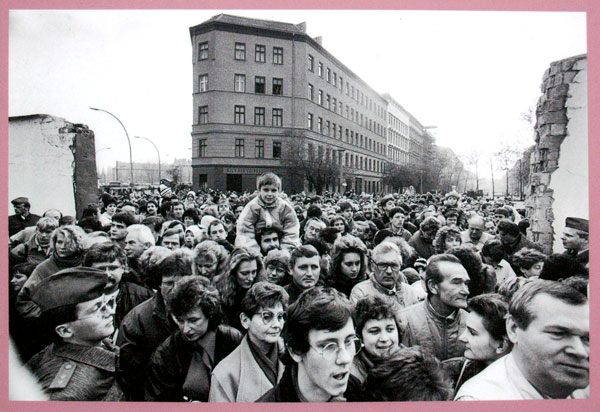
Five major events in German history* are directly connected to November 9, the most recent being the fall of the Berlin Wall, twenty years ago today. Whatever else we make of it, the anniversary of this latest in a series of fateful moments should be a timely reminder, in our contemporary obsession with the present, that everything has a story, if not a reason. Of course I'm talking about history.

"The German Problem".

Historians don't record statesmen and diplomats ever speaking of an enduring "French Problem" or a persistent "English Problem" (although I believe Americans should be more aware than we are that the rest of the world is increasingly thinking of an intensifying and abiding "American Problem"), but over hundreds of years, even two thousand years, for the Romans, the Byzantines, the Carolingians, all the Slavs, the French, Poles, the Danes, the Belgians and the Dutch, the Russians, the Balts, even the Spanish, and, irregularly, the British, there was always something on the order of what would eventually be known as "the German Problem".

The problem was recognized or imagined by non-Germans as the perceived threat of a large and vigorous people without natural borders. The danger was to be minimized by means of policies which would contain the Germans geographically, limit their economic authority, and, by the later nineteenth century, assemble and maintain counterweights to their real or potential power in a united nation-state. It worked pretty well while "Germany" consisted of hundreds of mostly-independent realms (Reiche), and especially during periods when Germans were enduring or recovering from plagues and dynastic battles. The horrible ravages of the Thirty Years War were mostly visited on central Europe (viz., the Germans), but in the midst of the impressive economic and cultural resurgence which followed those religious "crusades" a new player, Prussia, equipped with a modern bureaucracy and a highly-trained standing army, appeared on the field, almost out of nowhere, eventually to succesfully engage with, or seduce, the cultural forces of nationalism in founding the Second German Reich.

Whatever the merits of the proposition, for much of the planet the most important lesson to be learned from two twentieth-century world wars was the imperative of eliminating "the German Problem" once again, and this time for good.

Then suddenly the unexpected, the inexplicable happened, confounding everyone's expectations. The Berlin wall fell, the Soviet bloc and its system collapsed, Germany was peacefully reunited.

New York Times Berlin Bureau Chief, Nicholas Kulish, in a piece in the paper two days ago quoted Robert E. Hunter, senior adviser at the RAND Corporation and an ambassador to NATO under President Bill Clinton. Hunter was able to describe the profound significance of what happened in 1989. After recalling the fears of those observing from the outside that the sudden appearance of "this thing in the center of Europe, if it were allowed to become unified, was going to be a cancer once again and lead to Act III of the great European tragedy." Instead, he continued, "the German problem, which emerged with the unifying of Germany beginning in the 1860s, is one of the few problems in modern history that has been solved.”

Okay, now my eyes were too wet to immediately read further.

Four months after the proclamation of the united German Empire inside the Hall of Mirrors of the occupied Palace of Versailles, the German Austrian composer Johannes Brahms completed a large-scale piece for chorus and orchestra.

Tonight I'm going to be listening to a recording of Brahms' Schicksalsied to accompany thoughts of the deep sadness and unbridled joy linked with this date. Brahms wrote it after reading a poem by Hölderlin which was included in the author's 1797 novel of letters, "Hyperion". The poet had been inspired by the freedom struggle of the Greeks and in these lines he contrasted the glorious world of their ancient gods with a mankind continually threatened by Schicksal (destiny).

The text appears here, in both German and an English translation.

I've just now listened to a sample of the Brahms on line and I was reminded of how much of it relates to the music of his near contemporary, the German German composer Richard Wagner, represented at the time of its composition as Brahms' musical antithesis, that is, defined so by the passionate factions of each. Together they created the Brahms-Wagner "War of the Romantics", which disfigured musical life in the second half of the nineteenth century, but which, so far as I can tell, resulted in no fatalities.


*
the symbolic collapse of the Revolution of 1848, the collapse of the monarchy in 1918, the 1923 Beer Hall Putsch, Kristallnacht in 1938, and the fall of the Berlin Wall in 1989


[image from lacma]

Goya_Giant.jpg
"Coloso" is more than a condemnation of war; it's an allegory of French imperialism, and as such it also condemns every previous or succeeding imperial crusade, regardless of the real or professed idealism of their apologists


NOTE: Obama had been president for less than twelve full days before nominations for the Nobel closed on February 1.


War is not peace.

I looked at my mail today while I waited for my browser to load, and there I read a note from a friend in Buenos Aires who knows me very well. He was effectively warning me that I should sit down before looking at today's news. Once securely seated, I went to my news page where I saw the announcement, "President Barack Obama wins Nobel Peace Prize". I thought it was a joke. Totally.

What peace? He's adopted every one of Bush's wars, extended some, and if you look closely, he's not even talking about ending them.

It's an insult to those who have received the honor in the past, many of whom risked their lives for peace and who did not ride around in armored cars while commanding the greatest arsenal of weapons in the history of the human race - and using them.

It's like giving the mayor's son a Ph.D soon after he's started his freshman year, because he's said he's somewhat interested in reading. He's been tossing everyone's books into a dumpster since he arrived, but maybe the sheepskin will turn things around. Disgusting.


ADDENDUM: On his own site, candidate for mayor Reverend Billy Talen writes eloquently of the Obama peace prize: "So - it has come to this. War has finally captured Peace. ".

Predator drones will be released tonight destroying the word we always depended on. The flying bomb will go out over the villages, sailing over the sleeping children and prayers and friends stopping for a laugh. The bombs will float and hesitate and change direction from computers in Florida and Missouri and the soldiers at the computers will know that Obama has been awarded the Nobel Peace Prize. And so they will be consumers of a war that is now being marketed as a product named Peace.


[image of "Coloso" (painted by Goya or by one of his friends and pupils) from redstateelectric]

Le_voyage_dans_la_lune_2.jpg
still from "Le voyage dans la lune", a 1902 film by George Méliès


Barry came across the story on Twitter late yesterday, but this is an excerpt from The Huffington Post report:

NASA is launching a dramatic mission to bomb the moon.

The LCROSS (Lunar CRater Observing and Sensing Satellite) mission will send a missile traveling at twice the speed of a bullet to blast a hole in the lunar surface near the moon's South pole.

Scientists expect the impact of the Centaur rocket to be powerful enough to eject a huge plume of debris from the moon. The moon dust should even be large enough to be seen from earth through telescopes 10-to-12 inches and larger, says NASA.

I don't know, it might actually be a worthy cause, and the idea of bombing stuff is very American, but attacking heavenly bodies just seems so unfriendly, . . . so, warlike.

It's just too bad the incursion is unlikely to be exciting enough to distract our armchair warriors in Washington - and elsewhere around the country - from blowing up people and stuff here on Earth.


Okay, my second thought is how come we hadn't heard about this dramatic mission earlier? Is the NASA's public relations department that lame? Maybe they were deliberately trying to keep it low key, perhaps to avoid street demonstrations, although by now we've all learned that liberal and progressive protest never works in this country.


image from momlogic, found while Googling]

NY_Oct_7_2001_antiwar_Times_Square.jpg
Anti-war protesters demonstrate in Times Square October 7, 2001 in New York City. Thousands of marchers participated in the rally on the same day that the US and Britain commenced air strikes against the Taliban regime in Afghanistan. [Huffington Post caption]


It could have gone much differently.

I was in the streets eight years ago today, but with a characteristic mid-western idealism continually renewed without any justification, I didn't believe we were actually going to war. It was just so stupid and wrong, so eighteenth century.

Today some of us mourn the eight years (and still counting) of the wars without end begun by George W. Bush and embraced by Barack Hussein Obama.

They are all Obama's wars.

Woodrow Wilson's war, announced as the "war to end all wars", lasted 19 months. Our participation in the Second World War lasted a little over three years and eight months. Our current series of insane, counter-intuitive, self-destructive, illegitimate, racist, imperial, immoral, and finally perpetually self-propagating wars, waged under the rubric, "Operation Enduring Freedom", have been programmed from the very beginning to go on forever.


[image, otherwise uncredited, from Huffington Post]

1.jpg
Jason Hanasik Steven Two-Faced 2007 digital C-print


5.jpg
Jason Hanasik Steven's self-portrait #2 2008 digital C-print


6.jpg
Jason Hanasik Steven's photograph of a man carrying two bottles of piss 2008 digital C-print


8.jpg
Jason Hanasik Patrick (Welcome) 2005 digital C-print


9.jpg
Jason Hanasik Steven (turn) 2008 digital C-print


I think it's about the fact that guys often have trouble functioning as full human beings, but sometimes they're offered an opportunity and they grab it; and then sometimes they lose it. I'd say this is true of both hets and homos.

The artist himself describes his project as

.

. . a photography, video, and installation project which engages image making as a platform to intervene inside Western culture's traditions and expectations as they relate to masculinity, sexuality, and class.

We, the men of these images and me, might not sit at an equal distance from the center, but we all have a complicated relationship to what is considered normal -- to our benefit and our destruction.


Jason Hanasik's show at +Kris Graves in DUMBO, with the (not quite) enigmatic title, "He Opened Up Somewhere Along the Eastern Shore", is an extremely moving exercise in storytelling with photographs, mostly the artist's own and some (not quite) "found".

Nine images are hung along one wall of the gallery and two more hang on a section of another wall to the left, with a final object, a hand-written letter reproduced as an inkjet print, at the near edge of a third wall on the right. Most of the photographs are dominated by the figure of a young male; some of the subjects appear several times. They are all marines.

Partly because the size of the prints varies and because they are each mounted at a different height, they appear to dance in front of the visitor, but without a real beginning - or an end; this is not going to be a simple narrative.

The images in the photographs bounce around in time and in space, and touch many emotions as they do so, as does their "story" itself; it's a story which could be written in many ways, and we can each find our own. Hanasik's materials provide a documentation of some intense, probably under-expressed, male friendships. They remind us of the difficulty we all have in characterizing the more heartfelt qualities of these friendships, whether we are parties to them or only observers.

The men photographed by the artist are brothers. Jason Hanasik grew up in Virginia knowing both Steven and Patrick, but he became a very close friend of Patrick, the older (his BFF, in fact). Jason and Patrick played football together in High School. Jason at first hardly knew Steven, who had his own best friend. His name was Josh, and he does not appear in these images. Their relationships, especially that of Jason and Patrick, were made more complicated as they grew older and each of them gradually became aware of Jason's homosexuality (including Jason himself), but Jason and Patrick's friendship survived, survived even the nightmares of Iraq, from which Patrick described this affectionate daydream in a letter to Jason:


15.jpg
Jason Hanasik 11Mar04 2009 inkjet print 10" x 8"


Jason was the only one of the four who did not join the marines and so was the only one who did not go to Iraq, where Steven was a part of a tragedy (the death in combat of his friend Josh on what had been the first "tour" for both of them) he was unable to share with his comrades. Then, on the first leg of an impulsive road trip with Steven something happened that changed Jason's relationship to his best friend's more taciturn sibling.

The title of the gallery exhibition refers to the catharsis Steven experienced while Jason and he were driving from Virginia to visit Patrick and his wife in upstate New York, Steven opened up, and it made possible a real friendship between the two for the first time. Like that shared by Jason and Patrick its emotional intimacy didn't fit the simple antithetical forms we're told are the only ones we can expect from male relationships.

Three of the photographs in the show were taken by the straight-identifying Steven while he was in Iraq. The two that are not self-portraits, in particular, are witness of just how inscrutable male emotions, and male sexuality, still remain to the understanding of all of us, male or female, straight or queer.

The installation also includes a video taken with a pocket camera or cellphone. It appears on the gallery wall as a smallish, faint, projected image, a short loop, and it shows two beautiful, smiling young marines dancing a tango, complete with dips, on the balcony of a barracks courtyard inside Baghdad. There is no sound.


inthegreenzone.jpg

Jason_Hanasik_In_the_Green_Zone.jpg
Jason Hanasik In the Green Zone: November 2007 digital video 2008 [two stills]


The video too is by Steven.

I remember, but only as someone who was able to watch from a safe distance, the horror of Vietnam, and what it did to the men and women of my generation: And the silence; all kinds of silence. It's excruciating to see it happening all over again.

After only a few minutes inside the gallery last week, I was already almost in tears, and at the time I had even less information than I am able to share in this post. Barry and I were fortunate to be able to hear more about the work in two conversations with the artist himself. Although at first I was somewhat reluctant to ask about the context of the project, Hanasik was generous in his replies.

I found that the images stand up either with or without much of a "background". Having seen them on line before talking to Hanasik and before we visited the gallery I know they can pretty much speak for themselves. That's why I had to get to the gallery: I wanted to hear them up close.


ADDENDUM: There is now a loop of the video, "In the Green Zone: November 2007" imbedded on the artist's site here.


[images provided by the artist]

roy_lichtenstein_hopeless.jpg

Roy Lichtenstein Hopeless 1963


Obama is a disaster, and I say that because his failure may mean that the kind of reform which could have saved America may never be possible again.

His time appears to have run out (I'm not sure he would be interested in doing anything with it even if he were given an extension). He has utterly failed to do what he said he would do, what his supporters voted for him to do. His election, following the disastrous failure of his predecessor, and coinciding with that of a Democratic House and Senate, created an extraordinary momentum and an extremely rare political opportunity for advancing a progressive agenda. It was an environment, a moment, which we're unlikely ever to see again. In the six months since we've witnessed the shocking success of the scurvy machinations devised by a radical Right which had been reported displaced and in serious disarray. They've given us an indication of what to expect going forward.

Our politics are a complete fraud: Any principled engagement in politics has become an absolutely futile exercise and this will remain the case unless we are able to take the system out of the hands of the plutocrats and the corporations that own it. I see no possibility of that happening.

If such a possibility were moral, or even real, I would be tempted to adopt a status of "inner emigration"*. I can say at least that I no longer argue with any American who says they don't vote; a decision not to go through the motions which might help legitimize a fake democracy appears to be pretty reasonable in the circumstances of the present.

Although I had started to worry about the future of Obama's "change" myth as early as late last November (see this entry), I held off publishing a more definitive list of complaints until now, finally deciding to pull it out of the "drawer" where I keep my drafts, because I just couldn't stand looking at the subject line any longer.

In a post written only days after the election I expressed my reservations about whether Obama would be able to pull off the revolution that it would take to undue the damage which Bush administration had done, but I concluded that I believed he really would pull it off.

I was wrong. While I could turn out to be wrong again and would welcome it, today I feel certain that he won't be able to pull off any reform and, looking at what David Sirota has called his Team of Corporate Zombies and checking off the list of the things he has done and the things he has not done, I have some real doubts about whether he ever intended to.**

For months I've been talking to friends about my despair over Obama's administration, challenging anyone to point to anything which it has actually accomplished. At first most people seemed shocked by my criticism, but if they gave me any argument it would usually only be a comment about something Obama has said he would do. I've not been registering any shocked responses in recent weeks, and I'm hearing no arguments, so while this post's downbeat argument might have really stood out earlier, maybe its novelty has been overtaken by events.

But I still think it's worth taking stock of what we have lost, so here's a partial list:

1. The Patriot Act remains almost intact
2. "State secrets" remain state secrets, and the administration argues that the privilege is rooted in the Constitution
3. The prisoners in Guantanamo, even if it the concentration camp is decommissioned, will remain prisoners; they and anyone our government rounds up in the future can be "detained" indefinitely, without charge or trial
3. The administration refuses to release prisoner abuse photos from years ago
4. The policy of rendition will continue
5. We now have an accelerated war in Afghanistan and Pakistan, and our troops remain in Iraq
6. The administration shows no interest in addressing ENDA
7. Obama's Justice Department has argued that the state has an interest in defending marriage as meaning a contract between a man and a woman
8. The administration shows no interest in addressing "don't-ask-don't-tell" (service people are still being discharged for being gay)
9. Addressing climate change appears to be a low priority (and coal is still being extracted through mountain-top removal)
10. Universal health care is off the table, opening the way for even more complicated for-profit systems which won't even address rising costs
11. Recognition of needle exchange programs is going nowhere
12. Financial regulatory reform, where it is alive, has been put in the hands of Wall Street insiders
13. The measures used to address the economic meltdown and bank failures, the stimulus and the bailout, were designed by and for the individuals and banks who were responsible for the Great Recession in the first place, and have neglected foreclosures, loss of home equity value, and unemployment (and underemployment)
14. No back-to-work program which might be aimed at greening American technology
15. Continued neglect of the infrastructure
16. Continued neglect of meaningful public transit programs
17. The ill-conceived and obscenely wasteful "Clunkers" program and the distraction from real, constructive change which it presented
18. Failure to reinstate the ban on assault weapons
19. "Flexibility" on the call for a halt to the illegal Israeli settlements on the Left Bank
20. Maintaining Bush-era procedures allowing the government to search (without suspicion of wrongdoing) traveler's laptops, cellphones, or other electronic devices
21. Obama's vaunted "Transparency" has become a joke
22. Maintaining the FISA spying-on-citizens protocols
23. Extending a free pass to Bush, Cheney and Rice for their clear violations of the Geneva Conventions
24. Expanding both the scope and power of the "faith-based" initiatives introduced by the Bush White House [added to the list Sept. 8]

ADDENDA (post-publication):

25 And now (revealed September 15) asking Congress to in fact extend three key provisions of the Patriot Act, which would otherwise expire at the end of the year
26. Unlike the last four presidents, Obama has not replaced the prior administration's district attorneys wholesale, but has instead left in place "the majority of the Bush administration DA's who had survived Rove's purges intended to make sure they were loyal Republican apparatchiks" [quoted from Ian Welsh], an alarming realization for anyone whose politics are to the Left of Attila the Hun
27. [the words of Ian Welsh once again:] "Obama has not cleaned out the administration in general of Bush-era appointees and plants; indeed he has filled less spots than either Clinton or Bush II had by this point in their terms--and no, it's not because the Senate won't confirm them."
28. The despicable private army formerly known as Blackwater remains in Iraq today, and the Obama administration recently extended the company's contract there indefinitely; the firm, whose owner has styled himself a Christian crusader, also has contracts in Aghanistan
29. Once again employing the argument of "National security", the administration is trying to weaken the "media shield" bill, designed to protect reporters against being forced to testify, which is currently working its way through Congress

One wonders just what have they been doing since moving into the White House, besides worrying about how not to offend their political enemies. Did everyone else notice that Van Jones, the man Obama threw to the dogs late Saturday night (an interesting news-hour calculation for the announcement), was one of the only genuine progressives in the White House, a real community organizer (like POTUS, before he got religion) and not a political hack like everyone else, including, I now believe, the boss?


*
Innere Emigration describes the the choice of some intellectuals, certain artists and writers, to remain in Germany (and, after the 1938 Anschluss, in Austria) during the era of National Socialism, although they were in opposition to the Nazi regime. It assumed a complete withdrawal from public life.


**
I notice that last November I included a footnote saying that in the end his race had proved to be no barrier to Obama's achievement of the White House; today, if I weren't in despair of Obama's competence or even his commitment, I could easily add a footnote about the fact that from the beginning race has however proven to be behind his opponents' mindless campaigns against every policy he has proposed: It's almost all about that uppity negro.


[image of Lichtenstein's "Hopelesss" from theheretik]

This page is an archive of recent entries in the War category.

previous category: Queer