July 2003 Archives

Anything smaller than an SUV is just plain un-American, says the Senate.

Washington - The Senate yesterday easily rejected an amendment to require the nation's car makers to boost the gasoline efficiency of their vehicles.
And Trent Lott (who certainly knows something about trying to overcompensate for a man's feelings of inadequacy) says, about DaimlerChrysler's tiny Smart car, one of the most brilliant automotive designs of our time, "Don't make the American people drive that little runt of a car."

In fact, contrary to the commercially-cultivated prejudices of the American consumer who will never feel, or in fact be, safe even in a Bradley tank, the Smart is one of the safest cars ever designed. DaimlerChrysler's site in the UK describes the design [click onto "safety"] here.

In fact I'm just crazy about the car, and my affection has little to do with its ability to withstand impacts - other than the impact of its own delicious appeal. If it sounds like I'm marketing this beautiful little car and its entire way of life, I am. The more people in the U.S. know about its virtues the sooner I may be able to drive one here.

Well, I can dream.


infectious image from the Brazilian site, Carsale

Mitchell's Home Delivery Service drops the NYTimes and Newsday (the latter is essential because it's more human and more Lefty than its big sister) in front of our door every morning (well, almost every morning). I'm pretty fussy, so there have been times when I had to call their office for one reason or another, but I've always been very impressed with the people at the other end, especially Maury.

I sometimes talk to Maury. Maury Gordon is actually the co-president of this scrappy little company, but not only does he know my account number by heart, he seems to know each of the carriers like sons and daughters, and he has actually delivered papers himself when some emergency or human failure meant there was no alternative. In our conversations Maury sounds like a Mensch.

I learned more about Mitchell's this week when the Daily News did a story on another aspect of the company's resourcefullness, and in doing so it filled in some of the blanks about its history. Now I had to look for more, and I found Mitchell's website. I suppose I shouldn't have been surprised at the amazing diversity I found in the kind of people working at the top. Take a look for yourself at what I love about New York - Mitchell's included.


Steve Cosson has a mini-profile in today's NYTimes.

He was drawn not only to theater as a child but also to directing, getting his parents to act out bedtime stories. He and a playmate in elementary school wrote a play about Persephone's fall into the underworld. He wrote a play for his second-grade class. By third grade, he had won a playwriting competition sponsored by Children's Radio Theater in Washington, not far from his childhood home in Potomac, Md.

"It was agitprop," he said. "It was about an albino eagle whose parents die from DDT poisoning. But they wrote music for it and it was broadcast. It was the coolest thing that happened to me by the age of 8."

He plunged into the usual world of high school theater, although he acknowledges he is a mediocre actor. He perished on stage as Mercutio in "Romeo and Juliet."

"I acted my heart out," he said. "Unfortunately, there was no way that scene was not going to evoke gales of laughter among my high school classmates."

He was in three productions of "The Music Man." But by college, convinced that life in the theater was a hobby, not a passion, he was studying to be a biologist. Unfortunately, he said, he went to Dartmouth, a place where he felt on the margins of campus life.

"I did not know there were people my age that actually supported Ronald Reagan," he said. "It was the height of the culture wars. I had no idea what this New England prep school thing was about. I was confronted with a narrow elitism that drove me back into the theater. By sophomore year, I was a theater major."

Steve remains as thoroughly committed politically as he is committed to theatre - but not as an actor, even if he's as much a delight to look at as he is to listen to. If you don't have the print edition, you'll miss out on the photograph which accompanies the article.

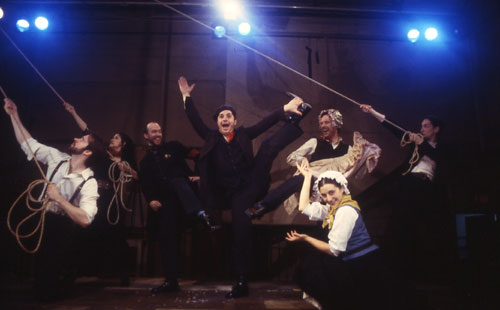
Steve's a beautiful and amazing phenomenon, but the Times piece hardly begins to describe the incredible theatre company which now gives expression to his energy and creativity. How many people would pick the shockingly-radical failed social and political phenomenon of the 1871 Paris Commune as a subject for a musical and still be able to retain the integrity and good conscience of the history?


"Paris Commune"

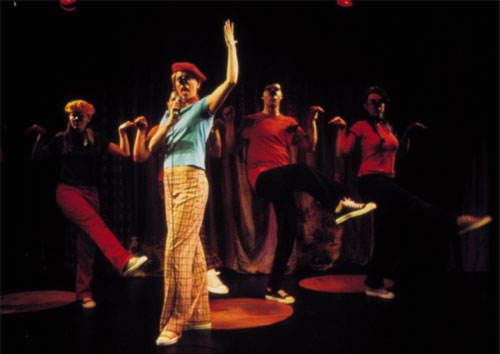
The Civilians performed the delightfully gentle and eccentric play alluded to in the closing lines of today's article, "Canard, Canard, Goose."

In the fall of 2001, The Civilians leave New York City to pursue a story about a Hollywood movie and a lost flock of carelessly imprinted geese resulting in an eclectic show about disorientation, misplaced empathy and coming home.
An audio clip is available here.


"Canard, Canard, Goose"

Barry and I are crazy about these people and this company, and we both shun traditional "musicals" like the plague. This is more than a recommendation; this is unconditional love.

"Gone Missing" opens October 9 at the Belt Theater in New York.


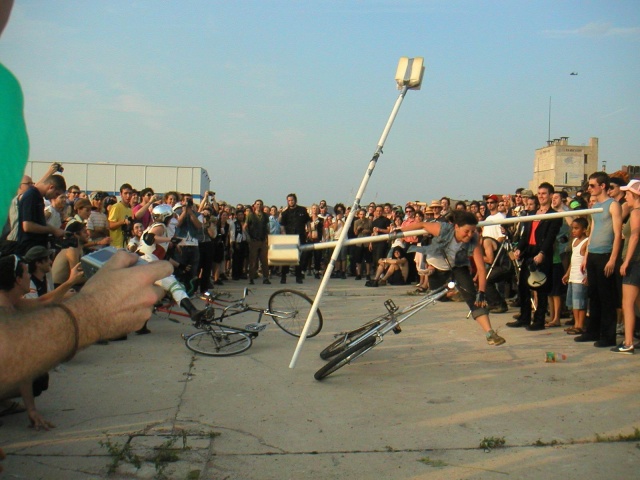
both go down here, but in the end Amy, the white knight on the left, was topped

We walked down to the Willamsburg shore yesterday afternoon and had a delirious good time as part of the 2003 Chunkathalon. By the organizers’ [C.H.U.N.K. 666] own description, the event was "a series of death-defying bicycle contests that purge the group of weaker members while amusing the survivors." No attitude, no swagger, and as some cute sage said yesterday, "bikes are for fun."

There are dozens of annotated images in this gallery.

Bloggy has much more. Don't miss the [teabagging] item at the bottom of his post.

We ran into Tom Moody on the field of honor yesterday. Tom has his own report, with still more pictures.

See this site for a report, with pix, on last year's event.

Who needs Chelsea, when you have ambisexuality, who needs cars when you have bikes, and who needs a summer getaway when you have North 7th Street?

And so to Relish, for dinner.

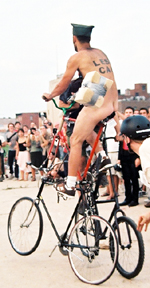
Oh, now there are more images available, on the yeabikes site, including this, of Zach:


The tattoo reads, "ONE LESS CAR" - but more Zach is good.

In today's The New York Times Magazine "The Ethicist" delivers the last word on behalf of New Yorkers who have just about had it with the assault of those infernal machines - and specificallly, the continuing outrage of on-street parking.

Two of my neighbors are in cahoots. When one pulls his car out of a spot, the other is always parked directly in front or behind and moves his car just enough to take up two spaces, so no other car can squeeze in. When the first car returns, the other moves back, restoring parking spots for both. Is it ethical for them to save spaces for each other, instead of leaving one for another parking-deprived New Yorker? Joseph A. Moskal, New York

If either of them were ethical, they wouldn't use private cars in Manhattan, a city with excellent public transportation. Why should the non-car-owning majority allow the car-owning minority to store their private property, i.e. cars, on public property at no charge? Why should my every walk to the store be akin to a stroll through a parking lot? Why should that majority be subject to the many costs and risks to health and safety attendant on the private car? I'm sorry: could you repeat the question?


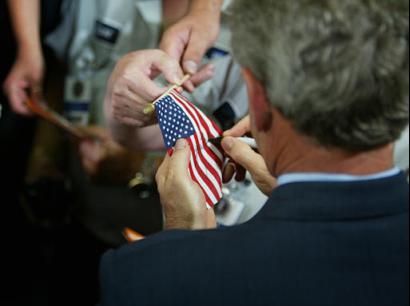
AP image via dKos


Am I bad? When I saw this image, it didn't occur to me that the story was about desecration. I thought only of the outrageous presumption; it's his, so he can write whatever he wants on it, no?


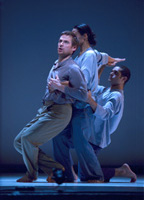
They're back! Trisha Brown's magnificent "Winterreise" is being reprised in three performances next week. You won't need cold and snow to fall in love with the entire company. This creation is highly, highly recommended.

Full details.


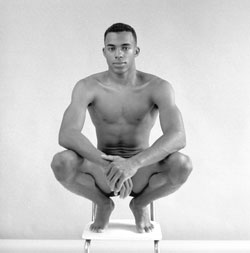
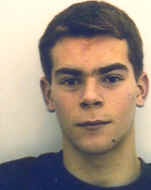
Othniel "Niel" Boaz Askew
[Photo by Victor Carnuccio]


The story about Askew most people won't hear is in the Gay City News.

Emanuel Xavier is a gay poet and author who frequented many of the same nightclubs as Askew did back in the 1990s. This past December, Davis honored Xavier and other LGBT activists at the Councilmember’s Holiday Pride event at Long Island University. According to Xavier, around 1995, he and [Clifford Nass, Askew's roommate at the time] dated for several months, well before Askew’s 1996 arrest.

During his relationship with Nass, Xavier spent a considerable amount of time in the West 43rd Street apartment.

He recalled Askew as "an incredibly sweet person," saying that "the media is portraying him as a monster and he wasn’t one despite committing such an inhumane act."

. . . .

Despite Xavier positive recollections about Askew, he also recalled signs of a troubled side to the man.

"He had issues with being comfortable within his own skin," Xavier said. "He was concerned about his image. We often joked about how he was so white. In connecting with me as a person of color, I think he was trying to be comfortable with himself and always complimented me on being an out artist who was proud of who I was."

The two men maintained a casual acquaintance, running into each other occasionally at gay events.

"I ran into him on and off for the last several years," Xavier said. "The last time I saw him was last year at the Roxy. He looked really good."

Like [Victor Carnuccio, a friend of Askew's who had photographed him in 1992], Xavier noted that Askew had bulked up, with a noticeably muscular physique.

"It was a very brief conversation. He told me about going into politics," said Xavier. "When I read about Councilmember Davis threatening to out him it was so surprising because he was already so out and on the scene."

What's it all mean? I suspect there are more tales to be heard before this story dies.

We're free now, and some of us just won't shut up.


Is the story going to be "Wacko AIDS homo slays saintly populist in hallowed hall?" Or will it be, Homophobia helped to destroy two lives - again?"

Interesting developments available from the media today:

Askew's police record, supposedly sealed, was somehow made know to Davis.
Since his record was (supposedly) sealed, Askew purchased a gun legally .
The gun Askew used to kill Davis was bought in North Carolina.
Askew and Davis were allowed to skip the metal detectors.
The little girls with tiaras, there for a presentation, got screened.
"Court records" (still officially sealed) indicate Askew was HIV-positive.
Askew had once planned a modelling career - apparently with good reason.
Askew was beautiful.
His former lawyer describes Askew as "a charmer."
Askew may have thought the charming Davis had been flirting with him.

But see these commercial sites for the complete (sometimes hysterical) news stories:
NYTimes
Newsday
Daily News
Post
NY1


Need a lift, Lefty cynics? Look at Mark Morford's upbeat column today. I've been feeling it in my bones myself for a while, thinking at first it was the humidity. Things are happening. Although Morford warns it's not yet time for delicious plates of schadenfreude, we and the administration now know "Shrub's numbers are down."

This is what happens when it's all a house of cards.

This is what happens when you build your entire presidency on an intricate network of aww-shucks glibness and bad hair and cronyism and corporate fellatio and warmongering and sham enemies and economy-gutting policies and endless blank-eyed smirks that tell the world, every single day, whelp, sure 'nuff, the U.S. is full of it.


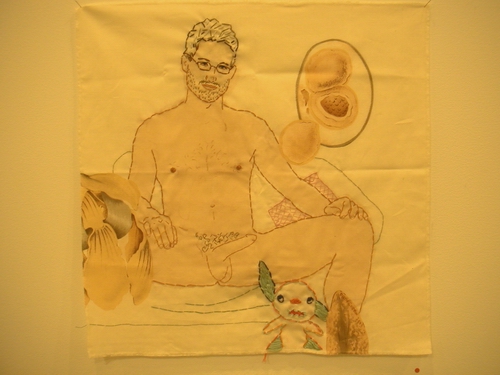
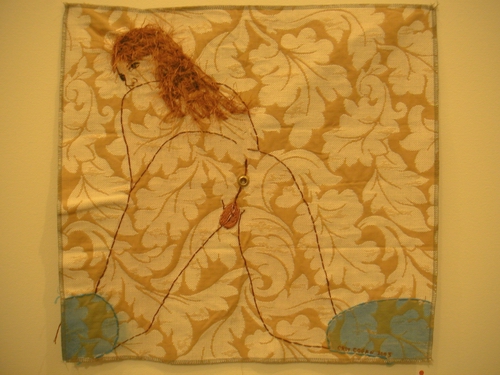
Orly Cogan "Michael" embroidery, paint on printed cotton fabric 18"x18"


Orly Cogan "Exposed" embroidery, paint on printed cotton fabric 18"x18"


Now I know why the crowd was not quite as intimidating as I had expected at the fabulous Reverend Jen's Troll Museum opening at Printed Matter last night!

It wasn't because of an interruption in L train service this time. ACRIA was holding a benefit and juried exhibition at Lehmann Maupin Gallery a few blocks away at the same time, and it wasn't just the free sparkling stuff in real glasses that had attracted the huge crowd.

They were almost giving away ($150, duh!) hot works by hot young artists picked by hot older artists - and for the benefit of a wonderful institution! Everyone wins.

We had forgotten the time-sensitive nature of the event, so we arrived after just about everything had been sold. Otherwise the two extraordinary Orly Cogan works reproduced above, which were scooped up in the first few minutes, might now be ours. Orly's third image, not reproduced here, was titled, "Puppy Love."

The art will remain on the walls of the gallery until August 2.


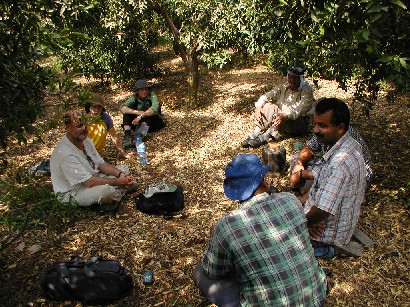
Steve and friends in an olive grove near Jayyous

Steve has been characteristically busy, but he writes home:

Qalqilya, Occupied Palestine
Thursday, July 24, 2003

On Monday night we learned that a time bomb had been
found by security near the farmers' gate, and was
detonated by the Israeli army. As a result, the area
around the gate was closed by the army and was
crawling with troops. We decided not to attempt
access to the lands west of the fence on Tuesday.
There has been speculation here that the Israeli army
planted the time bomb in order to justify widening
their off-limits zone on either side of the fence.

Tuesday morning, we participated in a demonstration
organized by all the political parties in Qalqilya in
support of Palestinian political prisoners in Israeli
prisons. We started with a short talk at the Qalqilya
branch of the Palestine Prisoners' Association, a very
important group made up of former prisoners (i.e. just
about any Palestinian man) which provides support for
prisoners and for their families. They explained to
us that their current focus is to have 3 prisons
located on army bases (Howwara, Salem, and I can't
remember the third) closed because the conditions
there are so harsh as to violate not only
international law, but Israeli law as well.

The demonstration was in the Qalqilya demonstration
style: loud, colorful, and short. ISM was there with
banners and signs (a picture of us made it into the
Palestinian daily Al-Ayyam today), and we're told that
people were really happy to see us there. There was a
group of boys in front of us-little boys, not
teenagers-who were chanting energetically without
apparent adult guidance. I was struck by how these
boys see themselves as empowered members of the
resistance to Israeli occupation and injustice.

There were family members of prisoners at the demo
carrying photos of their imprisoned loved ones-some of
the people carrying photos were little kids.

The demo went from the city circle to the office of
the International Committee of the Red Cross/Geneva,
where Lysander and I joined the officers of the
various political parties and the head of the
Prisoners' Association to present letters to the ICRC
with our concerns. The ICRC representative was an
Australian who could only talk about ICRC policy,
passing on concerns to the Jerusalem and Tel Aviv
offices, etc. The official meeting was interrupted by
some women who demanded to know why they were being
denied permits to visit their sons, and wanted to know
what ICRC was going to do about it. One has two sons
in prison, and had been denied a permit as a "security
risk". She wanted to know how she, an old woman,
could be a security risk? Another also had two sons
in prison, had been granted a permit to visit one, and
was deemed a security risk when she applied for a
permit to visit the other. She wanted to know how she
could be eligible for a permit for one visit, yet a
security risk for the other. They represented Israeli
policies about family visitation as cruel and
arbitrary, and expressed frustration at the ICRC's
apparent impotence.

In the afternoon, we met with Faris, the local
coordinator for a village called Mas'ha, and 5 from
our action group (3 from JAtO) volunteered to go there
for a couple of days. Mas'ha has hosted a peace
encampment along the fence for months now, and it has
become a place for Israelis, Palestinians and
internationals from all walks of life to come together
in dialogue and in opposition to the fence. The 5
return tomorrow, and I look forward to hearing more
about Mas'ha Camp.

I was talking with a little boy in front of our
building, and one of the adults pointed out to me that
his father was killed by the Israeli army. There are
6 children in the family.

Late in the evening, some local Muslim leaders came
over to talk with us about Islam. They are people who
dedicate their lives to the service of Allah and the
duty to be a good person, and I was thinking about how
painful it must be for them to hear Islam slandered by
political and religious leaders in the U.S., Israel,
and elsewhere. Their talk was a little too much like
a visit from the Jehovah's Witnesses for my taste, but
they were well-intentioned, and we had a good time
just shooting the breeze after they were done with
their spiel.

I was awakened at 3:00 yesterday morning by Jihad, a
young man who spends time with us internationals. He
was alarmed that Israeli army jeeps had entered the
city, and a couple of internationals walked him home.
We then bolted our door, and I didn't sleep very well
as I waited for the alarm to ring at 5:00. At 6:00
[the hours seem to be accidently transposed in these
few lines - JAW] I saw a jeep driving right near our
apartment, and quickly ducked inside.

I was up at 5:00 for attempt #3 to go out with the
farmers - successful this time!! There were no
soldiers or security at the farmers' gate, and we high
-tailed it into the fields west of the fence. We
ducked behind some trees as construction vehicles and
security sped past, and were not spotted.

We were horrified, however, to see that the Israeli
army had dug a trench between the gate and the road
from Qalqilya, and piled the dirt and boulders up
before the trench. Passage into the lands outside of
the fence, impossible by car, truck, or tractor for
months, is now impassable by donkey as well. Farmers
must bring in their crops on foot. Some of the trees
immediately west of the fence and its attendant jeep
road had been destroyed by a tank or a bulldozer.

Mohammad from the Peasants' Union took us around the
lands of Qalqilya and Jayyous all morning. We stopped
and talked with many farmers (and drank tea, natch).
The scene was idyllic - carob, loquat, orange, avocado,
fig, berry, and olive trees, grape vines, fields of
cauliflower, tomatoes, cucumbers, peppers, and
eggplant, lovely little farmers' day huts, and a huge
chicken house. But the idyll was marred by the fence,
this awful gash that cuts across Palestinian farmers'
lands. We passed many dried up fields and abandoned
greenhouses belonging to farmers who just can't get
through the security at the gate. We encountered
numerous road blocks; many dirt roads within this
agricultural area have been rendered impassable by the
Israeli army. Some of the lands are on the other side
of a settlement bypass road put in during the Oslo
process, and no Palestinian agricultural roads are
allowed to intersect with this Israeli-only West Bank
highway built on confiscated Palestinian land.

Farmer after farmer told us about the assaults on
their livelihood caused by the fence. One man has a
property that was cut in half by the fence. He used
to go from one olive grove to the next by walking a
few meters. Now he has to walk half an hour to the
farmers' gate, and half an hour back. Another has a
number of farm vehicles at home. He can get none of
them onto his land. He has to bring in his crops by
donkey cart, and then unload them by hand onto a
vehicle at the roadblock. Some farmers have taken to
sleeping in the fields during the week, because the
way home has now been made so circuitous and long. To
make matters worse, Israel has declared economic war
on Palestinian areas during this Intifada, no longer
allowing Palestinians to export, and using roadblocks
and checkpoints to impede commerce within Palestine.
Qalqilya was once the bread basket of the West Bank,
with exports to Jordan and Iraq as well. Now, all
produce goes to market in Qalqilya, at a fraction of
the price.

The attached photo shows me, Andrea from California,
and Eric from Sweden sitting with Mohammad and 3
farmers from Jayyous in an olive grove, talking about
the difficulties of harvesting caused by the fence.

We crossed back through the farmers' gate quickly and
without incident. There was a security vehicle there,
but no personnel. We went to the farm of Ziad, also
of the Peasants' Union, for lunch. He and his son
made a delicious feast for us, cooking everything with
vegetables he picked as he cooked. While we waited
for lunch to be ready, Mohammad told me about reading
Angela Davis's book about prison in the U.S. while he
was in prison in Israel, and talked about how similar
the conditions are. He also told me about the little
girl in Qalqilya who's named Angela, after Angela
Davis.

Ziad's farm is breathtaking, but his property, which
used to extend further than it now does, is abruptly
cut off by the fence. The contrast between the beauty
of well-tended fields of tomatoes and cauliflower, and
rolls of accordion wire blocking entrance to the ditch
in front of the fence, is enough to make one cry.

Back in town, we visited a house that had been visited
during the night by the Israeli army (hence the jeeps
we saw). There were eleven people in the house: 3
women, one 13-year-old boy, and the rest little girls
(one a baby). We saw hundreds and hundreds of bullet
holes in the house outside and inside, including in
one of the women's dresses in her closet. It's a
miracle that no one was shot or killed, and I can't
imagine how frightened the children must have been.
One little girl (I can't say how old she is; I usually
underestimate the age of Palestinian children because
they look so small. Perhaps it's malnutrition?) was
eager to show us the damage, and they all welcomed the
attention. The teenage boy lay in a fetal position on
a mat, having had his stomach stomped on by Israeli
border guards in an attempt to force him to say where
they can find the man they were looking for. They
never found the wanted man, so they took another man
from the family, 26 years old, beat him, and arrested
him. He may be facing 6 months of administrative
detention now; under Israeli law, no charges have to
be laid for administrative detention to occur.

For the past 2 days our action group has been meeting
with community members about our proposed action at
the Qalqilya wall on Wednesday. This morning I
participated in meetings at the Palestine People's
Party with someone from the Farmers' Union, and at the
Chamber of Commerce with the Chamber's president.
Everyone has the same story - total economic devastation
as a result of closure and the wall. The rest of the
day has been preparation for the action - it's a giant
undertaking, but we hope it will be spectacular.
Tomorrow morning I'm off to document the plight of the
villages south of Qalqilya, which have themselves been
encircled by the wall.

Then President Bush's canon will come back to us: "You're either with us or with the terrorists." Those words hang in time like icicles. For years to come, butchers and genocidists will fit their grisly mouths around them ("lip-sync," flimmakers call it) to justify their butchery.

Arundhati Roy
September, 2002

And with that he closes for the night.


For more news, from the International Solidarity Movement (ISM) site itself, see the story, "Palestinian Farmers Break Gate in the Wall."

[updated information added to the bottom of this post]


Only this time "cherchez l'homme" might be a more useful suggestion.

Neither James E. Davis (41) nor Othiel Boaz Askew (31) had ever married. Both were described as bright, attractive, smart dressers, ambitious, real talkers - and at least a little kooky.

Today the NYTimes capsule story on Askew reveals something missing so far from other accounts of yesterday's tragedy.

"The councilman [Davis] began to think of himself as something of a mentor to him," said Amyre Loomis, who was Mr. Davis's spokeswoman. Ms. Loomis said Mr. Askew had asked Mr. Davis to write a letter for him saying that Mr. Askew had a promising future in public service.

But according to a law enforcement official, Mr. Askew gave a very different version of events when he called in a complaint to the F.B.I. against Mr. Davis yesterday, claiming that Mr. Davis had threatened him.

James Margolin, a spokesman for the F.B.I.'s New York office, said yesterday: "Late this morning, a caller who identified himself as Askew alleged that he was the victim of harassment by Councilman Davis in connection with the upcoming primary election. He expressed no intention to cause harm to Councilman Davis."

According to the complaint, Mr. Askew and Mr. Davis took a walk together earlier this month through Fort Greene Park, and the councilman said he had done a background check on Mr. Askew that he claimed revealed that he was gay and that the information might be exposed in the race. Mr. Askew considered this a threat, the law enforcement official said.

Ooops! This just in.

Now NY1 tells us a little more.

Police said [Askew had] been arrested in the past, convicted of harassment in 1996 after hitting his live-in boyfriend with a hammer in a domestic dispute and leaving him bruised and bleeding. Askew was also charged in 1999 with stealing a leather bag from another male friend. Both incidents were in Manhattan.


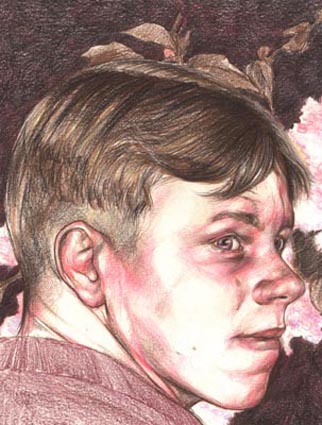
colored pencil on paper (2002) [not in the current show]

I've been neglectful.

Almost didn't mention the wonderful review which Paul P.'s show at Daniel Reich received this past week from Holland Cotter in the NYTimes.

So I'll print the entire text to make up for the delay.

Paul P.
Daniel Reich
308 West 21st Street, 2A, Chelsea
Through Aug. 2

Paul P., who is based in Toronto, makes an attractive New York solo debut with this show of 20 colored-pencil portraits of young men. Seductive, reflective or goofy, the pictures look informal enough to have been taken from life, though each face comes from gay pornography of the 1970's and early 80's.

Paul P. has done much to aestheticize his subjects. The obvious model is Whistler, with his wispy touch and a Symbolist sensibility, though most of the Whistlerian effects are relegated to background elements: patterned wallpaper, flowers or shimmery curtains in bleached pink, sooty lavender and jaundice yellow. By contrast, the faces are rendered carefully and deliberately, with each beautiful feature and gauche flaw carefully observed, like those of Caravaggio's punk-angels.

Given the identity of Paul P.'s subjects — sexually active men at the beginning of the AIDS era — the drawings can't help seeming like memorial portraits. At the same time the work is different in tone from most art produced during the AIDS crisis. These aren't heroicizing or mournful portraits: however historically aware, they're secondhand, distanced, dandified and oddly unsensual, as if their homoeroticism was taken for granted, or beside the point, or part of some larger, still-developing content or style.

What the developments will be, I'm not sure. But place Paul P.'s work with that of other young artists like Christian Holstad, Assume Vivid Astro Focus (a k a Eli Sudbrack), Scott Hug, Asianpunkboy, Phiiliip, and Hiroshi Sunairi, to name just a few, and it seems clear that some new, multifarious version of "gay art" is in formation, just in time for this post-criminal, premarital, passively resistant gay moment.
HOLLAND COTTER

Wispy Whistler and Caravaggio's punk-angels! Yea!

An elected lawmaker was shot dead today during a City Hall Council meeting in one of the most tightly guarded buildings in the most tightly guarded city in the most tightly guarded nation of the world.

We are told that New York has tough gun control laws, yet much of the rest of the country does not. There is no wall around New York.

We believe that New York is open to and loved by people from around the world, yet much of the rest of the country fears and hates those unlike themselves. Because of its importance as a symbol, New York has been and continues to risk being the primary target of a world angry with our disastrous foreign political and economic policy.

Today's deaths were not the work of a terrorist, but the circumstances which made them possible would work for anyone determined to wreak even the same or much greater havoc in another location tomorrow.

We could spend trillions (although we never will), but we still wouldn’t have security in our streets, our places of work, even our great monuments and institutions. The world can’t offer perfect security, but we would do far better, and at far less psychological, social and monetary cost, if we prevent easy access to firearms and if we begin to relate to the rest of the world with intelligence and justice.

We cannot continue to shoot each other to make us safe from guns, just as we cannot continue to bomb people to avoid the bombs of others.

And from Barry just now: "We don't believe in prevention, only punishment."


When war is created by a leader for his own purposes of revenge, greed or power, it is unspeakable, but we're Americans, and we're going to speak anyway. We can't help it.

No one could speak of the personal, American impact of this war more eloquently than Anne Hull and Tamara Jones do in a two-part series in the Washington Post this week. The still photographs and video which accompany the story on the Post's "Nation" page are ineffable.

For each antagonist, war wounds or destroys both individuals and societies. Viet Nam was horrible and stupid. Iraq is horrible and calculated. Calculated is worse.

Point of information: Worthy as any account of the cost of this war may be, I'm disturbed by the fact that most of the media seem to be concerned only with tabulating the cold numbers of [Americans] who have died in Iraq, before or even after "Mission Accomplished." The absurd impression is given that the casualty numbers are something like 150 (or 226), and everybody else is safe - and sound.

The military hospitals can't bury the injured, maimed and mentally deranged, even if we do.

And don't even mention the Iraqi dead and injured. Nobody here does, unless we've murdered someone in Bush's deck of playing cards.


This is barbarism.

Think about it.

Barry shot out, "It's no wonder this administration is opposed to the International Criminal Court!" Or any court, apparently.

For a take takes not in debt to any gosh darn mainstream media interest known to humanity, see dKos.


"Who's Unpatriotic Now?" asks Paul Krugman today. He's writing about the White House's appalling manipulation of the media, which means the manipulation of all of us of course, also the intelligence services, and, yes, the military, including every last young man or woman still at home or in danger abroad. "Support our boys," indeed!

Someone should finally ask "Why are they doing this?" any day now, but those who never bought the sales pitch and the lies in the first place already know perfectly well why. The wars were created in order to distract us all from the administration's domestic schemes, both their cynical successes and their miserable failures, and to finally secure the entire world for the same narrow purposes. These are wars for security indeed, the security of corporate America.

To illustrate dramatically the lengths to which Bush and his people will go to protect their inventions, Krugman ends his Op-Ed essay with the news, shockingly not reported anywhere else in the NYTimes today, but easily found elsewhere, that administration officials have disclosed the identity of a C.I.A. operative, Joseph Wilson's wife.

Mr. Wilson is the former ambassador who was sent to Niger by the C.I.A. to investigate reports of attempted Iraqi uranium purchases and who recently went public with his findings. Since then administration allies have sought to discredit him — it's unpleasant stuff. But here's the kicker: both the columnist Robert Novak and Time magazine say that administration officials told them that they believed that Mr. Wilson had been chosen through the influence of his wife, whom they identified as a C.I.A. operative.

Think about that: if their characterization of Mr. Wilson's wife is true (he refuses to confirm or deny it), Bush administration officials have exposed the identity of a covert operative. That happens to be a criminal act; it's also definitely unpatriotic.

So why would they do such a thing? Partly, perhaps, to punish Mr. Wilson, but also to send a message.

And that should alarm us. We've just seen how politicized, cooked intelligence can damage our national interest. Yet the Wilson affair suggests that the administration intends to continue pressuring analysts to tell it what it wants to hear.

The article in Newsday today reminds us that in uncovering her name, including her maiden name, and her security position, the administration officials responsible may have endangered the career of Wilson's wife, Valerie Palme, "and possibly the lives of her contacts in foreign countries."

. . . .

"If what the two senior administration officials said is true," Wilson said [He has quite properly refused to confirm his wife's employment.], "they will have compromised an entire career of networks, relationships and operations." What's more, it would mean that "this White House has taken an asset out of the" weapons of mass destruction fight, "not to mention putting at risk any contacts she might have had where the services are hostile."

Sure sounds like the Constitutional definiton of treason, especially as understood by the gung-ho Radical Right: "treason n the offense of attempting to overthrow the government of one's country or of assisting its enemies in war"


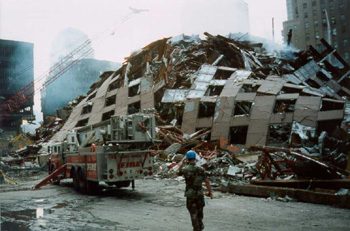
The 47-story 7 World Trade Center greatly reduced


Is Larry Silverstein a greedy man interested in power and fame? Or is he just trying to do his sad little thing again?

Monday’s front page NYTimes article tells us that Larry Silverstein now has control over what happens at the site of the World Trade Center. Later in its text we are told that Silverstein annoys a lot of important people because he has a tin ear for political discourse. But his affliction is much more serious. He has a tin soul. He certainly has a tin aesthetic.

I read a lot about what’s happening in New York, but I have an additional connection with Mr. Silverstein. I worked in an office high in 7 World Trade Center for about a dozen years. That building, which collapsed the afternoon of September 11, was Silverstein’s personal flagship before he acquired the lease to the Twin Towers 6 weeks earlier.

7 World Trade, which was across the street from the two Trade Center towers themselves, fell most likely as a consequence of the combustion of fuel stored for emergency generators designed as a backup for his friend Mayor Giuliani’s suspiciously ill-conceived high-tech 23rd-floor [sic] emergency command bunker. But no one talks about the fact that Silverstein, in his anxiety to attract Solomon Brothers as his prime tenant, had the entire 43rd floor removed after the building was completed in order that a trading floor could be constructed as part of their occupancy, with unknown consequences for the integrity of the building when put under severe stress. But what do I know?

What I do think I know is that Silverstein should be perhaps a building superintendent or possibly the owner of a chain of dry cleaning establishments. He should not be the arbiter of taste or design for what is arguably the most important site and the most important building project of our time.

Like his family’s nemesis, Donald Trump, Silverstein is not a self-made man. He started not at the bottom, but somewhere near the upper middle, and managed to advance only to the upper reaches of the upper middle, at least until just before the disaster which destroyed all of his showy real estate.

7 World Trade was a machine, an ugly monstrosity. The building had not even opened when its lobby was chosen as stand-in for the fictional inhuman Wall Street high-rise office building in Oliver Stones’ film “Wall Street.” If you know anything about the film, you know this was a very appropriate location choice.

Everything about the environment of 7 World Trade was repellant, but somewhere along the line a curator must have persuaded Silverstein to decorate his repellant lobbies with painting and sculpture from significant, even great, contemporary American artists. Then Larry destroyed this worthy impulse by installing a number of kitschy, junky, iron-man, submissive-woman and Amerindian-racist sculptures in the same areas. I can confirm it was Silverstein’s doing, and that it was work by a friend of his, someone he was said to admire. I made inquiries at the time they appeared in the lobbies, I was so amazed that they were there – that they could even exist in public in New York City at the end of the 20th century. These uglies were finally removed several years before September 11. The Held, Lichtenstein, Nevelson and others were destroyed along with the building.

Silverstein has been tolerated in or advanced to the importance he occupies in the redevelopment of the World Trade Center site only because for various reasons he appears to be in a position to get things started in time to satisfy the agenda of those who need something started right now. Bloomberg, Pataki, the national Republican Party and any number of commercial and political interests in New York and elsewhere are concerned not with the social, moral or aesthetic values of whatever takes shape west of lower Church Street, but with the political and financial opportunities early construction will offer them.

Silverstein is paying $120 million in rent to the Port Authority each year, but he receives no income from the 16-acre site. Silverstein wants to build – now. That’s all he’s concerned about. There is not one word in the Times article that suggests he has any other interest.

His motive is not patriotism or altruism, and I don’t think the man is looking for power, fame or even more fortune. He and his financial backers have an investment, and they want it to pay off. That's his job. It's business - as usual. All right, Silverstein is 72, and I’m sure he’d be in a hurry for that reason alone, even if he didn’t believe lots of huge, new, dreary office buildings would suitably crown a quite ordinary career. There is no time or room for beauty, vision, or greatness of any kind in this kind of deal.

If Larry Silverstein retains control of "ground zero," New York and the entire world is a loser.


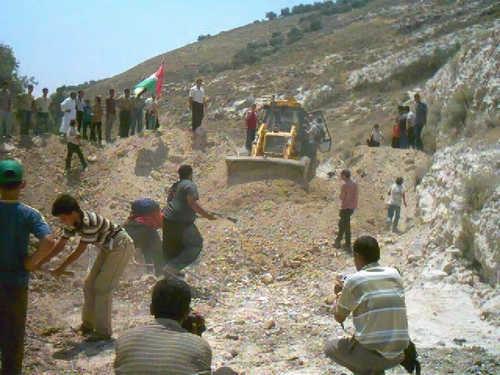
removing a roadblock*


Steve writes from Jenin.

Jenin, West Bank, Occupied Palestine Sunday, July 20, 2003

On Wednesday evening in Qalqilya, we ISM folks were
invited to meet with representatives of the
organizations that comprise the PLO in Qalqilya. They
were all middle-aged men, and all had done time in
Israeli prisons (as has Marwan, our local coordinator,
as have most Palestinian men in the occupied
territories). Each of them spoke about the misery of
occupation, the falseness of Israel's peace
negotiations, and the Palestinian determination to
resist. We threw out a few ideas about direct action
that we can participate in alongside the community,
and there will be more meetings to knock around some
ideas.

The meeting was followed immediately by a second
meeting, with representatives of the farmers' union.
We spoke about the roadblocks on the road to orchards
within the fence, difficulty in access to their land
outside the fence, irrigation lines being cut by the
workers constructing the fence, and so on. I thought
about the day last fall when Lysander and other ISM
folks were asked by the farmers to join them in
witnessing the destruction of their fruit trees to
clear a path for the fence. She described how some of
the farmers cried and had to be led away.

We decided that we will go out into the fields and the
orchards with the farmers on Sunday to work alongside
them and to witness the difficulties they encounter.
Then we'll sit with them that evening to decide what
needs to be done in Qalqilya.

In a third meeting on Wednesday night (oy), this time
just ISM, we decided who would replace the interim ISM
international coordinator in Qalqilya, since she's
leaving this weekend. Lysander and I volunteered to
share the role.

Thursday morning, we returned to court in Tel Aviv for
the deportation hearing of the 8 ISM internationals
arrested in Jenin and Nablus. They had 4 of the top
human-rights lawyers in Israel, and a packed court of
international and Israeli supporters. The court
officers kept many of the supporters in the hallway
throughout the proceeding, even though there were
empty seats in the courtroom.

Our lawyers pointed out that the 2 Israelis arrested
with the 8 internationals were released almost
immediately, that the arrests were illegal, that the
facts alleged were contradictory. They produced
affidavits in support of ISM from Member of Knesset
Yossi Sarid and from Terri Greenblatt of Bat Shalom.
They showed that while the Ministry of the Interior
was alleging that ISM interferes with the activities
of the army, endangering themselves, soldiers, and the
Israeli public, they offered no evidence to show that
the 8 defendants interfered with the army in any way.

The judge upheld the Ministry's deportation order
anyway, and agreed with the Ministry's
characterizations of ISM. He also denied a one-week
stay of deportation while an appeal is filed in the
Israeli Supreme Court.

We spent last night in Jerusalem. The pedestrian
mall in West Jerusalem was packed, because it was
Thursday night (everything's closed Friday night for
the Jewish Sabbath), and because there is a currently
a cease fire between the Israeli army and Hamas,
Islamic Jihad and the Al-Aqsa Martyrs' Brigade.
Everyone entering the outdoor mall had to be
thoroughly checked by one of a legion of security
guards. I found it pretty scary. I also thought that
the Israeli peace movement ought to do an action
there, hanging banners on the barricades that point
out that it's the Occupation that makes metal
detectors on a city street necessary.

I was with Lisa, from JAtO, who doesn't read Hebrew,
so I was translating the graffiti and political
posters on the walls for her. They were uniformly
right wing, and said things like "Kahane was right",
"Jordan is the Palestinian state", and "Oslo proves:
it's forbidden to give them a state." There was even
graffiti on the walls of the Old City. (To be fair,
there's lots of graffiti in Palestinian communities
throughout the West Bank, and I usually can't read
what it says.)

The previous week when I was in West Jerusalem, I saw
a number of young men who appeared to be Arab pulled
aside by police, apparently based on looks alone, to
have their IDs scrutinized and to be questioned about
their activities.

While in Jerusalem, I got a call from the ISM people
who had returned to Qalqilya from Tel Aviv. They were
absolutely denied entry to Qalqilya via the
checkpoint; apparently, the Israeli army wants the
50,000 people of Qalqilya, entirely surrounded by the
wall/fence, to be cut off from the outside world. Our
people ended up crawling under a locked farmers' gate
in a part of the fence away from the checkpoint, in
the dark. It remains to be seen how this will play
out, but it looks like our mobility in and out of
Qalqilya is going to be very limited.

Friday morning, 3 of us from the Qalqilya crew
traveled from Jerusalem to Jenin to help out with an
action. Getting from Jerusalem to Jenin was a 45
minute drive once upon a time, but now that a network
of settler roads has been built in the West Bank and
declared off limits to vehicles with Palestinian
license plates (while West Bank cities are off limits
to vehicles with Israeli license plates), the trip
involves a long detour through the Jordan Valley, many
humiliating checkpoints, and 3 hours' travel time.
One of the passengers in our van was a young man from
Jerusalem who is a student at the Arab-American
University in Zababde, a village near Jenin. His
Jerusalem ID means he is seen as an Israeli by the
authorities, so each week when he goes to school, he
gets stopped at the last checkpoint and told that he
mustn't go to Jenin "for his own safety". The delay
caused by the soldiers checking his ID led the driver
to leave without him, stranding him at the checkpoint.

We got to Birqin, near Jenin, just in time to
participate in a roadblock removal*. Lots of men and
boys from the village, as well as the ISM crew from
Jenin, converged on the giant dirt mound with a front
loader, pick axes, and shovels. If you look carefully
at the attached photo, you'll see two people hanging
off the sides of the front loader. Those are ISM
internationals there to protect the front loader from
confiscation, and the driver from arrest. My job was
to eavesdrop on the soldiers communicating with one
another, since I understand Hebrew, while another
international negotiated with them in English.
Fortunately, I had nothing to do, since the army never
showed up. The roadblock that the army built is gone,
and the drive from Birqin to Jenin is once again 5
minutes, instead of 40.

After the successful action, we spent time at the home
of Moayed, an organizer in Birqin. We were served tea
and coffee, of course, and listened to Moayed and his
family play the oud and sing songs of Palestinian
liberation. His teenage daughter recited a poem about
Palestine that made a Palestinian-American ISM member
cry. It was great chatting with Moayed; he spoke with
me about the need for coexistence of Jews and
Palestinians in this land, and about how the Torah and
the Qur'an are both used to justify exclusive rights
to the country.

We proceeded to the ISM apartment in Jenin. The walls
of Jenin are covered with martyr posters (anyone who
has died in the struggle is called a "martyr" in
Palestine), from Rachel Corrie to civilians shot by
Israeli soldiers in Jenin to fighters who died
defending Jenin from Israeli invasion to suicide
bombers. One sees these posters in every Palestinian
community in the West Bank and the Gaza Strip, but
they're particularly plentiful here. I am sorry that
bombers get the same status as other people who resist
the Occupation; personally, I'm convinced that the
bombings are reprehensible as well as
counterproductive. I worry about them when I'm in Tel
Aviv, Haifa, or West Jerusalem (I never ride buses),
and my friend Shanka in Tel Aviv narrowly missed
getting killed in a bus bombing a year ago. I think
it's important to remember, however, that there were
almost no bombings when the peace process was on track
in the '90s, that the bloody Israeli army assault on
unarmed Palestinian resistance in September, October
and November of 2000 preceded any of this Intifada's
bombings, and that Israeli army targeting of
Palestinian civilians has killed 3 times as many
people as the bombings have. So while I disagree (to
put it mildly) with anyone who sees the bombers as
people to be admired for sacrificing themselves for
their people, I think it's clear that the way to end
the bombings is to end the Occupation. (The Israeli
Knesset this past week reaffirmed that the West
Bank-"Judea and Samaria" in their Biblical view-is not
occupied territory, that settlement expansion must
continue, and that Israel must control all the land
west of the "security fence", even though that land is
in the West Bank and represents vital Palestinian land
and water resources.)

The ISM folks in Jenin tell me that the Israeli army
has been going into Jenin Refugee Camp at night,
destroying the building materials that the U.N. is
using to try and rebuild the community that was
bulldozed by the army in April of 2002.

I had a good discussion tonight with folks in Jenin
about their upcoming actions in and around the city,
and how we might proceed in Qalqilya. The conditions
in walled-in Qalqilya are very difficult for people
who live and work there, and for internationals trying
to support non-violent resistance there. The people
there have welcomed internationals in solidarity with
them, but I think we all feel a little stymied by
being caged up. We'll see what we can accomplish.

The trip Saturday morning from Jenin to Qalqilya was
another exercise in roadblocks, humiliating
checkpoints, and 5 shared taxis for what should have
been 1 short trip. The racism at the checkpoints was
blatant; at one point all the Palestinian men in the
car were forced to get out and stand in the sun while
their IDs were checked. I was allowed to sit in the
car with the women. No soldier asked spoke to me or
looked at my passport to ascertain who I was; I was
apparently judged not in need of checking by virtue of
my appearance alone.

We finally got to Qalqilya, and did manage to talk our
way in through the checkpoint. We had a few things
going for us: we were a small group (only 3), we had a
Palestinian-American with us who could claim to have
family in Qalqilya, and the District Commanding
Officer who has ordered internationals kept out of
Qalqilya wasn't there because it was Saturday.
Nevertheless, we got in by the skin of our teeth.

While we waited and haggled at the checkpoint, I
observed the soldiers' interactions with Palestinians
requesting permission into the city. They were spoken
to and manhandled in a way that the soldiers would
never dare with us, another manifestation of racism
run amok. The soldier with whom we were negotiating,
who was friendly to us and sympathetic, left for a
moment, transformed from Dr. Jekyll to Mr. Hyde. Hyde,
and screamed at some boys on a donkey cart. Another
soldier went through a young man's pockets without
speaking to him about it first, in order to see if he
had another form of ID. I couldn't imagine him doing
that to me.

On Sunday morning we went out to the farmers' gate in
the fence. The idea was to spend a day with farmers
working in their fields and orchards and observing the
ways in which the fence is disrupting their
livelihood. Agriculture has become a central source
of income since Palestinians' travel to their jobs in
Israel was banned, and since Israeli shoppers stopped
coming to Qalqilya.

One can no longer bring a car, truck or tractor into
the Qalqilya fields and orchards outside of the fence.
The army blocked the way to the gate with boulders
and a mound of dirt, so that one can only travel on
foot or, with difficulty, by donkey. The impact of
this demechanization on Qalqilya farmers' ability to
extract income from their fields is obvious.

We walked through the gate with Shukri, an AP
photographer who is a Qalqilya resident and some
farmers. We were stopped by the private armed
security (from a company called Ari) who work for the
companies contracted to build the fence for the
Israeli government. They were very aggressive and
caused all the farmers except one to turn back and try
again later. We ignored them and walked into the
lands beyond the fence with a farmer named Khaled.

Khaled pointed out how many of the plots were
neglected since September 2002 when this part of the
fence went up. Under the Ottoman land laws, which
Israel uses to confiscate Palestinian land, property
belongs to the state if it is uncultivated for 3 years
in a row. The state's role in preventing cultivation
is not a mitigating factor in the eyes of the Israeli
legal system. The Israeli government then turns the
land over to the Jewish National Fund, whose charter
says that the land is held in perpetuity for the
Jewish people, making it technically illegal for
non-Jews, even non-Jewish Israelis, to rent or live on
that land. (The heavily fortified Border Police post
at the Qalqilya checkpoint has a sign denoting that
it's on JNF land. Not what I had in mind when I put
my allowance in those little blue boxes as a kid.)

Israeli soldiers in a Hummer followed us up the path
among the fields, and forced us to leave. We tried to
negotiate to let us stay and work with the farmers for
the day, but they said they were calling the Border
Police to come and arrest us. Again: apartheid. They
said that the farmer could proceed to his fields (his
wife and children already had), but they were intent
on keeping us apart from them.

One of the soldiers freaked when we walked back
through the gate into Qalqilya. I guess they thought
we'd walk alongside the gate on their jeep road until
we got to a checkpoint, or until the Border Police
came along and arrested us. They REALLY don't want us
in Qalqilya. They didn't follow us in, however. I
think they need fairly high level orders to come
inside the cage. They did stop Shukri, and took his
ID and press pass (Palestinians can be arrested for
not carrying ID). Shukri went to the District
Commanding Officer later, who returned his ID, but
said he'd need the name of the soldier in order to
file a complaint aimed at getting back his press pass.

This morning we tried again to go out with the farmers
(they hadn't expected that we'd come back). We
arrived at the gate at 6:15 on the assumption that the
workers constructing the fence wouldn't be at work
yet, and therefore security wouldn't have arrived.
What we found was a tank, a jeep, and some soldiers,
waiting apparently for us. Some farmers got there at
the same time, and were allowed through by the
soldiers. We of course did not attempt to cross, and
I'm really disappointed that the army has so far been
successful at separating us from the farmers.

Israeli army jeeps came into Qalqilya today and
arrested someone-I don't know the details.
International activists and local residents in the
nearby village of Jayyous had an action today at which
they went to the fence and threw food and supplies
over to a Bedouin family trapped by the fence and
unable to reach Jayyous themselves.

We're working hard on our upcoming wall actions-July
28 in Jenin, July 29 in Tulkarm, July 30 here, and
July 31 in Mas'ha. We have to find a way to bring the
world's attention to the fence and what it's doing to
Palestinians.

That's all for now. Peace.

Steve

Sunday, back on the river.


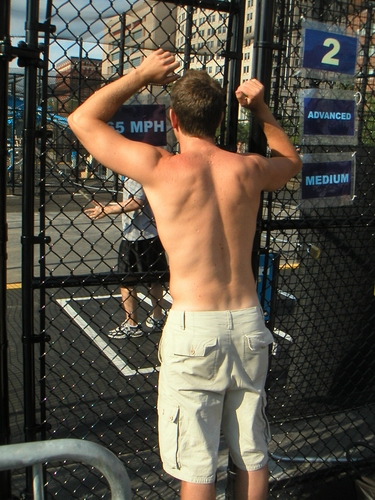
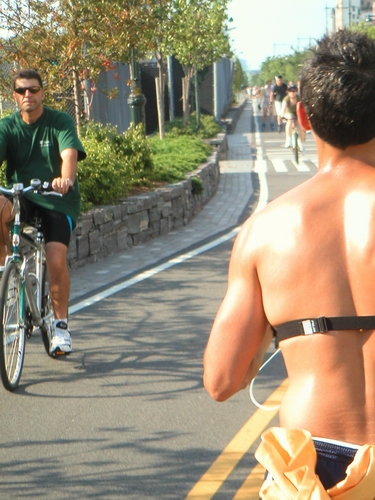
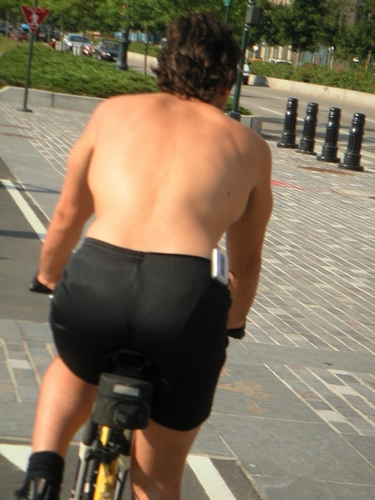
The chain link separates him from the batting machine, the strap is not a brassiere, but it sure is sexy, and bike shorts* seldom looked better.


_____________________

*
Sorry he's a bit blurry, but we were both turning, I had only one arm on the handlebars, and both eyes behind the camera. It still seemed worthwhile.

Robert F. Wagner, Jr. Park, July 20, 2003

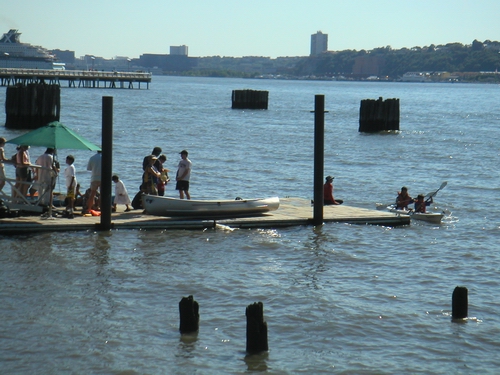
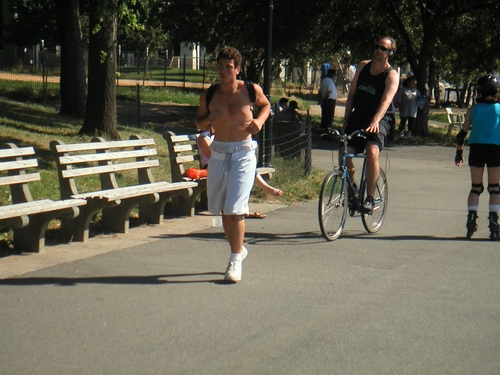
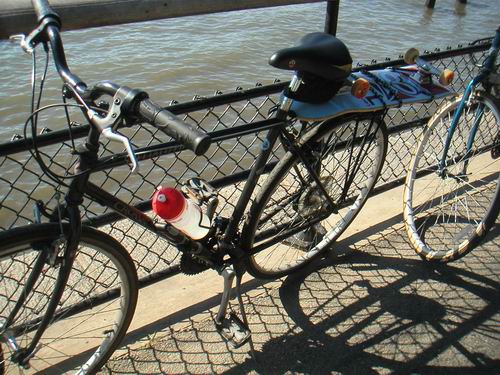
I ran up along the west side of Manhattan on my bright-green shamefully under-utilized two-wheeler this afternoon. Along the way I spotted a delightful variety of approaches to the concept of urban transportation.


rickshawing


skating


kayaking


running


resting (sort of an exception to the transportation theme)


skateboarding (or with intentions - maybe he's kayaking))


wading, and then finally


bicycling, like meself, but looking very, very pretty, and waving to everyone along the way


If you missed the birth of Abstract Expressionism, Op Art, Pop Art, Minimalism, the rise of Conceptual and Process Art, The New Realism, even Grafitti Art, all because you weren't born yet (or maybe because your parents weren't born yet!) or just because you were elsewhere engaged, don't miss this one. Stop by John Connelly Presents tomorrow evening and be a part of your time.

It doesn't have a name yet, and that's probably a very good thing, but in the NYTimes on Friday Roberta Smith tried to describe the current unfolding arts phenomenon. She did alright.

Group shows are proliferating all over town, especially in Chelsea, with more opening this week and next. But the energy of this year's explosion transcends format. New York seems to be having a Summer of Art not unlike the 1967 Summer of Love in its liberating effects. Mark my words, or those of an astute junior observer who simply termed it "our June 2003 moment." Whatever, it's still going strong this weekend with an array of artworks, curatorial ideas and aesthetic developments that reveal the quickening, centrifugal vitality of contemporary art, a result of several combustible collisions or collusions.

One way to put it is that the "Return of the Real," as the critic Hal Foster noted in the late 1980's, is being met head on by the "Return of the Formal," most visibly in the prominence of saturated color that runs through these shows like a radiant thread (as it does through this year's Venice Biennale).

From another angle, the counterculture and avant-garde tendencies of the late 60's and early 70's continue their fruitful interaction. That is, the handicrafts, scavenging, sexual openness, psychedelic palette, body decorations and druggy spirituality of the hippie era are being given backbone by the reductivist tendencies, material eccentricities and political consciousness of Conceptual Art and Process Art.

Design and architecture are part of the mix, as are continuing variations on Grafitti Art. There is a fuller embrace of the Pleasure Principle, which is perhaps the most important legacy of popular culture. Artists want to have fun, but not just fun. Call it responsible hedonism. Op Art's revenge.

Implicit is a free-flowing equality of media, mixed or unmixed. Video has assumed the very position into which it forced painting in the late 1980's: it is now one among many means of expression. Artists are developing so many distinctive and individual ways of working with it that often you barely see it anymore. Finally, in all mediums, collage, sampling, appropriation, bricolage, recycling — call it what you will — continues to mutate and expand as an artistic strategy, an ecological statement and a metaphor for inclusiveness.

John Connelly opens a very special group show tonight at 6 o'clock, called "Today's Man." You won't be able to get into the gallery space itself if you're shy about human contact, but the huge hot and happy crowd will hold down the hall as well, so you won't be lonely.

From John's press release:

"Today's Man" is an exhibition of mostly small works on paper and canvas (paintings, collages, drawings etc. but no photography) and consists solely of representations of men by male artists. The relatively small scale of the works (almost all are less than 18 x 18 inches) is a purposeful inversion of what one might normally associate with the stereotype of the patriarchal grand canvas.
So maybe it's ok if it's just about guys this time.


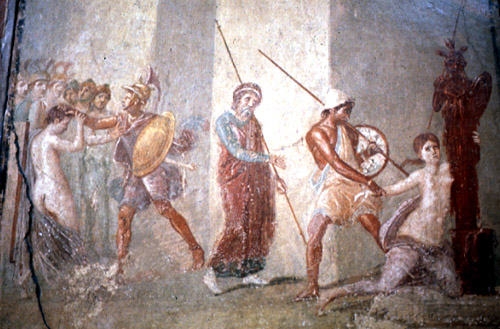
Ajax drags Cassandra from the Palladium before the eyes of Priam (Roman wall painting, Pompeii, House of Menander)

He's back. I posted something from Sheldon S. Wolin just two months ago, but since he just may be our Cassandra I thought another hearing was in order.

If the administration hasn't changed in the interim, perhaps the country has. In May Wolin's words were found in the lefty [by U.S. standards] Nation. This month they appear in a mass-circulation daily, Newsday. Excerpts:

No administration before George W. Bush's ever claimed such sweeping powers for an enterprise as vaguely defined as the "war against terrorism" and the "axis of evil." Nor has one begun to consume such an enormous amount of the nation's resources for a mission whose end would be difficult to recognize even if achieved.

Like previous forms of totalitarianism, the Bush administration boasts a reckless unilateralism that believes the United States can demand unquestioning support, on terms it dictates; ignores treaties and violates international law at will; invades other countries without provocation; and incarcerates persons indefinitely without charging them with a crime or allowing access to counsel.

. . . .

In institutionalizing the "war on terrorism" the Bush administration acquired a rationale for expanding its powers and furthering its domestic agenda. While the nation's resources are directed toward endless war, the White House promoted tax cuts in the midst of recession, leaving scant resources available for domestic programs. The effect is to render the citizenry more dependent on government, and to empty the cash-box in case a reformist administration comes to power.

Americans are now facing a grim situation with no easy solution. Perhaps the just-passed anniversary of the Declaration of Independence might remind us that "whenever any form of Government becomes destructive ..." it must be challenged.


[image from VRoma]


Jasper Johns, "White Flag" (1955) Metropolitan Museum of Art

Some day, when we stop shaking in our boots in fear, we'll realize just what evil we have done in the name of September 11. While history doesn't give us much reason to seriously believe that anyone in a position of power will pay for his or her crimes [remember Vietnam], some of us already already know that their victims here and abroad already have, and that they will continue to be paying forever.

But we ourselves should not be able to simply point fingers, now or on some hoped-for day of redemption. A letter to the NYTimes today is a sober reminder that not all of the guilty sit in Washington.

To the Editor:

Re "16 Words, and Counting," by Nicholas D. Kristof, and "Pattern of Corruption," by Paul Krugman (columns, July 15):

Mr. Kristof and Mr. Krugman make strong arguments about the deception tainting the White House, and rightly so.

But there's another party that should not be let off the hook: the American public.

When most of the deception by the Bush administration and the intelligence communities was lauded as truth and reinforced by the media, despite the numerous reports and intelligence stating otherwise, most Americans took the lies at face value, without questioning their validity.

Worse, many Americans chided and dismissed those who called for truth and reason.

True, as Mr. Krugman writes, Iraq "didn't have significant weapons of mass destruction and wasn't supporting Al Qaeda," but that didn't stop many Americans from thinking otherwise.

Those who substituted liberty for a blind patriotism are as much at fault as those who perpetrated deception.


HAYAN CHARARA
Jersey City, July 16, 2003

I read this to Barry this morning. His immediate retort: "We're 'good Germans.'"

Three months ago Harley Sorensen explained what what a "good German" was.

One of life's mysteries, for me, is how masses of people can do the incredibly cruel things they do. Individual brutality makes a certain amount of sense in that it's limited to one person. But mass brutality?
I think this subject first came to mind after I read Adolf Hitler's Mein Kampf and William L. Shirer's The Rise and Fall of the Third Reich, A History of Nazi Germany.

There was nothing in either book that told me how such a highly civilized and culturally advanced nation as Germany could sink to the level of the Nazis.


"How could that happen?" I wondered.

"What is there about the Germans that allowed them to become the monsters they became? How are they different than the rest of us?"

So I spent a month pondering the question.

The answer I came up with satisfied me then, and it satisfies me still: There is nothing different about the World War II Germans. What happened to them could happen to anyone. It could happen to us. We are no better than them.

. . .

The formula to become a brutish leader, as Jean-Marie Le Pen proved recently in France, is a two-step process. First, you convince the masses they are in grave danger (Le Pen used immigrants as his boogie man), then you promise to save them.

That's exactly what Hitler did, and it's exactly what Bush and Sharon are doing.

. . . .

It's the fear factor, I believe. They go against their basic decent instincts and support a brutal regime for fear of being criticized or ostracized as traitors. Peer pressure.

You see the same thing with Americans' blind support of Bush's war policies.

"If you're not for us, you're against us," Bush said, immediately making sheep out of otherwise hard-nosed, independent-thinking Americans.

Driven by fear, masses of people can do horrible things. Now is a good time to recall the admonition of Franklin Delano Roosevelt, who said:

"The only thing we have to fear is fear itself."

Roosevelt's warning was about the Great Depression, but the words are appropriate now. Fear can turn us all into "good Germans." We must resist it. We must not let it turn us into sheep.


Things are just not going well for the White House. Nothing is being handled well. This has been the case for almost three years now, but finally people are beginning to notice.

Barry suggests that any day now we can expect the terror alert will be raised to orange [where it's been in New York City ever since September 11].

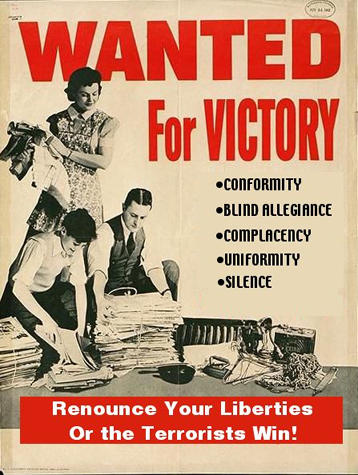
[photo image Courtesy of E.J. Fischer and the Propaganda Remix Project]

Steve reports on his last 6 days in Palestine and Israel.

The subjects, in order, include Ramallah, Black Laundry, checkpoints, "refuseniks," his new all-gender affinity group "faygelach," a Tel Aviv court, the farming village of Jayyous, the Apartheid Wall, aquifers, Qalqilya, the wonderful and sad Amal Society for the Deaf, "extrajudicial executions," and his friends's chagrin about being generously feted rather than actively useful in the communities so far.

Qalqilya, occupied Palestine
Wednesday, July 16, 2003

We went to Ramallah on Friday and Saturday for ISM
training. To get into Ramallah from Jerusalem, we had
to pas through the Qalandia checkpoint. The
checkpoint is a huge affair, with giant concrete
blocks arranged into mazes for incoming and outgoing
people, lots of Israeli soldiers scrutinizing people
passing through, and an Israeli sniper tower overhead.
Where once people could just drive between Jerusalem
and Ramallah, two of the most important cities and 20
minutes apart, there are now giant clogged parking
fields at either end for the taxis taking people to
and from the checkpoint. We got through without any
problem because they were only checking people leaving
Ramallah on Friday, but the whole experience was
incredibly stressful. I can't imagine what it's like
for people who live in Ramallah.

There were about 25 of us trainees, from the U.S.,
Scotland, England, France, and Canada. Quite a few of
us were Jewish, including one Israeli-American and one
Orthodox woman.

Our trainers were a member of Jews Against the
Occupation/New York and a member of the Michigan Peace
Team. They facilitated role play and discussion about
commitment to non-violence, how to de-escalate in the
face of settler and soldier violence, how to protect
Palestinians and ourselves non-violently, what to do
if arrested, and so on.

George Rishmawi, a co-founder of ISM from the
Palestinian Center for Rapprochement Between Peoples
in Beit Sahour, Palestine, talked with us about the
history of non-violent resistance in Palestine and
about Palestinian cultural norms in the communities in
which we will live and work.

A member of Black Laundry, Israel's gay, lesbian,
bisexual and transgendered activists against the
Occupation, talked about his military service in the
Occupied Territories and Lebanon, and why he now
prefers to serve time in a military prison rather than
serve the reserve duty required of every Israeli
Jewish man until age 55. While in prison, he met one
active duty soldier who was in prison for 6 months for
smoking a joint, and another who was in for one month
for killing an elderly Palestinian civilian. The
death had been deemed an accident, but the prisoner
said that his commanding officer knew that he had
killed the old man on purpose. He also met fellow
"refuseniks" who had served their active duty during
the Intifada of the late 80s and early 90s. He said
that they were gentle, intelligent, educated men who
had never talked about the things they had done in the
army, not even to their wives, until their time in
prison with him. He was amazed at the terrible things
they had done, and the trauma they were still living
with.

Neta Golan, an Canadian-Israeli co-founder of ISM who
now lives in Nablus with her Palestinian husband and
their baby came to speak with us, baby in tow, about
arrests, deportations, and legal issues. She also
spoke about the weaponry that the Israeli army uses
against peaceful protest, and how to respond safely to
tear gas, sound grenades, rubber bullets, moving
vehicles, shooting over out heads, and live fire aimed
at demonstrators. (The way to respond safely to live
fire is to remove oneself from the situation
immediately.)

Two Palestine activists from New York helped us work
on how to use the media to get the message out.

Ramallah is a bustling, prosperous town, now that it
is not under Israeli military curfew, although one
must still pass through Israeli checkpoints (more like
choke points) to get there. We had a nice time there
on Friday evening, eating shawarma and ice cream, and
visiting an Internet café.

By the time we left, our affinity group had
crystallized. An affinity group is a small group of
activists who know one another well and trust one
another, who work as a unit in planning and
implementing direct action. There are 6 of us in my
affinity group, all from New York, all of whom have
organized together before, and we named our mostly
queer, mostly Jewish group Faygelach for a Free
Palestine (faygelach is Yiddish for faggot, although
we intend it to mean queers of all genders). For the
JAtO and DAP folks on this list: the group is me,
Eric. Lisa B., Amy Laura, Ady and Lysander. Dena will
be joining us in a few days, Ryan a week after that,
and Gabriel from DAP in early August. We are hoping
that Ora and Ramzi will be joining us as well.

Leaving Ramallah was a little tricky, because the
Israeli soldiers suspected that our Israeli-American
member was Israeli. She pretended not to understand
Hebrew, and was eventually waved through despite her
lack of a visa. Our taxi was then stopped at a
traffic checkpoint, where the soldiers said they were
going to hold us for a while so they could check out
the two of us with U.K. passports. Must have had
something to do with the guy they were looking for in
the West Bank, who's a peace activist, but who the
authorities are claiming is an IRA bomb maker.
(Thankfully, he has no connection to ISM; I'm sure
they'd love to use him to smear us.)

On Sunday, a large number of ISM activists, consular
officials, and Israeli peace activists went to court
in Tel Aviv for the trial of 8 ISM activists awaiting
deportation. (The American, French, Swedish, Danish,
and British consulates were all contacted because the
arrestees come from all those countries. Only the
Swedes and Danes bothered to show up to support their
citizens.) The judge was clearly impressed to see a
full courtroom; deportation proceedings usually
involve workers from Nigeria, Thailand, and other
Third World countries who have replace Palestinian
menial labor in Israel since the Intifadas. They
usually sit in prison while their deportations are
adjudicated in writing.

The case has been put off for a few days or longer,
and the 8 young men continue to be held in the police
station at Ariel, one of Israel's illegal West Bank
settlements. We did win a preliminary injunction
preventing the deportations while the case is being
decided; one of the Ministry of the Interior's
favorite tricks is to put people on a plane in the
dead of night while their deportation cases were being
argued. Hopefully this injunction will prevent them
from doing so. We of the Feygelach have volunteered
to contact folks to write affidavits attesting to
ISM's non-violent mission, and have had a good
response from Israeli and international individuals
and organizations, including members of the Knesset.

On Monday, we traveled from Tel Aviv to Jayyous, a
West Bank farming village close to the pre-1967
border. We had to travel to an Israeli road block
where trucks have to back up to each other on either
side of the road block and their cargo has to be hand
carried from one to the other. We got into Jayyous,
where we met almost all the men, women and children of
the town, as well as about 40 internationals, for a
march initiated by the farmers.

Jayyous lost 90% of its land when the war of 1947-1949
ended, and the village found itself on the Jordanian
side of the armistice line with its land on the
Israeli side. (That land had been slated to be part
of the Arab state of Palestine in the U.N. 1947
Partition Plan, but was captured by the new state of
Israel in the war.) When Israel occupied the West
Bank in 1967, more land was confiscated to build
illegal Israeli settlements nearby. Now, with the
construction of Israel's "Separation Fence" (which we
are calling the Apartheid Wall), they are being cut
off from 70% of what's left. Farmers have one gate in
the fence through which they may pass to get to their
fields, but when internationals aren't present to
monitor, they are often detained and/or beaten by the
private armed security guards hired by the contractors
who are building the fence for the Israeli government.

First, we attended a lecture in the municipality by a
Qalqilya hydrologist about how the Oslo Agreement maps
and the location of the Apartheid Wall have nothing to
do with security, and everything to do with stealing
access to West Bank aquifers. (Millions of
Palestinians in the West Bank have limited access to
fresh water for living and for agriculture, while
hundreds of thousands of Jewish settlers in the same
territory have watered lawns and swimming pools.)
Then the people of Jayyous, with international
accompaniment, marched through the olive groves to the
fence. The women and young men of the village chanted
for a while as we watched the construction equipment
completing the fence that cuts through Jayyous's
lands. Some nearby soldiers watched, and some of the
security guards joined them, but the men of the
village made sure that the youngsters kept their
distance. On the way back, some of the boys had
slingshots to throw stones at the security guards who
stood menacingly in the distance as we passed, but
they were not permitted by their elders to engage even
in this symbolic act of violence. The march ended
without the soldiers gassing, beating, arresting or
shooting at anyone, a testament to the discipline of
the Jayyous organizers as well as the effect of
international accompaniment.

Back at the municipality, the mayor thanked us for our
support, and explained that the Israeli decision to
cut them off from their land and therefore their
income is an attempt to force them to abandon their
homes. I agree. The fence is part of a policy of
ethnic cleansing, in which parts of the West Bank are
slowly being emptied of their indigenous Palestinian
population and replace with Jewish settlers, many of
them from the United States.

We proceeded from Jayyous to nearby Qalqilya, through
the Azun roadblock and the Qalqilya checkpoint.
Again, we made it through the checkpoint with our
Israeli-American member coming under special scrutiny
and pretending not to know Hebrew. We joined up with
the crew of Americans and one Brit already here. And
met our local coordinators.

Qalqilya is a town of about 50,000 Palestinian Muslims
that sits right on the Green Line, next to the most
densely populated part of Israel. It's surrounded by
rich agricultural lands, and appears to be a busy,
though not particularly prosperous, trading center. I
imagine that things were much better here before the
Intifada, when Israelis came here to shop and
Palestinians from neighboring communities didn't have
to beg soldiers to let them through checkpoints in
order to come here. When I participated in a summer
high school program in Israel in 1980, we were taken
to the position in Qalqilya where Jordanian artillery
had been able to shell Israel before 1967. We were
taught that the occupation of the West Bank was
important to protect this narrow and heavily populated
strip of Israel. We were not take to see the town of
Qalqilya, not taught anything about how the people of
Qaqilya suffered during fighting between Israel and
Jordan 1948-1967, nor given any indication of what is
was like for the people of Qalqilya to live under
military occupation. The occupation was 13 years old
then. Now it's 36.

Our primary local coordinator, Marwan*, invited the
12 of us to his home for a delicious meal. That
evening, we were hosted at Qalqilya's Amal Society for
the Deaf, the only deaf society in the Arab world
that's run entirely by deaf people. We toured their
school, received dictionaries of Arabic sign language,
and had a fascinating triple-translated discussion.
Hamid*, a member of the Society, spoke to us in sign,
the Society's one hearing member translated what he
had signed into spoken Arabic, and Marwan translated
from Arabic into English. Hamid taught us a great
deal about the Society and its programs and
international contacts. He also told us about the
deaf Palestinians who have been maimed and killed by
Israeli soldiers during this Intifada. In each case,
soldiers had opened fire on an unarmed deaf
Palestinian man after he failed to follow an order to
halt that he did not hear. Hamid also told us about
the night last year when Israeli soldiers raided the
Society's boarding school, terrifying the children and
wrecking their offices and computer lab.

Yesterday, we were invited to a demonstration in the
town center in support of political prisoners in
Israeli prisons. Tens of thousands of Palestinian men
are in prison in Israel under the administrative
detention law that relieves the Israeli government of
the responsibility of laying charges or trying the
Palestinians the army arrests. Abed*, my host from my
first time with ISM in April 2002, was imprisoned
under this law after his wedding and while his new
wife was pregnant with their first child. As far as I
know, he's never met his daughter.

The demonstration was lively and colorful, and
without army interference. The army came in the
middle of the night last week to assassinate someone
(look up "extrajudicial executions" on Amnesty
International's website to find out just how flagrant
a human rights violation that is), but in general they
don't come into Qalqilya much. Instead, they've built
a wall and a fence all the way around the town, so
that the only way in or out is the checkpoint. Now
that 50,000 people are locked in a cage, there's
little need for the Israeli soldiers to step into the
cage with them. One little boy in the demonstration
was holding a photo of his mother, who was murdered by
Israeli soldiers.

In the afternoon, we went to look at the wall that
separates Qalqilya from Israel and from the rest of
the West Bank. A photo of the wall is attached.
Construction started in April of 2002, and the
Qalqilya will be completely surrounded some time this
summer. We passed by the new girls' school that was
attacked with tear gas by the Israeli army last year.
Now they don't gas anyone-they watch from their tower
in an 8-meter-high concrete wall.

We also visited a farmers' road into orchards near the
"security fence", which has been blocked by 4
roadblocks by the Israeli army. We're going to talk
with the Farmers' Union about clearing the roadblocks
together. Last, we visited a gate in the fence meant
to allow farmers to pass into their fields and
orchards on the "Israeli" side of the fence. The
fence at that point is indeed a fence, about 8 feet
high. It appears to be electrified, although the
cable may be for motion sensors or camera. On the
"Israeli" side of the fence is a paved road that is
restricted to army jeeps, and on the Palestinian side
there is a dirt track, a ditch, and rolls and rolls of
razor wire. The path to the gate is impassable except
on foot or donkey. Farmers were returning from their
fields without interference, but we're told that at
times Israeli soldiers prevent them from passing
through the gate.

This morning, four of us spent two hours watching
Qalqilya Checkpoint. There was nothing out of the
ordinary-just the usual humiliations of men being
forced to wait for an hour in the sun while the
soldiers hold their IDs, and then being allowed to
pass. Yesterday, other members of our team intervened
on behalf of a taxi driver who was arbitrarily
detained and his taxi confiscated. They succeeded in
getting him his ID back and passage through the
checkpoint, and will try today to get his taxi back.
The cab is his only way to feed his family.

Everyone we've met in Qalqilya has been warmly
welcoming, and we've received official invitations to
events as well as lots of public thank yous. We're
being treated a little like a delegation to be feted
and not as participants in non-violent resistance, but
we're working toward a more active relationship with
the community. There was a big meeting today toward
that end while I was at checkpoint watch, and I'm
looking forward to hearing about what was
accomplished.

That's all for now. Thanks for reading, and call
anytime.

Steve

*In these journals, I will always use pseudonyms when
writing about Palestinian individuals other than
members of ISM's core group. Using their real names
could potentially subject them to imprisonment by the
Israeli government, which has historically taken a dim
view of Palestinian non-violent organizing.

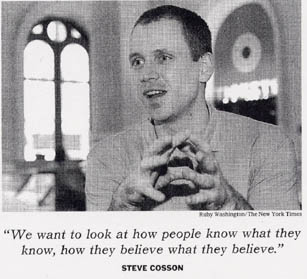
And then there was one, or two.

We love Al Sharpton and Denis Kucinich both, but it's Al who goes straight to the point.
The question was gay marriage. Everyone else avoided logic and the plain issue of fairness and human or civil rights, and not least the nature of the secular state.

Senator John Edwards of North Carolina and Senator Bob Graham of Florida didn't bother to show up for a candidates' forum sponsored by the Human Rights Campaign in Washington yesterday. Five of the seven who did come by equivocated. It seems that they variously believed that boy-girl marriage deserves the same respect for its historical, cultural or religious roots as once commanded by slavery, child labor, male overlordship, the divine right of kings, religious crusades, heretic- and witch-burnings, among other pillars of our civilization.

Kucinich and Sharpton are both reported by the NYTimes to have supported gay marriage unambiguously, but yesterday Al captured the moment with his forthrightness.

"That's like asking me, 'Do I support black marriage or white marriage,'" Mr. Sharpton said, to thunderous applause, when the moderator, Sam Donaldson of ABC News, asked if he supported gay marriage.
Sharpton's the only candidate who is a member of the clergy. The directness which has always described him becomes him handsomely here, and it shames his rivals competing for the votes of obsessive religious zealots.