
August 2003 Archives
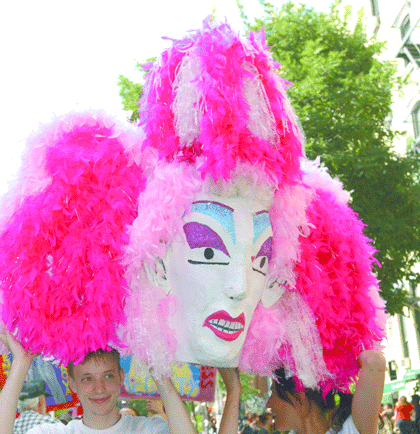
Ethel Eichelberger honored in Howl!s Pantheon Parade - would she be pissed too?
It's not just me, and I didn't make it up.
I'm talking respectively about my disappointment with the narrow focus of the HOWL! Festival, and the Festival organizers' ouster of ACT UP from Tompkins Square Park.
It's right here, and in hard print.
Many long-time residents felt that the festival was not for them, but for the people who recently took over the area. Members of ACT UP claim that police force was threatened against them by the very organizers of the festival. Latinos were largely invisible, and not even lip service was made to punks.The Gay City News article explains why some in the community, especially those concerned about the largely absent Latino and punk representation, are complaining that the Festival "was engineered for the people who gentrified the East Village," and describes in some detail how ACT UP, a part of the neighborhood since the 80's, was evicted from a very public park last week.. . . .
Exclusion still exists on a large-scale, and it can be sensed everywhere these days in the East Village. Perhaps that is the most authentic part of the HOWL festival, that the inequalities and discriminatory practices that prevailed reflect some of the themes that influenced the scene back in the 80s and 90s.
The most hopeful note in the entire account was sounded in its report of a call for an "Anti-Howl Festival."
A few blocks across from Tompkins Square Park, on St. Marks, Bobby Steel, formerly of the punk band The Misfits, and now of The Undead, mentioned the possibility of an Anti-Howl Festival. Punk rock as a cultural movement had deep roots on the Lower East Side during the 80s and early 90s, with punk venues including ABC No Rio, the World, and the Pyramid, among numerous other clubs. Mohawks, leather, and chains were once common accoutrements in East Village fashion.- and as ever, both playful and provocative.Nonetheless, there was little punk visibility, either through nostalgia for the past or a respect for the on-going punk culture. Perhaps Steel was serious, but even as a joke, the idea of an Anti-Festival illustrates how some Lower East cultural actors felt dissatisfied.
[image: Villager photo by Elisabeth Robert]

In a short post about the fluidity of male sexuality, where he references the legendary six beer theory, Welshcake evokes the media's latest tizzy over the supposed ascendancy of the gay aesthetic, commenting:
Metrosexual? Heteroflexible? Whatever. As my late friend, Richard, was fond of saying, "Ah, they all help out when we're busy..!"
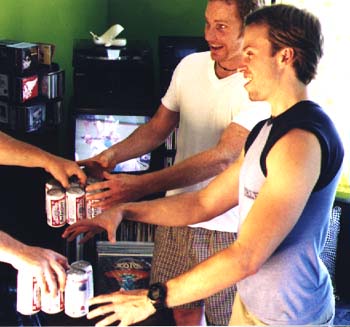
exactly six beers each [uncoolcentral.com]
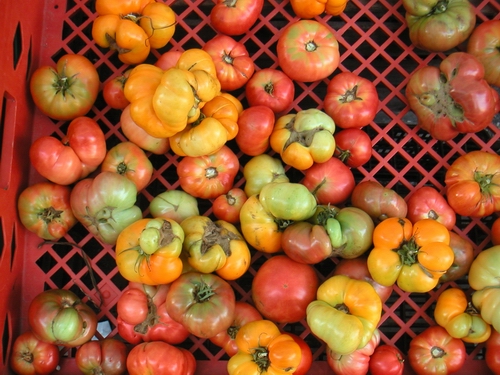
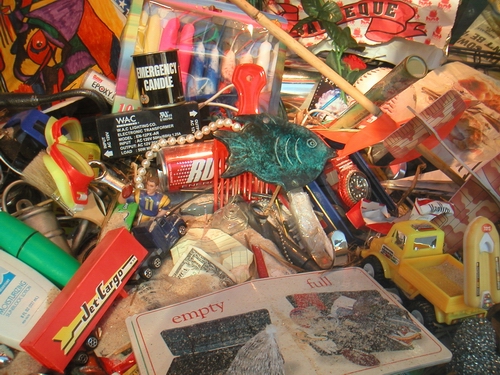
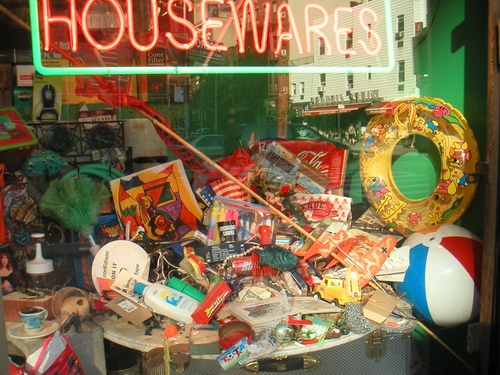
Chelsea, August 28, 6pm, SGS Hardware, 157 8th Ave., between 17th and 18th Sts.
Our tiny neighborhood hardware store has always had interesting windows, but this special end-of-summer-2003 set excels. The guys tell me it's a work in progress, so I'll be going back.

Ole von Beust
Rex Wochner reported two days ago:
The mayor of Hamburg, Germany, Ole von Beust, came out Aug. 19 after firing the city-state's interior minister, Ronald Schill, for allegedly trying to blackmail him.. . . .
Von Beust's coming out means Germany's two biggest cities now have openly gay mayors. Berlin Mayor Klaus Wowereit also is gay.

Klaus Wowereit
[photo of Beust from Landesseniorenbereit Hamburg/ photo of Wolvereit from Der Bundesrat]
The Republicans. They really are stupid, but maybe there's a shiny lining for us in that empty cloud.
Am I hopeful? Look at all the headlines these days. Bush and his handlers are dead. Traditional Republicans used to be able to survive their incompetence, because they never really did anything. I suppose that was part of what made them conservatives.
Today's Republicans are radical activists in every aspect of domestic and foreign policy, and they are making a very big mess, as many of us expected they would. They are totally incompetent, and they will not be able to extricate themselves or the nation from the disasters they have created. The world, including even the simplest Americans, now suspects that truth.
They've clearly already lost the 2004 election, but it takes two sides to win office. My fear, and it's a reasonable one, considering what we have seen so far, is that the Democrats will not do their part, and some 14 months from now the incumbent regime will be able to snatch victory from certain defeat.
If that happens, the republic is gone forever.
Jogged by current arguments over New York's Harvey Milk High School, and a recent postcard from his own school, bj has written an honest, beautiful piece about an ugly memory, one whose counterpart I share shamefully, as I'm sure do many others. An excerpt:
John I love YouDon't miss the music clip in his headline.
I actually started thinking a lot about my high school days during the first bits of current "controversey" over the Harvey Milk School's expansion this fall when that postcard arrived. No, I don't have horrible stories about constant harrassment from fellow students (but you can imagine in an all-male high school); yes, harrassment took place, and yes, I managed to survive it. And no, the Harvey Milk School wouldn't have been a good alternative for me. But then I remember John.See, back then, I would get only the occasional taunts - the name-calling, the teasing. I remember one horrible day just after Christmas. My parents had bought me a leather/vinyl shoulder bag for my books - very 70's, very nice. But the day I brought it to school, the taunting began immediately. Guys grabbed it, put in over their shoulder and "minced" around, lisping words pretending to immitate me. They passed the bag around, wouldn't let me have it back. I tried to ignore them, and eventually got it back. But the day continued like that, name-calling, joking, tugging at the bag, laughing at my expense. When I got home, I walked straight down to the basement, put it on a shelf with all the abandoned toys and games of childhood, and left it there, never touching it again. Oddly, my parents never asked about it (it wasn't cheap, and we didn't have much money), and of course I never mentioned that horrible day to them, I was ashamed. Maybe they knew, and didn't know what to say or do.
But John. He was the "obvious" one. He had the pronounced lisp, limp-wrists, effeminate manner. He got it every day, all day. I don't know the real extent to what happened to him, I kept my distance. And it makes me feel very sad, and ashamed. Not once did I ever consider befriending him, and not 'til my senior year did I ever raise my voice to defend him, or tell the other guys to knock it off (By then I was into drugs, so that "coolness" aspect trumped my suspected homosexuality.) I remember once, sitting in the assistant principle's office, trying to get a class changed, and John was in the waiting room; our eyes met, a moment of sadness from him, then a determined resolve toughened him up, and he looked away. The assistant principle looked in John's direction, breathed a heavy sigh, and mumbled something like "not him again, won't he ever learn?" I said nothing, but was deeply disappointed in this 'educator'. John never got into trouble, he was no doubt there to complain about whatever latest incident happened to him.
Then I went to my next class, attendance was called, and when John's name came up, some tittering from the students, and I said "Oh, he's in with the assistant principle." The art teacher, who we all assumed was gay, then said "Jeez! What's wrong with him, he brings it on himself, he just needs to stop acting that way." You have no idea how clearly that is set in my memory, 25 years later, as vivid as if it happened yesterday. No, I didn't say anything, but I felt even sadder, more disappointment with the adults, and much, much more isolated. And I must say, I must've secretly been feeling "thank god John's here, otherwise it would be me."
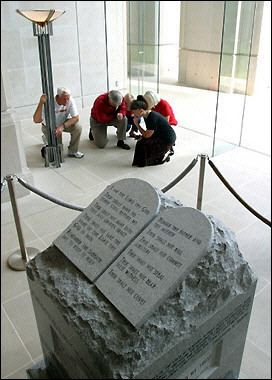
Ten Commandments Cultists pray in Montgomery, Alabama.
Atrios says it:
300 bigots and lunatics protesting around a carved rock, worthy of nonstop coverage. 100,000 people protesting a war, worthy of brief snide commentary.In fact, there were 3 to 10 times that number in New York City alone on one day. One comment on his post is deliciously, wickedly on:
It's fundie flypaper. Anyone who wants to chain himself to a rock in Birmingham [sic] deserves our buying him free manacles.
[AFP-Getty Images/File/Gary Tramontina, via Yahoo News Photos]

Maple Ave (Digimon)/ Meredith Allen
Meredith Allen now has a full-page image in this week's New Yorker and a website as well. [Don't miss the "kiddie rides."]
We love Meredith!
And we love her work! Obviously the magazine does too, since they use a full-page color image to illustrate a Dave Eggers story. Now people around the world will know why.
See Bloggy for her cute host/webmaster's take on these events.
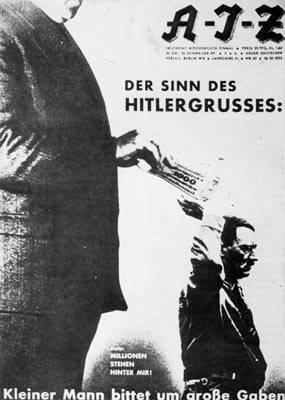
Illustration by John Heartfield on cover of Arbeiter-Internationale-Zeitung (Workers International Newspaper), October 1932.
There is no war on terror; there is only the terror of war. One of the top stories on Reuters at this minute:
"Our war on terror continues," Bush told about 600 supporters at a lunch in Minnesota that raised $1.2 million for his 2004 re-election bid.'Nuff said.
____________________
Translation of the Heartfield text:
Der Sinn des Hitlergrusses
The real meaning of the Hitler salute
Kleiner Mann bittet um grosse Gaben
The little man asks for big gifts
Millionen stehen hinter mir!
I've got millions standing behind me
"With a people denied so many basic rights for so long, the only way to stop the terrorism (of the few) is to end the suffering (of the many)."
For an understanding of what actually is the thinking within the beleaguered Palestinian community, both that of the different leadership groups and that of the population generally, read Anees's description posted last night.
"The villagers can't get to the schools or the medical centers. They are surrounded by settlements, extremly aggressive ones, and are not allowed to travel on the Jewish roads. Yes, the Jewish roads. Palestinians are not allowed to travel on the road that goes right past their own villages and towns. They are also not allowed to use their own roads as they have all been blocked. No passage. No movement. If they are caught driving on the Jewish roads, they are fined, jailed or beaten. Sometimes all of the above. They cannot get to work, they cannot get to hospitals, schools, etc. There were hundreds of men walking along the road as we drove, they were walking because they cannot drive and there is no transportation for them. Coming back from what work they manage to keep. They are walking because their roads are blocked and they cannot use the Jewish roads."
Our friend the activist and filmmaker Ellen Flanders writes today from a tiny, almost totally isolated Palestinian village near Hebron.
Hi folks, well what can I tell you? The situation once again has spun out of control, dead people everywhere, ongoing violence and no-end in sight. Spending time in the West Bank and Gaza as opposed to Tel Aviv and Jerusalem is of course night and day. I read all the reports various others send out and few people who are here doing solidarity work seem to move between both, perspective however, is everything.Even city to city, village to villlage, it is important to draw the distinctions and the realities of daily life. Leaving Jerusalem for the day and heading to Ramallah in the morning, back to Jerusalem, and then to the Hebron area in the evening, gave me a chance for some of this perspective and perhaps wide-angle lens. I met with a gay Palestinian-American man who was kind enough to take me and my cameraman, Chris, on a little tour of the road from Jerusalem to Ramallah. I was wanting to try and find a visual way of describing this journey and landscape. Words are insufficient and I find that comparing it to Apartheid or ghettos, or anything like that not all that useful in the end. This place has its distinct appearance and history, much of it grisly and worthy of its own terms. I can only try and describe it as I have seen it both over the years and presently. It's funny you know, because in some ways while I know this place and spent some years growing-up here, there are many ways that I do not know it or the people at all. I know slogans, ideologies and symbols. I know the landscape from one angle and then another. But people, take a lifetime to know. And people are what *place* is in the end. And while I have forged friendships here, both Israeli and Palestinian, we have not grown-up together, lived together, or shared in each others lives daily over the years. So I will continue to know this place from anew everytime, which can both be a benefit and a loss.
I will try to describe for you some of the things that seemed both new and old in the past days: The roads leading from Jerusalem to Ramallah are often named in the most honest and blatent of terms. At some point we were on the *Okef Ramallah Road.* Okef means to go around, hence it was the road that bypassed Ramallah. As an Israeli, one does not want to be anywhere near Ramallah, one does not want to see what is happening there. Ignorance is serving the Israeli population all to well. It is amazing how many Israelis I talk to that know NOTHING of these towns, nothing (well, except that they are dangerous). The road leads to all the settlements surrounding Ramallah from Jerusalem. The settlements are spreading like a tangled web, getting longer, wider and more populous. They are sometimes quaint, sometimes more like small cities. They surround the nearby Palestinian villages and towns, cutting them off from their fields and taking the surrounding agricultural land as their own. This then impoverishes the Palestinian villages/towns, as they now have no means of income. They take the water, 80% of it, and control whatever flows in and out of the Palestinan towns. And the electricity. Visually, when you stand high above the settlements you can see them virtually strangling these places. It is quite clear. And then we passed the outposts and the new settlements being built. What? You say there has been a halt on settlement activity? No fear! They are growing rapidly, often attaching the new settlement to one right next to it, so hence now it is a *suburb* of the former settlement. Using it's name allows the Israelis to claim that no new *legal* (although all are in fact illegal), settlements are being built. Then there are the ones that we don't even talk about, as they slip under the radar screen of all press and media, not to mention general public interest.
When you look at the network of settlements you think, this is not going anywhere. These *facts on the ground* that have been established long ago, so incredibly strategically, and continue to do so, does not give me much hope. When the mainstream Israeli peace group, Peace Now, says *dismantle the settlements,* most of the individuals (the few that are left there anyhow), have no idea what would really be involved in this and how intricate and intrinsic they have become (hece there has never been a real plan in place to do this removal). How they choke and clog all that they surround and at the same time have families, trees, yards, dogs, schools, shops etc many who have been lead here by a government offering many benefits, easing the economic burdens they would experience elsewhere. I read this over and over, but a walk around brings it home again differently everytime.
Now contrast this with the lovely cafe that Chris and I sat in for lunch in Ramallah, talking to our neighbours about what we are doing there etc. It all can seem like anywhere else in those moments, lunch, drinks, cafe, conversation and a beautiful breeze. Nasser, who is at the next table inquiring what we are doing here, teaches at Beir Zeit University. He starts to give me a lot of pointers about all the politics and surrounding areas etc. When he realizes however that I seem to be quite in the know, he asks me how I know what I do? Am I local? I tell him, no, but I did grow-up in Jerusalem for years in my youth and so I am somewhat familiar. He asked me if my father was a diplomat or something? I said no, they were Jews, Zionists, coming to live in Israel. He was stunned for a moment and then said *Really? so you are a Jew?* *Really,* I said, I am a Jew. *And you are here, talking about Occupation?* Yes, there are many others like me, I am by far unique I told him. But nonetheless Nasser was shocked. And I continue to have this experience. There are only two sides to this conflict heavily endorsed by the media, there is us and them. The people are all but removed.
We leave Ramallah via the Kalandia crossing and it takes us an hour to cross. We sit in the car with the smell of garbage all around, the dust flying and a view of the new fence cordoning off Ramalla. The soldiers are rude by the time we get to the checkpoint and wave us through. We were lucky, some people saw that we had a camera and obviously wanting this documented, told us to go ahead of them. It is bedlam and it causes such frustration that you think you are going to lose it. But here, everyone does this daily. Humiliation does not begin to describe what it is like to be at the mercy of these 18 year olds that decide whether you pass or go back.
We then pick-up Rauda in Jerusalem, one of the women in my film, a Palestinian lesbian and poet, who is joining me and Chris and Ezra, another character in my film, to head down on the road to Hebron. Ezra has been working with this one tiny village that has had their access to the nearest Palestinian town completely cut off. He helps them to remove roadblacks, only to be replaced the next day. The villagers can't get to the schools or the medical centers. They are surrounded by settlements, extremly aggressive ones, and are not allowed to travel on the Jewish roads. Yes, the Jewish roads. Palestinians are not allowed to travel on the road that goes right past their own villages and towns. They are also not allowed to use their own roads as they have all been blocked. No passage. No movement. If they are caught driving on the Jewish roads, they are fined, jailed or beaten. Sometimes all of the above. They cannot get to work, they cannot get to hospitals, schools, etc. There were hundreds of men walking along the road as we drove, they were walking because they cannot drive and there is no transportation for them. Coming back from what work they manage to keep. They are walking because their roads are blocked and they cannot use the Jewish roads.
We got to the village to help open one of the blockades by removing a steel highway barrier and by removing enough of the mound of dirt that had been piled high to cut off access, to get one car through. Ezra says this is the third time in a week he has done this as the army or the settlers come and reblock it daily. We worked at night, in the dark mostly, with the hood up on my car, pretending whenever a settler of army jeep passed that we were having car trouble. If anyone from the village is caught doing this, they are severly punished.
After, when we were invited to sit for tea with the villagers, I was told horror stories. The settlers coming into the village and chasing the women and children in jeeps, beatings of old and young (the head of the village's mother who is 80 was beaten by nine settlers and had to be hospitalized). Ta'ayush, a Palestinian-Israeli peace group, brought a tent to the village where they set-up activites for the kids (as they couldn't get to school). They were chased from the tent and told, the children that is, by settlers and army, that if they have anything to do with peace groups or go near that tent again, they will come in the night and chop their heads off. Needless to say, the children did not return. I was talking to a little girl who was about three and was asking her about her sisters etc. She turned to her mum after our chat and asked her if the army would come and slice her head off that night because she was speaking with me. They sleep on the roofs of their houses in the summer because of the heat and the ants. The settlers come by at night and throw rocks as they sleep. They have torn down some of their few olive trees, destroyed their few vegtable patches, drive their jeeps through the village, terrorizing them, especially as they have now had contact with peace groups. Let's talk about terrorism!
The village has no electricity or water beacause the settlements will not allow them to run a wire or a pipe. The village has about 20 houses.
Again, I read these stories as you must as well, from others who are spending time working here, but truly words are insufficent to describe how horrific it is. When you are sitting there, listening, you are also trying to figure-out what these people have done to deserve this lot? To be treated as less than human, as people without children, without elderly or illness, without any needs. I am sitting by the light of the kerosene lamp under the most incredible desert sky and I am paralyzed. I am helpless and my rage surges. I can see how easy it is to want revenge, to want to take a machine-gun and terrorize these bullies back, to take away their rights and dignity. I climb down the stairs to my car, the dogs of the settlers are barking in the night and their towns glow from above in the most menacing of ways. I try not break-down and leave most reluctantly, both wanting to stay and help and flee at the same time.
That was just one day, and I get to go home.
That's the update for this week,
with love,
EllenEllen Flanders
Graphic Pictures
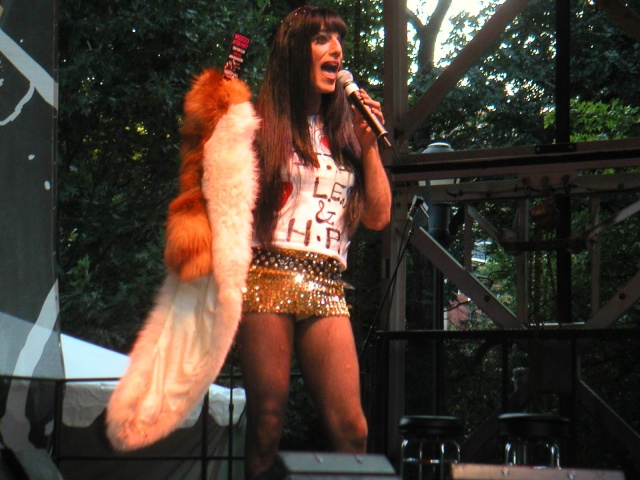
TABBOO!
On Saturday my Wigstock experience began on a sour note, and it had nothing to do with wigs. As Barry and I were about to cross Avenue A at 8th Street I spotted a small, dedicated contingent from ACT UP with their table of literature on the sidewalk. They had been thrown out of Tompkins Square Park by the HOWL! Festival organizers because they had not paid a concession fee.
ACT UP doesnt pay concession fees, and ACT UP has always been a part of Wigstock. [In the interest of complete disclosure I must say that I have been a member of ACT UP almost since its beginnings, but in recent years I have been more neglectful than supportive.] I understand the costs of the festival have to be met somehow, but I also understand that, at least the last time I checked, Tompkins Square is a public park. Surely something could have been arranged for the inclusion of genuine public service organizations in a celebration of the creative and radical tradition of the East Village.
Now feeling a little like contraband myself after hearing of their experience with the authorities, we entered the park which had once been a very major civic battleground.
Wigstocks return to the park where it was first conceived (and delivered) 18 years ago by a gaggle of not-so-mad drag queens was of course wonderful - with at least one, no two or even more, reservations. The Lady Bunny emceed of course, operating in the customary, tired bitchy form she shares with too many of her sisters, and significantly she had even managed to sorta witches-kiss and make up with Mistress Formica in consideration of this momentous occasion. But where were the new artists? The question could, and should well, be asked of the entire HOWL! enterprise.
The Dazzle Dancers wound up the afternoon's program with a spectacular salute to the ultimate irrelevance of costume as a quantity except of course for the glitter, which they generously shared with the first hundred feet of the fans packed around the stage.
I was sorry to see that in spite of the good vibe among those in the bois propre below the latest Wigstock incarnation had attracted far less spectator hair, makeup and costume involvement than those of legend, and yet I have to admit that I didnt wear my wired golden pigtails this year myself.
The tiny ATM Gallery on Avenue B (yes, it's behind the ATM machine), just north of the park, was showing what was billed as the First Annual HOWL! Invitational through late Sunday. Just inside the door on the right in this group show were Chris Tanners three colorful works on fabric with built-up patterns which suggested chenille bedspreads gone mad. They were pretty wonderful.
The Festivals community-driven "Art Wall" around much of the park was, not surprisingly, very political, and some of its statements managed to ignite tempers, arguably a good thing even for a festival. Much of it had something to do with Bush, Israel, police states, etc., and we can report with satisfaction that Michael Stewart has not been forgotten.
The East Village today is not your fathers East Village, and ironically the best evidence of that may have been the strong presence of child-friendly elements in the HOWL! Festival schedule.
Local color to straddle the two generations: At 8pm Saturday night, while we were walking about the neighborhood, we passed a barely-30-something mother and her young 7-something son out walking their house pets. The mother was pushing a folding grocery cart which supported a gold fish in a stormy bowl of water on its lower shelf and a hamster merrily racing on its treadmill in a cage on the upper.
As darkness replaced twilight, we slipped into the Sixth Street and Avenue B Garden for a few minutes to walk through the green stuff and to listen to the music of Mr. Ragas Neighborhood players (a very nice ECM-ish ambience).
As we started to go out I realized the beautiful tree we had been standing under was a perfectly healthy and fructiferous fig, something I am still not accustomed to, having lived most of my life in northern temperate zones. Do the magnificent branches and the perfectly-formed fruits reveal gardening care or betray global warming?
We managed to find a table at Raga on 6th Street for a leisurely dinner, followed by a slow walk home.
The next afternoon we returned to the same scenes to meet our friend Kate, who is visiting from Antwerp for a few weeks. We went back to the ATM Gallery, which was just then cleaning out the bottles from what appeared to have been a very successful opening party the night before. We talked to Bill Brady, the delightful artist behind the space, and we easily became somewhat enchanted with his very adventurous curatorial choices.
Aside from the work of Chris Tanner, the show, which was created especially for the HOWL! Festival, included UFO-imaged work by Ionel Talpazan, the geometric devices of Vince Roark, the sweet/scary world of Min Kim, the graphite Altamont of Mike Paré, Karen Finley's efficient, Titian-esque nudes, and her menstrual blood flower drawings, the delicate collage-drawings of Yuh-Shioh Wong, Jack Davidson's cloud landscapes which were oil paintings passing as cottoncandy pastels, David Leslie's wonderful soap sculpture of a not-quite-successful Evel Knievel outing, and Bill Brady curating himself with an exciting, strangely iconic, somehow-non-objective, neo-op oil in very primary colors.
We lingered at the music lot on Avenue A and 11th Street for a bit, unfortunately missing the magnificent John Moran but very pleased and provoked by Rebecca Moore and her band, Prevention of Blindness. We bought her CD. We already owned all of the recordings of Johns operas spread out on the table next to it, and a good thing, too.
Passing through the willow tree oasis of La Plaza Cultural Garden we hung out for a few songs by a wonderful [unfortunately unidentified to us] performer who was part of the WOW Café Cabaret, before we had to leave to call our friend Anees to settle on a time and place for dinner, always the days paramount event for the both of us.
We now four soon found ourselves at Gnocco on 10th Street, in their beautiful back garden sheltered by Trumpet Vines and heating ductwork ready for the winter. Anees had arrived bearing gifts from Palestine, two keffiyahs and a beautiful CD of a young Palestinian oud player, Samir Jubran.
And so, after another hike home to the northwest, to bed.
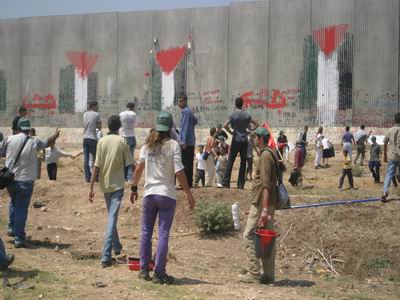
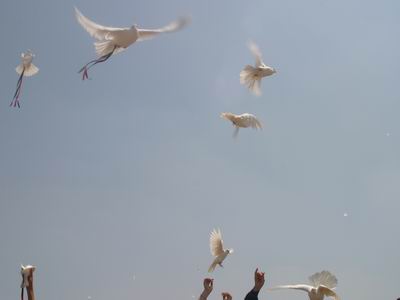
Steve writes from Tel Aviv, on his last full day before he returns to New York.
The pictures above, of the Apartheid Wall from the side of the imprisoned, are my own choice, from the International Solidarity Movement site.
Context Is Everything
Tel Aviv, Sunday, August 24, 2003I came to Tel Aviv from Jayyous on Thursday evening
intending to stay for one night, but I awoke on Friday
morning with one of my all-too-familiar sinus
infections. I saw a doctor, got some antibiotics, and
extended my stay at the Tel Aviv hotel until my
departure in the wee hours of Monday morning. It's
Sunday afternoon now and I'm fever-free, although
still a little nervous about flying with congestion.My hotel is right on the beach, and it's lovely here.
Lots of people out and about, bar-restaurant-cafes
right out on the sand, streets bustling until late
into the night. Jayyous is 10km from here, and my
friends there haven't seen the sea for 4 years. You'd
never know here that there's so much suffering so
close, being inflicted by the Israeli army.On Wednesday night two Palestinian-American friends
were staying at the same hotel. They were not
permitted to bring their Palestinian Israeli friends
to the room--the armed security guard was quite
insistent. I, in contrast, have had free run of the
place, welcome to come and go as I please, even when I
was their late-night guest before I registered at the
hotel myself.I've been pretty starved for news all summer. I've
been living without radio or TV, in communities where
all the newspapers are in Arabic. Poor email access
kept me away from Internet news sites. Now that I'm
in Tel Aviv, lolling about in front of the TV and with
English-language newspapers, I see how the present
grisly turn of events is being framed.Israeli media are forefronting the suffering inflicted
by the bombing in Jerusalem. This is perfectly
reasonable. It was a horrific attack, and its
ultra-Orthodox victims conjure up images of terrible
Jewish suffering in Europe in the 20th century and
before. The sequence of events presented in the U.S.
and Israeli press seems to be (1) bombing in
Jerusalem, (2)assassination in Gaza (3) end of Hudna
[cease fire]. Journalists (or their editors) don't
seem interested in what happened prior to the
Jerusalem bombing, in what the Hudna was really like.A look at the website of B'Tselem, the Israeli
Information Center for Human Rights in the Occupied
Territories (www.btselem.org) shows that between July
1 and August 13 of this year, 9 Palestinians (1 of
them a minor) were killed by Israeli security forces
in the Occupied Territories. In addition, the
construction of the Apartheid Wall and destruction of
Palestinian property continued apace, as did the daily
violence and humiliation that is part and parcel of 36
years of military control of a civilian population of
millions.During the same period, 4 Israeli civilians (none of
them minors) and one member of the Israeli security
forces were killed by Palestinians.Then came the Israeli attack on Askar Refugee Camp in
Nablus, in which 4 Palestinians were killed by Israeli
security forces. The Rosh Ha'Ayin and Ariel bombings
followed, with one Israeli death in each case,
followed by the Israeli assassination of an Islamic
Jihad student activist. Then the bombing in
Jerusalem.The attack on the bus of worshippers was not
justified. It was sickening. Its planners and its
perpetrator distort Islam beyond all recognition. But
it was, without a doubt, provoked, and the Sharon
government knew it. They knew it when they attacked
Askar, and they knew it when they went into Hebron.
Now the situation has spun out of control again,
Israelis will again see their buses, cafes, and
restaurants blowing up, and Palestinians will die (as
always, in much larger numbers) as the occupation army
storms through Nablus, Jenin, Tulkarm, and Gaza. The
Israeli media today are proudly showing photos of
dozens of tanks assembled at Erez Checkpoint ready to
reinvade Gaza; I can only think of the 1.3 million
desperately poor Palestinians packed into ramshackle
housing in the tiny Gaza Strip, and what these killing
machines are going to do them.So now Bush and Powell and Rice have stopped bugging
Sharon about the Apartheid Wall, and Mayor Bloomberg
is flying to Jerusalem tomorrow to stand with Israeli
victims of terror, even as the Israeli army creates
untold numbers of Palestinian victims of state terror
in the Gaza invasion. So it seems like the Sharon
government got exactly what it wanted.I'll he home tomorrow afternoon. I'm looking forward
to doing lots of public speaking about the occupation,
as well as reconnecting with family and friends.Peace,
Steve
[images of Qalqilya on August 12, 2003, by Niki Dean of the UK]
Bloggy has an extended post "On Israel/Palestine, violence, and ethnic cleansing."
Silipups explains.
He's describing the intent of his own weblog, but on the subject of Palestine he could be speaking for many of us.
Hi, my name is Anees. As per many questions I was recently asked:I THINK SUICIDE BOMBINGS AGAINST ISRAELIS ARE AN ABOMINATION AND A CRIME. LIKE ALL CRIMES, I WISH THEY WOULD STOP FOREVER.
I AM NOT A JEW-HATER AND HAVE MANY DEAR JEWISH FRIENDS. DO I HATE ISRAEL? ANSWER: I RESENT ISRAEL FOR HAVING INFLICTED MUCH PAIN ON A POWERLESS PEOPLE FOR SO LONG. DO I BELIEVE ISRAEL HAS THE RIGHT TO EXIST? ANSWER: AS THE FORCE WHICH ENACTS A RACIST AGENDA IN BRUTAL WAYS, 'ISRAEL THE IDEA', DOES NOT HAVE THE RIGHT TO EXIST AS IS. IT MUST CHANGE. BUT AS FOR ITS PEOPLE, I BELIEVE ISRAELIS LIKE ALL HUMANS HAVE THE RIGHT TO EXIST IN THE LAND WHICH HAS BECOME THEIR HOME.
THE MAIN PURPOSE OF STARTING THIS BLOG WAS TO SPREAD INFORMATION ABOUT ISRAEL'S MISTREATMENT OF PALESTINIANS. WHY NOT SPREAD INFORMATION ABOUT PALESTINIAN'S CRIMES AGAINST ISRAELIS AS WELL? THE ANSWER IS: BECAUSE AMERICAN MEDIA ALREADY COVERS THAT, AND I BELIEVE THAT IT IS BIASED TOWARDS OBSCURING THE SUFFERING OF PALESTINIANS UNDER ISRAEL'S BRUTAL RULE.
WHY JUST TALK ABOUT PALESTINIANS? AREN'T THERE OTHER PEOPLE WORTHY OF MORE ATTENTION BECAUSE OF THEIR SUFFERING? ANSWER: YES THERE CERTAINLY ARE AND PALESTINIANS DO NOT HAVE A MONOPOLY ON BEING VICTIMS, AND IF YOU CONSIDER THE AFRICAN CONTINENT AND WHAT'S BEEN GOING ON THERE, IT IS EASILY MORE HORRIFIC AND WORTHY OF MORE URGENT ATTENTION. BUT ONE FIGHTS AND PROTECTS THE PEOPLE AND THE AREA AROUND HIM, BECAUSE THESE ARE WHAT HE SEES AND FEELS. THIS IS HOW HUMAN EXISTENCE WORKS.
MY HOPE (SOME WOULD SAY AN UNREALISTIC DREAM) IS FOR PALESTINIAN ARABS AND ISRAELI JEWS TO LIVE IN PEACE IN ONE STATE.
Stupid can't even hear himself. Bush to reporters in Seattle today:
"There's a foreign element that's moving into Iraq."
The mayor of New York is going to Israel to show his support.
Am I the only one who finds this news appalling? Are Israelis the only victims of this horrible conflict?
Bloomberg's either a fool or a political opportunist who asssumes there are no New Yorkers, even Palestinians, who will question the limited object of his sympathy. Here is his reading of the current situation in Israel and Palestine:
"You can't let somebody start to bomb you or shoot you and then give up everything that they want in return for them to stop. They stop terrorism, then you talk. They don't stop, you hit back and you hit back with everything you have and as hard as you can repeatedly. And if you don't do that, shame on you.""They" equals terrorists equals every Palestinian. Simple. Stupid. Disastrous policy. Moreover, the history of terrorism in the areas which he will visit began earlier in the 20th century. Palestinians did not start the conflict, and Palestinians cannot end it.
Our mayor should know that.
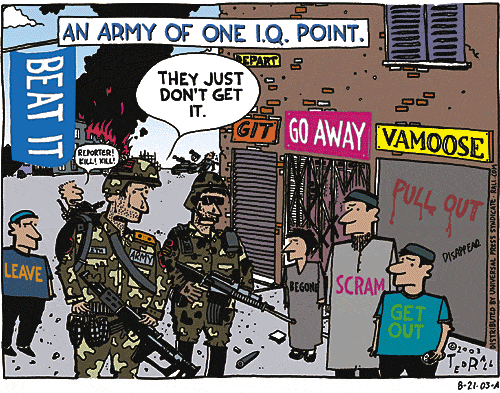
Ted Rall
Not only does the new world order keep its own subjects from the real news, but it keeps those who would report it from reaching an audience anywhere. Two days ago we murdered a journalist in Baghdad. It wasn't the first time.
Bloggy has lots more.
I guess it's probably a very good thing when activists are also very beautiful.
For the story of these two very young International Solidarity Movement volunteers chained to a Palestinian house in the dark, see this site, sections in the post below and in this post, and reports across the world web.
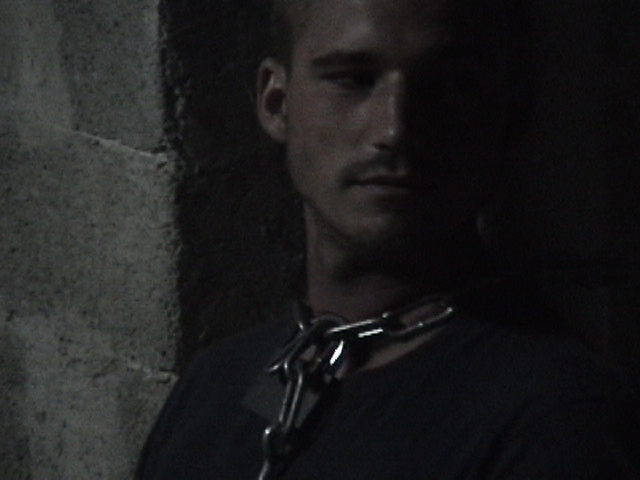
Andreas Koninek
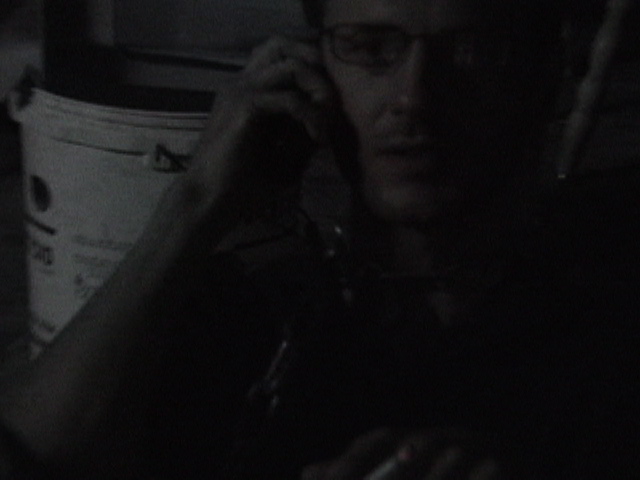
Andrew Muncie
Steve gets a bit of beach-y R&R, but only a bit.
"I continue to believe that this
is exactly what the Israeli Right
wants--the more warfare there is,
the more support they get."
Tel Aviv, Thursday, August 21, 2003Again, no photos attached--my apologies. I forgot to
bring my CD-ROM to the Internet cafe.Yesterday was a stressful and depressing day in
Jayyous. In the evening, some farmers and
internationals went down to the gate to try and cut
the wire that was holding it shut (for some reason,
the chain and lock had not been put back on after the
gate was opened for some construction workers working
on the Wall). We were especially concerned about
"Farhat's" 12,000 cabbage seedlings, which needed to
be planted before they died.We had a complex operation, with some folks at the
municipality on the top of the hill watching out for
security cars approaching, some of us halfway down the
hill, out of sight, with big clippers, and some folks
at the gate. Work on the wire ceased when security
showed up, followed by Border Guard and army--8
vehicles in all. Ora from JAtO and Abu Ali negotiated
and pleaded with the uniformed men to open the gate
for the farmers waiting. Eventually, they allowed the
3 farmers through--without internationals. We were
concerned about their safety out there with all those
soldiers, but they were OK. The affront to Jayyous
farmers' dignity, pleading for permission to enter
their own land, makes me want to cry.This morning, we went down to plant the cabbage
seedlings. The farmers came down to the gate in a
taxi, and the security refused to let it
through--totally arbitrarily, and completely beyond
their mandate. We proceeded on foot, and managed to
get all the cabbage into the ground.Afterward, Gabriel from SUSTAIN, Ora from JAtO,
Christy from Olympia and I left Jayyous for Tel Aviv.
It was really hard to say goodbye to the Jayyous Peace
Activists--I can't wait to see them again next year.Gabriel had a long talk with the Israeli Society for
Citizens' Rights about the situation with the gates in
the Apartheid Wall. They may be able to mount a
successful case in the High Court of Israel to change
the situation.We had planned to go to Nablus tomorrow for a Saturday
demonstration, but with the invasions of Nablus,
Tulkarm and Jenin by the Israeli army, the demo may be
called off. The Israeli army assassination of a Hamas
leader in Gaza today signals a whole new round of
strike and counterstrike. I continue to believe that
this is exactly what the Israeli Right wants--the more
warfare there is, the more support they get.It's good to be able to relax on the beach in Tel
Aviv. In the morning, we'll go to Tel Aviv District
Court to attend a hearing of Andreas and Andrew, Swede
and Scot from ISM Nablus who were arrested for
chaining themselves to a home slated for demolition in
Balata Refugee Camp (the cruelty of bulldozing
refugees' homes boggles the mind). [see the photo and
link on my post yesterday, and now the "after" photo
below]After that, perhaps to Nazlat Isa. It's a village
right over the Green Line from the Baqa el-Gharbiya,
the town I lived in 1985-1986. Nazlat Isa is one of
the communities isolated between the Wall to the east
and the Green Line to the west. Most of Nazlat Isa's
commercial district was demolished to make way for the
Wall last winter, and the Israeli army began
demolishing what's left today.
Steve
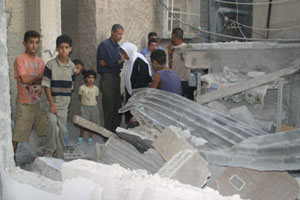
The Salim famliy in their destroyed home in Balata on Sunday.
[photo from International Middle East Media Center]
The White House may be ready to admit failure in Iraq, but how are they going to do it? - by asking the United Nations to give them moral and physical cover. The UN is supposed to make it an ok thing and its members are supposed to sacrifice their own young, effectively to draw the fire from ours.
All this is supposed to happen without the U.S. sharing with others the overall control of Iraq, the credit for any possible successes, the profits which are still anticipated to result from our fiendish venture, and of course our Middle East, and planetary, hegemony.
Weve just murdered 23 UN workers in Baghdad. International aid groups are withdrawing from the entire country. Months ago we eagerly invaded a defenseless people for reasons which will shame this republic for all time. We have destroyed a nation physically and morally. We occupy Iraq. All security there is our responsibility alone. We are killing Iraqis and our own people daily. Our ignorance, our ideological fanaticism and our greed for energy and world economic and political power have all blinded us. Weve botched everything and are continuing to botch everything, and obviously not just in Iraq.
I trust a majority even of the UN Security Council cannot be suckered now into becoming our accomplices - and their own executioners, but our nations unrestrained power has done such contrived or insane evil in Iraq and elsewhere, there may now be no possible prescription for the plagues we have unleashed.
For all time may last just a cosmic moment longer.
____________________
For a related post, see Bloggy and the comments posted there.

Rude rube
They cant win office or policy by democratic or constitutional means, so theyre doing it by any means they can.
The most dramatic examples are the Clinton impeachment attempt, the 2000 election outcome, the California governor recall, the Texas redistricting outrage, perpetual war for perpetual radical-conservative majorities and strong-arming or bribing both the UN and NATO. But its happening on every level across the country and around the world. Its all part of the new Republicanism.
The republicrats have adopted and turned inside out Malcom Xs warning phrase, later the Black Panthers call for action, by any means necessary. The words were originally used to confront racism and were later directed toward capitalism as well, but of course Karl Rove and his friends have very different ideas. Their confrontation is with democracy itself and with the common good. And the non-violence thing? Just look around. Only the state is permitted to use violence, and in fact it is more and more strongly encouraged to do so.
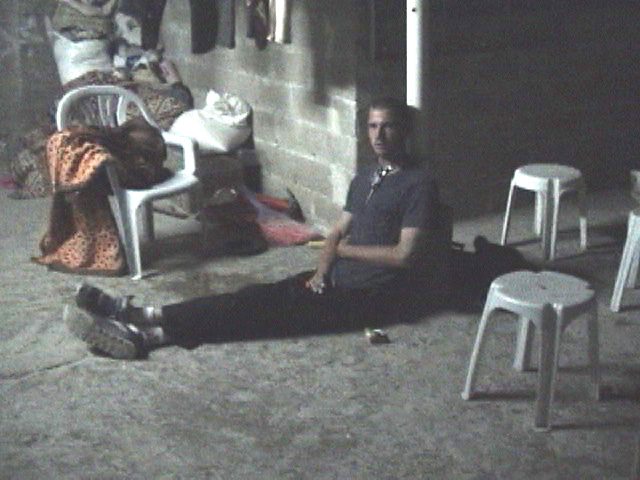
Andreas Koninek, 20, an International Solidarity Movement volunteer from Stockholm, chained to a Palestinian house in Balata refugee camp, waiting for the Israeli military to arrive on August 17. [ISM story]
Steve writes from Joyyous today. He includes accounts of Israel retaliating against farmers for the attacks of unrelated terrorists, Israel gasing Palestinians in their prison cells, Israel stealing Palestinian farmland to build ghetto walls which will isolate their victims, Israeli bulldozers destroying lemon orchards, Palestinians forced by Israelis to build their own cages in order to have work which will support their families.
After I read through it I concluded that the caption which Steve gives to his report was too restrained. He addresses the real story early in the text which illustrates it, and he elaborates on his conclusion near the end.
"Preventing a farmer in Jayyous from planting his
seedlings carries no benefit for Jews in Jerusalem
wishing to return home safely from the Western Wall.
What the closure does is make life in Palestine that
much more unlivable, Palestinians' access to their
land and water that much more tenuous, "voluntary"
ethnic cleansing that much closer to reality.
That's the real purpose of locking the gates in the
Wall.
. . . .
I'm convinced that the goal is not land and water
theft, it's ethnic cleansing. The Israeli government
wants to make the Palestinian communities within 5 or
6 kilometers of the Wall unlivable, forcing the
thousands living there to move deeper into the West
Bank or into another country. Perhaps the plan is
then to repeat this process a little further in, until
the West Bank is virtually Arabrein from the Green
Line to the Jordan River. Sharon's governing
coalition includes parties that support expulsion of
all Palestinians from Palestine; it seems that the
"moderates" have the same plan, but wish to make it
appear voluntary."
Gates As a Form of Collective PunishmentJayyous, Wednesday, August 20, 2003
Ras Atiyah's gate has been closed since the
demonstration last Friday. The people of Ras e-Tira,
Dab'a and the other communities walled in with Alfe
Menashe have been cut off from Palestinian life,
apparently as punishment for their daring to hold a
peaceful demonstration in favor of children's access
to school.Today, every gate in the Apartheid Wall in the West
Bank, from Tubas to Jenin to Tulkarm to Qalqilya to
Mas'ha, is chained shut. Thousands of Palestinian
farmers are unable to reach their land. The reason?
A member of Islamic Jihad from Hebron in the southern
West Bank, in retaliation for the Israeli army's
assassination of an Islamic Jihad activist in Hebron
last week, carried out a dastardly attack on
ultra-Orthodox Jewish worshippers in Jerusalem
yesterday. The connection with Palestinian farmers in
Jayyous? Absolutely none.None of the 35 farmers who lined up at the gate in
Jayyous this morning had anything to do with events in
relatively far-off Hebron and Jerusalem. Most of them
probably condemn the attack in Jerusalem, as well as
Sharon's provocations. But all of them were kept off
of their land, as were farmers up and down the
northern West Bank.The idea here is of course not to make Israelis safer.
Preventing a farmer in Jayyous from planting his
seedlings carries no benefit for Jews in Jerusalem
wishing to return home safely from the Western Wall.
What the closure does is make life in Palestine that
much more unlivable, Palestinians' access to their
land and water that much more tenuous, "voluntary"
ethnic cleansing that much closer to reality.
That's the real purpose of locking the gates in the
Wall.I'm sorry I haven't been in touch for a while. Here's
my journal for the last ten days. No photos - the
computers in the Internet cafe in Jayyous won't let me
attach.--Steve
Jayyous, Sunday, August 10, 2003"Nabil", ISM coordinator from Tulkarm, is in Jayyous
for a visit. He told us a hair-raising story last
night. He was taken from his house and imprisoned at
age 17œ during the waning days of the first Intifada.He said that the Israeli forces used to target the
top students for arrest. He was only in jail for 21
days, a very short term compared to most of the
Palestinian men I know, but during that time the
guards went from underground cell to underground cell,
opened a hatch in the very heavy metal door, and
dropped in a half kilo of powder with an action like
tear gas, only stronger. (I assume that the Jews
reading this journal have the same horrible
association that I have with this image, even though
the substance in question here is not Zyklon B and is
usually not lethal.) Nabil says that it took about
80 hours for the irritant to dissipate. "Rashid",
head of the Prisoners' Club in Qalqilya, had told us
about the same process in all 3 of the Israeli prisons
he was in. Last week, about 100 prisoners at Ashqelon
Prison were injured while being gassed in their cells,
9 of them critically.Gabriel and I went to the Falamiya Gate this morning,
and then walked over to the Jayyous Gate with John.
Very few farmers passed through either gate.I wonder
if a lot of them are sleeping in their fields beyond
the wall these days? The Border Guard was patrolling
and there were security at the Jayyous gate where
workers with heavy equipment (Caterpillar, natch) were
digging a trench, but we didn't see any harassment.
It's a tough call deciding whether or not to do Gate
Watch.one doesn't want to get up at 5:30 in the
morning to waste one's time, but we'd be devastated if
there were another incident at a time that we could
have been there.Walking back up to the village, a man stopped us and
told me about his 70 dunums of land taken from him by
the Wall. He referenced boulders on his land and the
nearby settlement of Tsufim, so his land must be near
the quarry. He said, "Can you help me?" I can't, of
course, and we both walked away feeling pretty bad.
A new crop of ISM activists came into Jayyous
today-all Jews, including Liat, a staff member of
Jewish Voices for Peace in San Francisco, Ora from
JAtO/NYC, and Rann, an Israeli who lives in Britain.
Qalqilya, Monday, August 11, 2003Today, ISM activists from all over Palestine once
again converged on Qalqilya for a big demo against the
Wall. The demo was called by the Qaliqilya political
parties in response to Democratic members of the U.S.
House of Representatives who visited Israel as guests
of the American Israel Political Action Committee.and
who didn't visit the wall. It was the usual
Underground Railroad scenario, and all of us, each in
a small group, managed to slip in undetected. We
spent a lot of time making signs and props for the
demo. (There are two ways to get media: someone gets
shot, or activists get creative. We prefer the
latter.) One activist drew a picture of Qalqilya
being hanged by a noose (representing the Apartheid
Wall that surrounds it), with an Israeli soldier
holding the noose. The soldier was drawn as an evil
looking guy with a big nose and Stars of David on
him.it looked more like a Nazi propaganda poster than
a sign for Palestinian freedom. David from JAtO/NYC
pointed it out to me, I said something, and the sign
was trashed.Tracie called me from Jayyous to say that some farmers
came to the house to look for us-there's a bulldozer
in the orchards beyond the fence knocking down lemon
trees. One of the farmers stood in front of the
bulldozer and stopped the work for the afternoon.
Tracie, Michelle and David went out to the orchards,
where an elderly farmer was holding branched of a
ruined lemon tree and wailing "Allahu akbar" over and
over again.
Jayyous, Tuesday, August 12, 2003Today was the 2nd big Qalqilya demonstration at the
wall. In the morning, we heard on the news about the
attacks in Rosh Ha'ayin and Ariel (undoubtedly a
response to the much deadlier Israeli army attack on
Askar Refugee Camp on Saturday night), and prepared
ourselves for soldiers with a hair trigger. The
Israeli authorities in the meantime closed Qalqilya
checkpoint, meaning that no media could get in to
cover our action.We had many more participants from Qalqilya than last
time. We marched to the vicinity of the military gate
in the southwest corner of what's left of Qalqilya,
just like last time. This time, instead of hoisting a
giant banner with balloons, we used paint rollers on
very long poles to paint giant Palestinian flags up
above the graffiti from July 31. We also tied strings
of names of prisoners to tennis balls, and threw them
over the wall, and girls from Qalqilya released doves.
Check out www.palsolidarity.org for photos.
Our two negotiators, Lisa from Italy and Sam from the
U.S., were awesome. At one point, a few boys from
Qalqilya threw stones in the direction of the troops
who were watching the demonstration with guns cocked.
Despite the fact that older boys and men from Qalqilya
exposed themselves to the troops by running out front
and literally tackling the stone throwers in order to
stop them, the Israeli soldiers began throwing sound
grenades at us (not exactly a de-escalatory tactic).
The usual Israeli army tactic is to follow the sound
grenades with tear gas, then rubber bullets, and
eventually live ammunition. Sam and Lisa, however,
who had positioned themselves among the soldiers from
the beginning of the demo, convinced them to stop
throwing the grenades and allow the demo to wind down
naturally. There were a few speeches and we withdrew.
As we left, Israeli soldiers were spotted in hiding
in the orchards off to the side (something the
commander denied to our negotiators), which was a
provocation that sparked more stone throwing and tire
burning. Fortunately, the army, withdrew, and no
Palestinian boys were hurt.
Tel Aviv, Wednesday, August 13, 2003In the morning, Rann and Ora and I from ISM went down
to the gate in the Apartheid Wall near the village of
Falamiya-the next gate to the north after Jayyous's
gate. The gate was open (although, ominously, the
same chain and lock that had recently appeared on
Jayyous's gate was hangin on this one), farmer traffic
was very light, and there was no military presence in
evidence. We chatted with a farmer working on is
trees right inside the Wall, who spoke with us in
Hebrew. He said that there would be a process
regarding the Wall and its gates: first the gates are
always open. Then the gates are always open, but
there's a lock and chain hanging on it. Then they're
locked at night. Then they're locked during the day
as well, except for certain hours. Finally, the gates
are locked for good, paving the way for the
confiscation of all the land outside the fence. We've
heard these same predictions from a number of farmers;
when you've lived under occupation for 36 years, you
tend to know the ways of the occupier.Later in the afternoon, the internationals from ISM
and Ahmed and Farouq from Jayyous Peace Activists went
down to the orchards where lemon trees were being
bulldozed. It seems that a farm road is being paved
and widened-for reasons we can't understand and quite
against the wishes of the farmers whose trees are
being destroyed. The farmers we met, however, asked
the Jayyous Peace Activists and ISM not to mount a
demonstration. They noted that the workers widening
the road are Palestinian, and were being careful not
to damage irrigation pipes or trees other than the
hundreds in the path of the widened road. They felt
that any protest against this unnanounced invasion of
their land would cause the contractors to replace the
Palestinian workers with Druze or Jewish workers who
would carelessly destroy anything in their path. They
were also afraid that any protest would lead to a
retaliatory locking of the gate; now that the
Apartheid Wall is up, the Israeli army has enormous
control over Palestinians' behavior just by holding
the keys to the gate.A group of us New Yorkers spent the evening in Tel
Aviv (the privilege to pass freely between Israel and
the West Bank of course being one that our Palestinian
friends and hosts don't have). We went to the Tel
Aviv Beer Festival because D.A.M., a Palestinian
hip-hop artist from Haifa whom we admire for his
political songs, was scheduled to appear on the
Israeli hip-hop and reggae stage. We spent a few
hours there, but were so disgusted by the acts that
preceded D.A.M. that we had to leave. Some were just
amateurish and stupid, but others were pro-occupation
hip-hop artists who rapped about crushing Gaza among
other things, and who were introduced as having "blue
and white flowing in their veins". Ugh.
Jerusalem, Thursday, August 14, 20003I went up to Jerusalem early in the morning for an ISM
Core Group meeting in El-Ram, a Palestinian West Bank
community illegally annexed to Israeli Jerusalem. It
was wonderful to see Lysander from New York's Direct
Action Palestine there; I hadn't seen her since she
was arrested in Mas'ha and banned from the West Bank.
The meeting was long and involved; ISM is an ambitious
international project committed to grassroots
democracy and consensus process. I had to miss the
second day of the meeting because of my region's
scheduled action in Ras Atiyah.
Jayyous, Friday, August 15, 2003Early in the morning I got on a bus chartered by Yesh
Gvul, a 20-year-old Israeli organization for military
refusers, to go to a demonstration in Ras Atiyah
organized by the Committee Against the Wall/Committee
Against the Settlements with ISM participation. It
was interesting to talk with Itai, an organizer from
Yesh Gvul, during the ride. He downplayed the time he
and others have spent in jail for refusing their
Israeli military service, noting that it's the
Palestinians who live in a jail all the time.I also talked with other ISM internationals on the bus
about the previous night's house demolition in Askar
Refugee Camp in Nablus, where I spent time last year.
The house demolished was under ISM's protection, and
the internationals in the house chose to stay with the
family when the family decided to evacuate (as per the
orders of the Israeli soldiers who arrived in the
middle of the night). It was hard news to take for
the many Nablus ISM members who would have wanted to
be there to help, but were in Jerusalem either to
attend the Core Group meeting, or because of their
arrest in Mas'ha.As I've written here before, Qalqilya is entirely
surrounded by the Apartheid Wall. South of Qalqilya
is a corridor outside the wall that allows passage
from Israel to the illegal settlement of Alfe Menashe,
east of Qalqilya. South of that are the villages of
Habla and Ras Atiyah, themselves surrounded by the
Wall. The Wall has been constructed in such a way
that 3 Palestinian villages and 2 Bedouin settlements
have been walled in with Alfe Menashe. 1000 people in
these 5 communities have been cut off from access to
the rest of the West Bank, but forbidden to enter
Israel. The stage is set for ethnic cleansing there.Ras e-Tira is one of those 5 communities in the Alfe
Menashe enclave created by the Wall. Children from
Ras e-Tira go to school in Ras Atiyah, which is in the
Habla-Ras Atiyah enclave created by the wall. The
school in Ras Atiyah is right next to the Wall
(children painted slogans against the Wall's
construction on the school), and the kids from Ras
e-Tira have to pass through a gate there in order to
reach the school. They are often prevented from doing
so, and the demonstration was planned to call
attention to Ras e-Tira's lack of access to education.We were met at the demonstration site by the usual
private security paid to guard the construction of the
wall. They were their usual aggressive selves, but we
were able to put a protective line of internationals
and Israelis in front of the Palestinian demonstrators
who held signs, chanted, sang, and made speeches
against the Wall. The security called the army and
the Border Guard, who showed up and demanded that
everyone withdraw inside the gate. We were asked by
the organizers not to give up the gate, because it
would be closed and locked, stranding the
demonstrators from Ras e-Tira. It was pretty tense
for a while, as soldiers and Border Guard gave us five
minutes to disperse before they began using force, but
our negotiators were wonderful, and Palestinian and
international demonstrators showed incredible
discipline in the face of verbal and physical
provocations by the soldiers, Border Guard, and
security. The Israeli demonstrators were not as
disciplined, and one got into a verbal confrontation
with a security guard that ended with the guard
slapping the activist, after which the activist
(natch) was arrested. They also tried to arrest
Jackie, a videographer from New York, but we swallowed
her up into the crowd (but not before a soldier
grabbed and broker her camera).As the time for Friday prayers approached, the
Palestinian activists prayed in the schoolyard rather
than going to the mosque, which put the soldiers and
Border Guard in a bind. When they were done, Ras
e-Tira demonstrators were permitted to cross the gate
and return to their village. Jackie crossed too,
since her bags were in Ras e-Tira, and the Border
Guard tried again to arrest her. Fortunately, she got
away. We then withdrew into the schoolyard, and the
Israeli soldiers closed and locked the gate.
The Jayyous Peace Activists were really happy with the
demonstration, and we're looking forward to more work
with the villages south of Qalqilya. One suggestion
from a member of the Land Defense Committee in Ras
e-Tira is that we set up a fence in the schoolyard in
Ras Atiyah to help ensure kids' access once school
starts on September 1.At 7 in the evening, a boy came to our door to tell us
that the gate in the Wall had been closed and locked,
and many farmers were stranded outside. We walked
down the hill, and found Abu Ali there among the
others, waiting to get out to his lands to spend the
night. He called the mayor, who called the Israeli
army District Commanding Officer, and at about 8:30
soldiers came by and opened the gate for the people
waiting to get in and out. I took a flask photograph
while they were re-locking the gate behind the last of
the farmers, which enraged the commander of the
soldiers. He demanded repeatedly to know who I was,
but I was long gone.The soldiers said that they'd be opening the gate for
a few hours each morning and evening from now on.
It's hard to describe how humiliating the whole
experience was, with farmers on their own land locked
out of their own homes by a capricious and vindictive
foreign army, an army that's been here for 36 years.
Jayyous, Saturday, August 16, 2003I descended to the gate four times today, as it was
locked, unlocked, locked and unlocked again, each time
with a different story of what hours it would be open.
Tracie and Michelle, ISM Jayyous, told me about our
friend "Mortaza" and why he stays away from the gate
and from demonstrations-he was arrested, held tied to
a chair for 72 days, and then imprisoned for 17
months. He was never charged. He's been told that if
he's seen "causing trouble", he'll be reimprisoned.On Gate watch I chatted with "Abd el-Wahid", who told
me about his grandfather's land, now in Tel Aviv, and
how he still has the Ottoman deed to it. Tracie and I
also had tea with Khaled, a shepherd who was taken by
the army a month ago while tending his flock outside
the fence, and taken to Jaljulya checkpoint and
released at 3:00 in the morning.Liat (of the Bay Area's Jewish Voices for Peace) and I
went to visit the Bedouin family trapped outside the
Wall. We were pretty worried about walking through
Jayyous's south gate, since Palestinians and
internationals have been threatened and shot at for
passing through, but we thought it was important to
check on the welfare of this family. The mom and some
of the kids were home, and they enthusiastically
welcomed us and served us tea as we sat and talked
amongst their rabbits and chickens (dad was out with
the sheep). They're running low on water, because the
pump in the nearby village of Azzun is broken. That
pump directs water from the aquifer to villages all
over the area. People in the village buy water ($150
for 11 cubic meters), but they can't get the tank
delivered from the other side of the Wall (not to
mention the obstacle of the money). The mom has
diabetes, and had medical papers indicating her
permission to pass through to Qalqilya for treatment,
but the security guards ripped up her papers and
denied her passage. She was also worried about the
kids' ability to pass through the gate to get to
school next month.We committed to having internationals walk the kids to
and from school each day starting in September, on the
assumption that the security, soldiers and Border
Guard would hesitate to harass them with
internationals present. We also went back to the
Jayyous peace activists, who said they'd talk to the
mayor about trying to get permission from the District
Commanding Officer to have a tractor with the water
tank cross the gate. We committed to raising the
money.When we returned to the gate, we saw that boys who had
seen us walk through the gate ventured to do the same
themselves, and set tires on fire in the road. We
were pretty mad about it, because of the danger it put
us in, but the boys were nowhere to be found. We
passed through the gate unmolested.The farmers were locked out of Jayyous again tonight,
and the mayor had to call the DCO to send soldiers to
open briefly.
Qalqilya Sunday August 17, 2003During Gate Watch this morning, some Palestinian
construction workers who are building the Apartheid
Wall sat down with us to chat (needless to say,
they're not from Jayyous). I kept my distance from
them. Israel's economic war on Palestine is so severe
that some Palestinians will build their own cages for
a daily wage. Later in the day, a reporter and
photographer from a regional newspaper in the Sharon
region of Israel came to interview people, see the
Wall, and met the Bedouin family. When the two
journalists, accompanied by a group of Jayyous Peace
Activists and internationals, tried to return to the
village, we found the gate closed and blocked by one
of the security guards. After we stood in the sun
arguing with them for a while, a jeep came along and a
soldier ordered the security guard to open the gate.
He told the two Israeli journalists (he didn't know
that one of the internationals is also Israeli) that
they couldn't go back into Jayyous without permission.
This is nonsense, of course; Jayyous is in Area C
according to the Oslo Accords, which means that there
are no restrictions on Israeli access. Nevertheless,
the journalists chose not to go back to Jayyous with
us.and accepted a ride with the soldiers in the jeep.
Now I understand why Palestinians distrust Israeli
journalists. What would we think if a Daily News
reporter interviewed people in Red Hook about police
brutality, and then got a ride out of there in a
police car?In the evening we were called to Qalqilya to help with
a situation there. A giant military bulldozer had
shown up with a surveyor, attempting to destroy all
the greenhouses, sheds, and farmlands within 50 meters
of the 8-meter high wall on the west side of Qalqilya.
The bulldozer stopped working and left when
internationals arrived on the scene, but was expected
to return during the night or the next day. ISM
activists converged on the city to block the
destruction. We decided that we would not allow tear
gas, rubber bullets, or threat of arrest keep us from
blocking the bulldozer.
Jayyous Monday, August 18, 2003We waited at a greenhouse by the Wall in Qalqilya,
watching a military bulldozer work outside of the
Wall. It never came in to destroy the lands within 50
meters. I heard that the political establishment in
Qalqilya wants a third Wall action, which I was
delighted about. The group assembled decided to stay
at the greenhouse, day and night, but John and I chose
to return to Jayyous.
Jayyous Tuesday, August 19, 2003At Gate Watch this morning, I asked Abu Ali why there
were so few farmers going out to the fields. (Most of
the people who passed were workers on the Wall.) He
said that many farmers were now living on their land,
a development he heartily approves of. He feels that
when farmers live on the land, the power of the Wall
and its gates is neutralized. This is tricky
business, though. If any farmer builds a shed that is
too comfortable or sturdy, it will be demolished by
the Israeli army because the land is zoned for
agriculture and not residence. We had long talks with
our closest partners in Jayyous today about how the
mood in the village had changed since last year, when
the olive trees were first being uprooted to make way
for the Wall. Ahmed said that people are now in
despair; the village united in a campaign of
non-violent resistance, and the Wall was built anyway.
Now the Israeli government has a noose in place,
which it's slowly tightening around Jayyous's neck.
I'm convinced that the goal is not land and water
theft, it's ethnic cleansing. The Israeli government
wants to make the Palestinian communities within 5 or
6 kilometers of the Wall unlivable, forcing the
thousands living there to move deeper into the West
Bank or into another country. Perhaps the plan is
then to repeat this process a little further in, until
the West Bank is virtually Arabrein from the Green
Line to the Jordan River. Sharon's governing
coalition includes parties that support expulsion of
all Palestinians from Palestine; it seems that the
"moderates" have the same plan, but wish to make it
appear voluntary.No bulldozer in Qalqilya again today-the oppressor is
patient.
[image from ISM site]

The HOWL! Opening Night Party is this evening at Angel Orensanz Foundation, with stuff and things beginning at 7pm and continuing until 11.
I wrote about the festival earlier, and this kick-off sounds more than passing promising. The details, from their own site:
Wednesday Aug 20th
7:00 PM - 11:00 PM
HOWL! opening night party
Art Salon & Auction
What: 7:00 PM Book Release Party for 2 FEVA publications
Captured - A History of Film and Video on the Lower East Side Created by Clayton Patterson, Designed by Alexandra Bourdelon, Edited by Paul Barlett and Urania Mylonas.
8:30 PM Art Auction & Exhibition on the Bohemian Balcony Curators: James Romberger and Marguerite Van Cook with David Leslie, Steven Kaplan, Gary Ray, Norman Douglas Howl Souvenir Book, edited by Greg Masters
9p.m. Fashion Show
DJ Liquid Todd from K Rock, Go-Go Boys and Girls, Beer and more..
Where: Angel Orensanz Foundation 172 Norfolk St. (between Houston & Stanton)
Tickets: $5.00
I'm definitely going to be there, but since Barry may have to come late, HOWL! and I could both use a few dozen dates.
When the power went off we were upstairs at the Metropolitan Museum. We had just finished walking through the extraordinary Art of the First Cities exhibit on one of its very last days, and I had picked up, but not yet paid for, a book in the adjacent little tie-in shop. That whole area of the Museum was immediately thrown into total darkness, but no one was the least upset, and once we were in rooms with natural light, most people, including the guards, seemed not even to have become distracted. There wasnt a crack of light visible in the Cities galleries, so we decided to wander around the grand permanent-collection areas where there was natural light from skylights, until we eventually decided it might be more interesting, if not wiser, to be out on the street. First I slipped around the ropes blocking the men's room on the first floor (absolutely no light inside, but I knew it well, and I was to be very glad I did that!). I reluctantly gave up my book at another museum shop just outside.
Our only delay getting home was the line of hundreds of people wanting to pick up bags and other interesting stuff from the checkrooms all at just about the same moment. Even now, about a half hour into it, no one seemed to have a clue about the scale of the blackout, but I was beginning to suspect the worse (short of a terrorist attack, which somehow I did not think likely) and I asked a security supervisor about it, since he appeared to have a radio headphone. He told me, the whole Northeast, including Canada, all the way to Ohio and Michigan." Heavy.
We walked home at a very relaxed pace, stopping for small meals along the way (gosh, I love hotdogs and brownies!), beginning in Central Park and continuing down 5th Avenue to 42d Street, then to Times Sq. and left down 8th Ave., taking pictures as we went. Arrived home early in the evening. The weather? Like September 11, a beautiful, beautiful day.
When we arrived home on 23rd Street, coming in through the lush interior garden from the north, we found ourselves in the midst of a residents and refugees garden party. There was lots of conviviality, the sharing of food, wine, flashlights and candles, much greeting and talking among people who had never taken time to approach each other before (and a certain number who had, of course), soft songs and one mandolin. We were almost half and half "boys" and "girls," but we agreed that it was still just about certain that there would be no new babies in this building 9 months from now.
Back in the apartment at first we even had warmish water for showers! We returned to the garden for a spell, until we became overheated by the zillions of tea candles and their truly monstrous relatives. We headed to the roof for a look at the darkened skyline and streets, and of course the Big Dipper, scads of other stars and red Mars itself.
We came down for a walk around the neighborhood where the real life was concentrated in and outside the gay bars on 8th Avenue, with hundreds of barely- (and bearly-) dressed Tom-of-Finland types hanging out in the dark. Pretty impressive group, even by Chelsea standards, but the most significant difference about the street on Thursday night was probably less the extraordinary subtle lighting than the relaxed friendliness and sociability of the guys. Attitude had taken a holiday. It felt like a steroid re-creation of the gyms and playing fields of my all-boy prep school or college experience, but here you could fearlessly look at the musculature.
In the end (if not at the very beginning as well), like those schools, it was a pretty dull scene without any women around. Eventually the cold beer ran out and the crowd started to thin.
On our way out the doors of our building we had run into our friend Glenn, and he was trailing a wheeled suitcase, having just arrived from D.C. in circuitous Greyhound routing. Since he lives pretty far out in Williamsburg and intended to go on to Texas the next day, he stayed here that night. The next morning he set off for the airport. We wished him luck. Hope he made it out that same day.
Now we all really understand why, pre-Edison, people went to bed early, and got up early. What do you do after dark, if it stays dark after dark? We tried sleeping, with only some success.
Friday we walked to our Hudson River Park (in the Village, since the Chelsea Piers corporation owns all of our shore in Chelsea), and had a beautiful day. The new park is wonderful. I hope it manages to be maintained properly. On the way back the power went on in the West Village, but we found it was still dark above 14th Street.
Later that afternoon, between 5 and 6, having just about had it with the information shutdown, I got on my bike and zoomed up and down Manhattan from 80th Street to the Battery, visiting both sides of the island. I found that the only neighborhoods which did not yet have power were either the poorest neighborhoods, or those which were the least important as far as corporations are concerned. Coincidence, political calculation, political reality or a reflection of where we build our substations?
Friday night I decided we'd have a relaxed supper on our own terrace, so I moved a small table and a couple of Windsor chairs out with the potted garden, along with some old candle lanterns, linens, and the food which might not last much longer (Italian salamis, cheese, bread, cooked broccoli salad, fresh plums, wine). Sweetpea joined us out there. It was a delightful meal, in circumstances which probably could not and should not be repeated.
I had reluctantly decided, very much against my nature, and for the first time since the lights and the hot water had disappeared, not to wash the dishes immediately. I was going to just rinse them in the dark and finish them the next day in light, with water heated on the old gas stove. But just after I had brought the dishes into the kitchen, I heard a loud roar, cheering actually, coming from the larger garden below, where there was the now familiar assembly of friendly neighbors being very friendly. The power had returned. Bingo! Hot water for dishes. And showers! We rushed to join the group, but by the time we got downstairs they had dispersed into the walls, and the now exotic hum of air conditioners already surrounded us.
Sleep came easily that night.
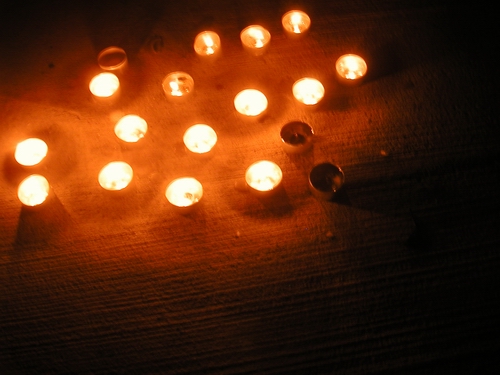
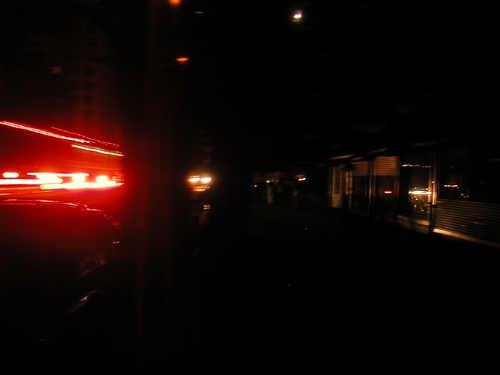
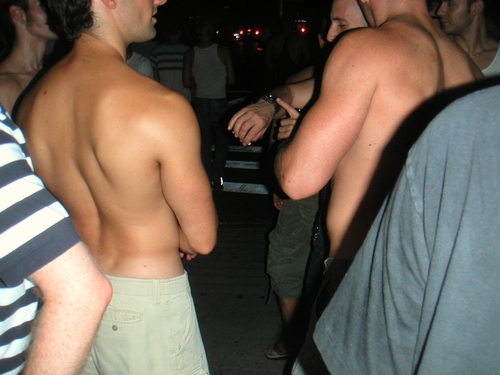
The images, from the top: tea lights in the garden, 23rd Street in front of our building, guys outside of Rawhide
Updated August 20, with pictures
Were back. Time Warner somehow managed finally to push the right remote control button exactly two days after electrical power (but, for our building, not their cable) was restored to Chelsea. We now have our connection once again, for email and the internet, and of course for television as well (although I havent looked, and now have no need for its sad contribution to news reporting).
As you see, Barry and I have been pretty much out of touch with the world since Thursday morning (We left the apartment early in the afternoon to visit the Metropolitan Museum, where we were when the power went off). This means that I have little idea of what has already been said on line about the events of last week, so Im going to limit my comments to personal experience and I guess Ill use the opportunity to let off a little steam.
First of all, I am so f ___ing furious about the spin we were getting, and still get! Yes, New Yorkers were wonderful, but the people everywhere at the very top (of the political, energy and communications heaps) who are supposed to be responsible for our security and basic services should be boiled in oil. Instead, we're forever hearing this counter-productive, counter-revolutionary crap about how well we made it through.
For most New Yorkers, at least for those with batteries and portable units, there was nothing but radio for word about what was going on, and that is another problem about which we should be hearing much more from both the cord and remote phone industries. We can at least ask whether it was necessary for our only source of information to give us only what they or the authorities thought would calm us poor children, rather than any real information. I only remember hearing over and over again about how relaxed the City was, about how there was one cooling-off shelter in each borough (one in each?), about calling 311 rather than 911 unless it was a real emergency (how were we going to call any number?) and about the mayor expecting power to be restored very soon, in hours, pretty soon, well, . . . soon, or maybe by some time on Monday. The only practical information I remember hearing (and this from public radio, where I should have expected real reporting and real questions to be asked) was the situation at the airports, certainly not a priority even for New Yorkers not stuck in subways or trying to survive without food or water.
New York did so well, Im almost surprised we dont hear some people saying, Bring it on, again! - the idea being that we should regularly have this kind of opportunity to prove our mettle and our civic sweetness. Besides selling papers and airtime, it helps the economy or so the reasoning might go. Even though we know there was no power overload this time, that it was the transmission and other systems that failed, I expect nothing to be done to prevent a recurrence, except what will further enhance the profits of the decision-makers at the top and their paid operatives in Washington, state capitols and cities. Alaskan oil drilling, tax breaks for the oil and gas industry, nuclear energy and countless other destructive rapes of the public and its weal, come to mind immediately. Hey, does anyone remember ENRON? Does anyone recall the vaunted and still very secret Cheney energy meetings that were supposed to result in miracles? The only miracles were the obscene profits of those whose conversations are still kept from us.
Second, do we really have to submit to "Blade Runner"-like assaults by police helicopters? We hardly slept Thursday evening, and the problem was not just the dark, warm, airless room. It was less the heat and humidity that arrested sleep and more the horrendous and mindless whop-clack of the police helicopters (infra-red cameras directed below them in a neighborhood "security" watch) passing every few minutes and hovering directly overhead for a few more, while occasionally and disturbingly shining searchlights onto the ground and the walls outside our rooms. Not knowing at the time how many days and nights this might continue made it even more horrible and obscene.
Can't the police walk, or pedal, or even drive cars anymore? Did they have to terrorize us (disturbing what peace we might have hoped for) in the name of combating terror (keeping the peace) by remote, and in fact secret, control? These may be rhetorical questions, since there is little doubt that helicopters are considered more fun, more manly, than the alternatives, even as they are less risky for the individual officer. If the police were only interested in preventing lootings or controlling what they consider to be the threat to order represented by the large public housing units in our neighborhood, they would have announced they were going to be haunting us all beforehand, but even after the fact you don't see any report of their overhead presence, at least in the print media. I figure it's something like the approach our cops use to catch speeders. In the U.S. they usually try to catch them by hiding; in Europe they are interested in keeping them from speeding in he first place, so they are very visible, especially on dangerous sections of roads.
And finally, why on this tight little island of Manhattan has no one apparently even thought of setting aside at least one or two north-south avenues for emergency vehicles and some routes for pedestrians alone? Why, in the great emergencies unfortunately not unexpected these days, do 10 million people on foot have to compete with the idiots who choose to drive private cars in Manhattan?
Walking down from the Metropolitan, we saw a couple of women try to force their Oldsmobile across Fifth Avenue on 52nd Street through the huge crowd of pedestrians. They nudged a woman pushing a baby carriage. At that moment there were thousands, maybe tens of thousands of pedestrians visible on Fifth Avenue at 52nd Street, and only a handfull of cars and SUVs, each of them carrying but one or two people. And yet the machines still seemed to think they had the right of way they wouldn't even pull over when an emergency vehicle was blasting its horn immediately behind them, until people on foot engaged the drivers. All this a habit of 50 years, encouraged by the authorities in the name of "keeping [vehicle] traffic moving."
In fact we ourselves were really very little inconvenienced, especially compared to the problems experienced by so many others, and compared to what could have happened to all of us.
There are a few pictures below. For the fun part of the blackout, and more pictures, go to the next post, just above this one.
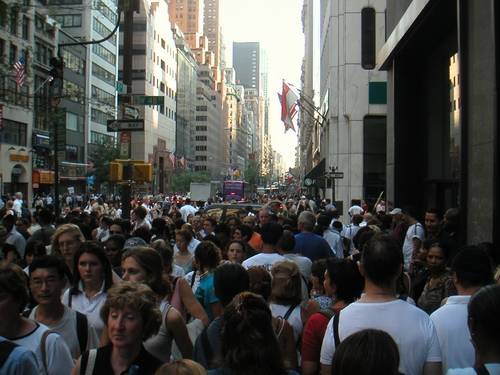
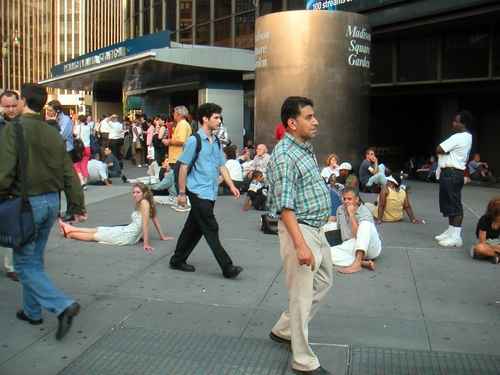
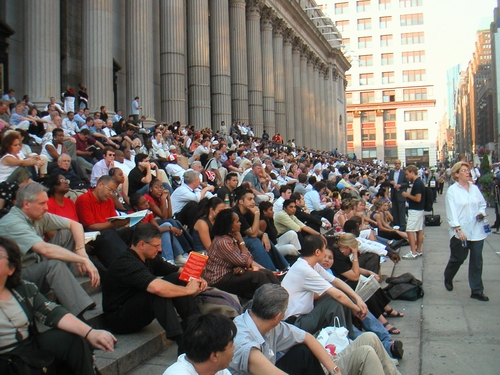
The images, from the top: 5th Avenue, Pennsylvania Station, Public Library steps across from the station
Posting will resume once Time Warner Cable/Road Runner deigns to get our cable modem running again. 24 hours after Chelsea (the last neighborhood in the city, yes) had its power restored, we have no cable.
Silipups reports the conclusion of a certain research study.
Follow-up on my August 2 Harvey Milk High School post
The big guns are still turned on the modest little New York high school which operates as a shelter for kids who really, really need it, and some on the assault team are homosexual.
The media's special tizzy includes this week's New York "Intelligencer" page, where 5 out homos are asked what they think about New York City's plan to expand its queer high school. Four of the interviewees just don't seem to quite get it, and they include Frank DeCaro, Andrew Solomon, Mistress Formica and Emil Wilbekin. Harvey Milk High may not have been necessary for them, and for the same reason Harvey Milk High probably wouldn't have enrolled them anyway.
Harvey Fierstein understands the stakes. First he replies to the question, "Were you out in high school?"
"At 13. I went to Art and Design. There was a boy named Pablo who used to breast-feed his baby doll in English class. I was hardly the most outrageous kid in school."When asked if he wishes he had gone to a gay high school, he explains of course that his school was a special school, but he understands that even art can't protect all kids. "Is [a gay high school] a good idea now, in New York of all places?" Harvey:
"The schools almost twenty years old! They wouldnt be expanding it if they couldnt say, 'Shit, this works.' This is not for all gay kids. Its for 14-year-old drag queens who get beaten up daily. Gay teenagers have the highest rate of suicide attempts, and because theyre smart, they very often do it successfully."For a pretty comprehensive outline of the issues at stake, see Michael Bronski's essay in the Boston Phoenix. I like his suggestion for an alternative solution to violence against queer kids in school:
Sending in the National Guard? Well, it was the last resort for integrating public schools in the South in 1950s.He articulates every argument against the policy of a separate school, but he still can't conclude that in the real world at this moment the kids could be safe without it.
The school is not the mistake; the mistake is that after almost 20 years we have done nothing to make it unnecessary.
"Peaking too soon?"
Gary Trudeau had Mark on the phone to Iraq yesterday.
Are we "supporting our troops," or are we afraid to admit that our government is one of idiots and spoilers, and that we personally share in that idiocy, but without sharing the spoils? Can we close our eyes forever?
Can a government which clearly doesn't know what it's doing long survive, at least if the people notice?
The issue of soldiers' tours [of duty] has been contentious, with troops and their families posting missives on the Internet criticizing the their government for keeping them in Iraq.No, not too soon, and maybe not too late.Some express concern about "mission creep," in which what begins as a swift war turns into a long-term occupation that could cause heavy American casualties as Iraqis become more and more skeptical of U.S. promises to let them govern themselves.
Is our current philosophy of government killing our troops and abusing Iraq? Paul Krugman says the mess in Iraq isn't just about poor planning and mismanagement.
The Bush administration's mixture of penny-pinching and privatization (both pursued for reasons of ideology and profit) is more than just an embarassment for our military, for our government and for ourselves. In fact it's become absolutely fatal for many.
In general, the "support our troops" crowd draws the line when that support might actually cost something.Troops in Iraq are still subsisting on M.R.E.'s, "the dreaded meals ready to eat," in Krugman's words, and there are serious shortages of water in the field.The usually conservative Army Times has run blistering editorials on this subject. Its June 30 blast, titled "Nothing but Lip Service," begins: "In recent months, President Bush and the Republican-controlled Congress have missed no opportunity to heap richly deserved praise on the military. But talk is cheap and getting cheaper by the day, judging from the nickel-and-dime treatment the troops are getting lately." The article goes on to detail a series of promises broken and benefits cut.
An American soldier died of heat stroke on Saturday; are poor supply and living conditions one reason why U.S. troops in Iraq are suffering such a high rate of noncombat deaths?We're not willing to pay what we must to support our fighting forces, but the greater scandal may be that the money being paid to corporations, in a shift of many tasks traditionally performed by soldiers, is money that is being wasted, and costing lives.
According to the Newhouse News Service, "U.S. troops in Iraq suffered through months of unnecessarily poor living conditions because some civilian contractors hired by the Army for logistics support failed to show up." Not surprisingly, civilian contractors and their insurance companies get spooked by war zones. The Financial Times reports that the dismal performance of contractors in Iraq has raised strong concerns about what would happen in a war against a serious opponent, like North Korea.Even the enormous and essential task of rebuilding what we have destroyed in Iraq is being compromised in the name of ideology and patronage.
In Iraq, reports The Baltimore Sun, "the Bush administration continues to use American corporations to perform work that United Nations agencies and nonprofit aid groups can do more cheaply."The bizarre experiment which we refer to as the current administration in Washington is sustained only at enormous human and material expense - ours and Iraq's.
The 2003 Ford ITU New York City World Cup Duathlon [sic], a "dry-tri," because of the polluting effect of recent perpetual heavy rainfall in Manhattan, was staged completely within Central Park on Sunday, incidently making it easier on the spectator, and especially the spectator's eye. Who's designing the boys' and girls' costumes?

We [heart] Spain! Ivan Rana (Esp), described before the race as a favorite, came in eighth in the men's. Well, he's probably still a "favorite" for lots of us.
Pip Taylor (Aus) was second in the women's.
Hot, but except for the wonderful ribbons, the costume just can't compete with Ivan's.
Students celebrate with Hines after a tap class of the Broadway Theatre Project in Tampa.
Gregory Hines died on Saturday night.
He was a good man, a beautiful man, a dancer, a New Yorker, a singer, an actor, and always a generous teacher for younger tap-dancers.
The last time we saw him was in the audience at LaMama a year and a half ago. We were all there for Thaddeus Phillips, a friend of ours who uses a gentle, timeless tap (in combination with incredible, abstract or improvised puppetry) in his own brilliant theatre pieces, to extraordinary effect.
Hines was obviously waiting after the performance to talk to him, so we spoke to Thaddeus only very briefly. It was a wonderful meeting of creative styles, and I sure wish we could have eavesdropped that night.
[image by Clint Krause]
Storied John Weir ( "The Irreversible Decline of Eddie Socket" author, CBS terrorist, elusive man about town, beloved professor) has been watching Television. Well, maybe it's less like pay-per-view than view-per-pay, since his account of what he has been seeing ran under his own byline in the NYTimes on Sunday.
Professor John has been watching "Queer Eye for the Straight Guy," but he has his own reading of both the amazing current popular flowering of queer sensibility, and the popular sense of queer powers which accompanies it. He thinks it's something of a misreading of reality, and something less than the straight guy's envy of a putative higher aesthetic way out of his reach.
I think John has adopted a French deductive approach in his analysis of the queer aestetic, something like, "It doesn't fit with my experience therefore it must not be true." John tells us that it's his experience that queers do not have an "eye" - or at least that they don't let it fashion their own appearance or manner, and especially not that of their personal environment.
If this is reality TV, why aren't the straight guys hostile and punctilious and the gay men sloppy and depressed? "All the gay men I know are terrible slobs, including you," my mother told me, when she called to discuss the show. "Do you think you could get them to clean up your apartment?" Indeed, the show insists on reinforcing the stereotype that gay guys are groomed and charming and slender and witty, and no more than 35 years old. Yet here I sit in my Megadeth T-shirt, dirt broke, middle-aged, downing a carton of vanilla ice cream and spilling it on my computer keyboard.Well, his proposition is at least worth an entertaining argument, and John is more than equal to that, but his take on why straight guys are willing to listen to queer style coaches is even more intriguing. He says the new "reality" TV show flatters heterosexual men by putting them where they already are, at the center of the action.Some gay men dress down to look "street," but I'm not a chic slob, I'm a real one. My apartment is designed like a bowling alley, with the furniture pushed against the walls, except where it can be used to cover carpet stains.
In the meantime, is "Queer Eye for the Straight Guy" creating a new "common ground" where gay men and straight men can bond? No doubt it is, for some people in particular, for television executives and advertisers impressed with the show's ratings. To me, however, the most touching aspect of the show is its plain proof that all men, straight or gay, yearn to be praised by a guy.Oh John, we miss you. Now where's the new book, dad?. . . .
Anybody with a father has learned how difficult it can sometimes be to get a man to pay attention to you. The subversive charge of "Queer Eye for the Straight Guy" may not be its homo/hetero get-together, but its demonstration that all men want contact with other men. Of course, you can learn the same thing from a hockey game.
Still, I think of the show's grooming guru, Kyan, asking his [straight guy] buddy Adam if anyone had ever taught him how to shave, and Adam's mumbled reply, "No, unh-unh, no."
In that moment, it seemed like five gay dads had been beamed down to planet Earth to give men what they really want: a father who's not afraid to pat your head and say, "Atta boy."
[image by Chris Gash, NYTimes]
WWII pilots
All day long, after posting the item below, "their flesh . . . revives," Ive been thinking about WW2. I have to admit that it's not dead to me. I actually remember it.
No, not exactly as a combatant. Even though I was in love with my two dashing and much older flyboy cousins, in the end the hunks wouldnt let a pre-schooler sign up and fly off to the Pacific with them. And then the war ended, and so did their uniform grace and their frequent visits. Those later war years and the immediate postwar years were to be the last time I was interested in military service except eventually as the very special friend of other soldiers and sailors.
But I do remember the war. There was the threat from Germans (strange, I dont remember Nazis) and Japs (sorry). There was rationing, car fan belts constantly needing mending (rubber, like our very pampered tires), white margarine. There were paper pennies, care packages from the farms in Wisconsin, certain big news stories. We loved spam (the old kind), and plane spotting (maybe less as a serious occupation than as a hobby) and dealing with the heavy blackout curtains was very exciting (blackout curtains were going to save us from Axis bombers yes, in Detroit!), and finally VE and VJ days. I dont remember any atom bombs until much later, but my parents were always pretty good at keeping other bad stuff from us like prejudice - and bless them both.
Still, one of my strongest and earliest memories is of peeing in glee and excitement on the chest of my knockout-handsome cousin Dick, while he was upright bathing the infant me during one of his frequent visits from Selfridge Field. It was very exciting. I also recall he was as genuinely sweet as he was hot.
Mother had gone out and put the big guy in charge for the afternoon. I dont remember the baths she gave me. I also cant remember where Dad was that day, but I do remember he and these two nephews were very close so long as he lived. They all loved each other very much. They were certainly all charmers and they made everyone around them very happy - or so I remember it.
Omigosh, James is asking for money now. No I'm not! I think the story in this post is important by itself, especially if you have been following Steve's reports from Palestine regularly included on this blog since last summer. However, if you do have any spare funds they would abviously be very useful in saving one good family in the occupied West Bank, and they might even help to establish a precedent which could help others.
The entire segment below is from Steve, but in fact his own words are only in the introduction to the letter from Tracie.
Folks,I hope you can help out in the case of Nasser Quzmar. Please read Tracie's letter below, and let me know if you have any questions.
Steve
Dear Friends,
I am writing on behalf of a man by the name of Nasser Quzmar. Nasser is a 32 year old Palestinian man who is a farmer in the village of Izbat Salman in the Qalqilya District of The West Bank, Palestine. Izbat Salman is a village of 690 people on 4,800 dunums of land (1 dunum = 1/4 acre). Of these 4,800 dumuns, 4,000 have been isolated or bulldozed for the wall. Last September, on our tour of the villages, Nasser was one of the farmers whose story we were told. His greenhouses were slated for destruction and his land for confiscation. Of course, his families' source of income historically has come from agriculture. Nasser is the breadwinner for a family of six. Their ages range from 2 months to 8 years old. Once a farmer with 27 dunums of cultivated lands of olive, citrus and vegetables, as well as greenhouses, he has lost almost everything due to the wall surrounding his village.All the papers, documents and evidence that Nasser collected to demonstrate his ownership of the land would not spare him and his community from the devastation. He filed legal complaints through a law office that deals with a number of cases about the wall. The clearest response he got was the arrival of bulldozers to his land. Another response he got was imprisonment. In the middle of the night, approximately 2 months ago, the Israeli Defense Forces entered the home of Nasser and took him away. At the time of his arrest, Nasser's wife was 9 months pregnant.
He has not been charged with anything. Nor has his wife been able to communicate with him since his imprisonment. Nasser was not involved in any political act at the time of his arrest, nor has he ever been. One can only surmise that it was due to his legal complaints and documentation that he may have become a target. He is a simple farmer who carries on the tradition in his family. In the eyes of the IDF, he defied them by continuing to work on his land. It has become increasingly difficult for the family to subsist with Nasser out of the home. It is possible that he will be in prison for years. In the words of Nasser Quzmar, "I never imagined that I would helplessly watch as my land was destroyed."
Nasser was formally arrested today after two months in administrative detention. He will be charged on Thursday, and it is likely that the charges will attempt to link him to terrorism. One of the ways that the Israeli government tries to quell non-violent resitance is to lump those resisters together with armed groups. This, we believe, is what is happening to Nasser.
Of course, there are many stories like this throughout the Occupied Territories of Palestine. Because this is a family who graciously accepted us into their home on two occasions, we feel a special connection and a duty to do what we can to offer assistance. The family is not in a position to pay for legal services. We have been able to lcoate an excellent attorney who is willing to represent Nasser. He is an Israeli Lawyer by the name of Shamai Liebowitz (do we want to put this in the letter?). The cost for his services is NIS 5000 (approximately $1180 US dollars).
We are asking for people to make contributions to the legal fund for Nasser Quzmar. Any money that is raised beyond the NIS 5000 will go to the ISM legal fund. Because our goal is to get Nasser back to his family as soon as possible, we are asking for people to donate today. We ask that you consider sending a check for $100, although any offering will be most appreciated! You can make checks payable to Gabriel Ash and write "Nasser Quzmar" in the memo section of the check. Gabriel is an activist with SUSTAIN who is with us in Palestine and will put the money up now to be paid back through your generous donations. Please send your donations to:Jews Against the Occupation
Prince Street Station
PO BOX 494
New York, NY 10012Please send an email to Tracie at [email protected] with the amount you are donating so we can keep track while here in Palestine.
Thank you for your assistance and on behalf of the Quzmar family, I thank you.Sincerely,
Tracie De Angelis
NOR CAL ISM
From The Occupied Territories
West Bank, Palestine
01197267723326 (from the states)
Frank Templeton Prince
A soldier and a poet died on Thursday.
In 1942 he wrote what some say is the greatest poem of a great war, not the Great War, but the one which seems to have been strangely niggard in inspiring great verse. It was a war which is now almost dead to us all, having been succeeded by so many unnecessary imitators which have perhaps been even more successful in killing poets.
An interesting man, and an interesting poem.
SOLDIERS BATHING
The sea at evening moves across the sand.
Under a reddening sky I watch the freedom of a band
Of soldiers who belong to me. Stripped bare
For bathing in the sea, they shout and run in the warm air;
Their flesh, worn by the trade of war, revives
And my mind towards the meaning of it strives.All's pathos now. The body that was gross
Rank, ravenous, disgusting in the act or in repose,
All fever, filth and sweat, its bestial strength
And bestial decay, by pain and labour grows at length
Fragile and luminous. 'Poor bare forked animal,'
Conscious of his desires, and needs and flesh that rise and fall
Stands in the soft air, tasting after toil
The sweetness of his nakedness: letting the sea-waves coil
Their frothy tongues about his feet, forgets
His hatred of the war, its terrible pressure that begets
A machinery of death and slavery,
Each being a slave and making slaves of others: finds that he
Remembers his old freedom in a game,
Mocking himself, and comically mimics fear and shame.He plays with death and animality;
And reading in the shadows of his pallid flesh, I see
The idea of Michelangelo's cartoon
Of soldiers battling, breaking off before they were half done
At some sortie of the enemy, an episode
Of the Pisan wars with Florence. I remember how he showed
Their muscular limbs that clamber from the water,
And heads that turn across the shoulder, eager for the slaughter,
Forgetful of their bodies that are bare,
And hot to buckle on and use the weapons lying there.
- And I think too of the theme another found
When, shadowing men's bodies on a sinister red ground,
Another Florentine, Pollaiuolo,
Painted a naked battle: warriors, straddled, hacked the foe,
Dug their bare toes into the ground and slew
The brother-naked man who lay between their feet and drew
His lips back from his teeth in a grimace.They were Italians who knew war's sorrow and disgrace
And showed the thing suspended, stripped: a theme
Born out of the experience of war's horrible extreme
Beneath a sky where even the air flows
With lacrimae Christi. For that nice, that bitterness, those blows,
That hatred of the slain, what could they be
But indirectly or directly a commentary
On the Crucifixion? And the picture burns
With indignation and pity and despair by turns,
Because it is the obverse of the scene
Where Christ hangs murdered, stripped, upon the Cross. I mean,
That is the explanation of its rage.And we too have our bitterness and pity that engage
Blood, spirit, in this war. But night begins,
Night of the mind: who nowadays is conscious of our sins?
Though every human deed concerns our blood,
And even we must know, what nobody has understood,
That some great love is over all we do,
And that is what has driven us to this fury, for so few
Can suffer all the terror of that love:
The terror of that love has set us spinning in this groove
Greased with our blood.These dry themselves and dress,
Combing their hair, and lose the fear and shame of nakedness.
Because to love is frightening we prefer
The freedom of our crimes. Yet, as I drink the dusky air,
I feel a strange delight that fills me full,
Strange gratitude as if evil itself were beautiful,
And kiss the wound in thought, while in the west
I watch a streak of red that might have issued from Christ's breast.
F. T. Prince
Collected Poems 1935-1992
(Manchester: Carcanet Press, 1993)
Well, maybe you had to be there. The Guardian comments on the aspect of the poem which most grates on modern ears, and relates its parochial imagery to what are its clearly homoerotic elements.
The poem culminates in a powerful, yet ambivalent, evocation of the naked Christ on the cross, the blood issuing from his wound being somehow as lovely as the sunset. Throughout the poem, the unassailable force of weaponry is contrasted with the vulnerability of the naked body.But then ends its obituary with some words of comfort on the subject of this family man's religiosity.
A devout Catholic convert, he nevertheless believed that literature could "emancipate one from oneself", and confessed that he had become irritated [while teaching] in Jamaica at having to contend with students who would only read books written from a religious point of view.
___________________
Note to all noble guardians of literary standards: Each of the two sources to which I referred for the complete text of the poem had its own typographical problems, including errant words, spellings and punctuation. I've examined both to complete the text I show above; I hope it's some improvement.
[image from University of Southampton]
The body count, or "Reported civilian deaths resulting from the US-led military action against Iraq in 2003," via Silipups.
As of today:MINIMUM
Total of civilians reported killed: 6087MAXIMUM
Total of civilians reported killed: 7798
Antifolk Festival, August 19-26
Let's respect the history and launch the future of the East Village, LOISAIDA, Village, or whatever our nicknames have been for New York's most dynamic cultural engine. HOWL!, The "1st Annual Festival of East Village Arts," begins August 20.
While it sure ain't just about Wigstock, we're ecstatic to see the Lady Bunny return three days later - all the way to her roots, to Tompkins Square Park, as part of this new Festival.
All hail the mission statement of the HOWL! organizers, FEVA:
Mission StatementWe're gonna get art (by genuine artists and other genuine people), a poetry festival (free in every way), a film festival (no awards! no awards!), EV homie Charlie Parker (resurrected!), an Antifolk Festival (Dylan meets Sex Pistols), all the "Way the F**K Off-Broadway people (including, just for starters, Dirty Martini, Rev Jen, FACEBOY, PORNO JIM, The Bitter Poet, World Famous *BOB*) and a nutty everybody-loves-a East Village parade, "The Pantheon Processional," at the Astor Place Cube (honoring local luminaries from the past, present and future), and all of that just richness and culture goodness just scratches the surface.Founded in 2002, the Federation of East Village Artists honors the historic role of the East Village as the cradle of the citys, if not the worlds, counterculture. We stand on the shoulders of the gods and the ghosts that have come before us, committed to preserve our unique history and to create opportunities for the next generation of visionaries to flourish. The neighborhood that has spawned the Living Theater and Independent Film, been home to poets from Auden to Pinero, to musicians from Charlie Parker to The Ramones, blank canvas for Haring and sanctuary for Basquiat, long-time stomping ground for generation after generation of beatniks, hippies, yippies and punks, cannot go the way of the dodo bird. FEVA will fight for the rights of local artists for health insurance, professional services and affordable housing. FEVA will provide an emergency relief fund for those in need, will connect local artists with local schools, will bring public art to our gardens and to our streets. FEVA will also create a Smithsonian of the Counterculture, a combination archive, museum, performance space and gallery to preserve our rich past and inspire the artists of the future. Artists are a natural resource, precious as light, air and water and just as crucial to the citys economic and spiritual environment. FEVA will advocate on behalf of this great community of experimenters and iconoclasts, to insure that its existence is not imperiled and that the legacies of Emma Goldman, of The Fugs, of Allen Ginsberg endure for generations to come.
This delightful extravaganza seems to be virtually an entirely volunteer-staffed labor of love for the people behind it - as in "I've got an idea, let's put on a show!" This downtown knows how.
Also, while it's very nice to memorialize the past, this thing is at least as much about the future. It better be, because without a howling future the entire Village will end up being about nothing more than real estate.
We gotta go. August. What the hell did we eschew that country place for, anyway? What country place? What country?
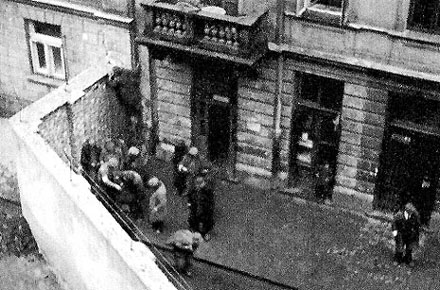
Warsaw, 1940's
"Does this remind you of anything?" [the text of a sign held, while standing on the scoop of a frontloader, by one of several dozen youg Israeli peace activists trying yesterday to obstruct the construction of the Apartheid Wall at Mas'ha]
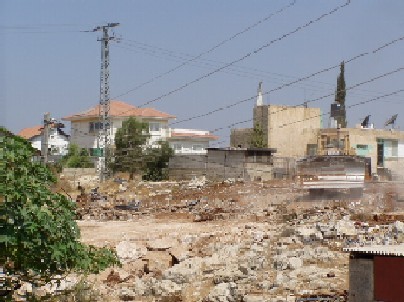
Palestine, 2000's
The [new, white] houses in the background are in
the illegal Israeli settlement of Elkana. The house
in the middle ground is the house to be isolated by
the Apartheid Wall. And the bulldozer in the
foreground has just demolished the family's hen house
to make room for the Wall. [from Steve's text below]
Steve has been in Qalqilya, Jayyous, Mas'ha and Tel Aviv. The letter is very long, but it's not dull, you won't read anything like it in the media, and it absolutely must be recorded as witness to the horror we and our Israeli instruments visit on Palestinians every day.
The report itself [followed by Steves attachment of an Israeli Peace groups media alert about an action tonight, which includes an eyewitness account of an Israeli raid of a Palestinian camp near Nablus]:
Jayyous August 5, 2003
I was sad to leave Qalqilya yesterday. The checkpoint
was the usual humiliating experience. The border
guard didn't know that I could understand the abusive
things he was shouting at me in Hebrew and Arabic as
he demanded to inspect my backpack. Sometimes
internationals are spared the abuse. Palestinians
never are. Then I had to quickly jump into an illegal
taxi to take me to my new home. The Israeli
government policy seems to be to criminalize any kind
of Palestinian movement, knowing full well that
Palestinians will still move, but painting a veneer of
"rule of law" onto military harassment of Palestinian
civilians.The next time I go to Qalqilya, we'll have to activate
the Underground Railroad that our local coordinators
and local volunteers have developed. Israelis
(whether Jewish or Palestinian) and internationals
just don't get through the checkpoint.As always, I had to change taxis at the roadblock at
the village of Azzun. A week earlier, on the way back
from the Jayyous action to bring supplies to the
trapped Bedouin family, we had watched soldiers and a
military bulldozer (Caterpillar, natch) pile more dirt
and boulders and concrete blocks onto the roadblock.
It's hard to describe how degrading the scene was. An
elderly taxi driver told me that tomorrow, vehicles
would be making their way around the roadblock
again.he said it was like Tom and Jerry. A soldier
told me to tell my friend (Ryan, who was passing
behind the bulldozer to photograph it) to be careful,
remember what happened to "that girl". He was
referring to Rachel Corrie. My blood ran cold. I
looked at him and said, "That wasn't an accident." He
shrugged.Jayyous is lovely, despite the ugly scar that runs
across its lands where the Apartheid Wall has been
built. Lately, Border Guards have been coming in at
night and shooting water tanks on people's roofs. My
landlord here, a local activist I'll call Saleh,
overheard them saying to each other, "shoot the white
ones [the hot water tanks], they're more expensive to
fix."Jayyous, population 6,000, is not connected to the
Israeli power grid. The illegal Israeli settlements
that surround it of course are connected to the grid.
Power here comes from a generator, is astoundingly
expensive, and is switched off every evening from
5:00-7:30 and every morning from 2:00-8:00. Cell
phone coverage is poor, it's hard to keep phones
charged with daily power outages, and the Internet
café is slow as molasses (when the power is on-no
Internet of course when the power is off). It's hard
to stay connected here.We watched the sunset over the olive groves. Jayyous
is on top of a hill, with a good view of its lands,
and of the densely populated coastal plain of Israel
beyond. Saleh, a mild-mannered and always polite
English teacher, told us that this was the spot from
which he used to throw rocks during the first
Intifada, because it was hard for the Israeli soldiers
to shoot kids from their position on the road below.We had dinner at the home of Abu Ali, leading Jayyous
activist. He is a farmer, and served us the most
amazing figs I've ever tasted. The best ones, he
explained, are the ones the birds have pecked at. I
ate one. It was so sweet, it made my teeth hurt.
(For the record, Jayyous mangoes are pretty tasty too.
I'm looking forward to the prickly pears and guava,
also in season.) Abu Ali just built a house for
himself and his wife; up to now, he spent all his
money sending his children to university, medical
school, and the like.Abu Ali camped out in front of Abu Mazen's office to
get him to start talking about the Apartheid Wall.
Today, he's meeting with President Arafat to demand a
number of services for Jayyous's beleaguered farmers.
All of Jayyous's spring-fed lands are on the "Israeli"
side of the wall (any one think that's an
coincidence?), and he wants the Palestinian Authority
to build pipes to bring that water to Jayyous's
rain-fed lands inside the Wall. Of course, the PA
can't go near a project like that without Israeli
cooperation.Early this morning, Israeli-American New York
Palestine activist Gabriel and I took an early taxi to
the village of Mas'ha, 5 kilometers east of the Green
Line (West Bank-Israel border). Mas'ha has been the
site of a peace camp for several months, a place where
Israelis, Palestinians, and internationals came
together in dialogue and shared rage about the
Apartheid Wall and the ever-expanding settlements it
"protects". Over the past days, it became clear that
the Apartheid Wall was going to run east of the
westernmost house in Mas'ha, trapping the family in
that house between the Apartheid Wall to the east and
the fence around Elkana settlement to the east. This
plan symbolizes to me the sheer brutality of the Wall
project; it exists only to serve the interests of
Jewish Israelis, and Palestinian people are just so
many obstacles in the way.Palestinian, Israeli and international non-violent
activists had gathered to prevent the continued
construction of the Wall at that point, and we had
word that the army was coming at 7 this morning to
clear them out. Gabriel and I were late because the
taxi we had booked stood us up, and by the time we
arrived 47 activists were in the custody of the Border
Police. They arrested everyone with a camera first,
followed by all the people who were sitting in the
path of the bulldozers, followed by the people who
showed up during the arrests and began filming. They
kicked people, and they dragged them by the hair.Most of the Israeli, and surprisingly, Palestinian
activists have been released, but about 40
internationals remain in custody at Ariel police
station (Ariel is an illegal Israeli settlement of
25,000 people, many of them Russian immigrants).
ISM's Freedom Summer will be decimated if they're all
deported.I stayed in Mas'ha about half the day, watching the
Israeli government's destruction. Check out the
attached photo: the houses in the background are in
the illegal Israeli settlement of Elkana. The house
in the middle ground is the house to be isolated by
the Apartheid Wall. And the bulldozer in the
foreground has just demolished the family's hen house
to make room for the Wall.I chatted with Mohammad, the owner of the house in
question. He is absolutely committed to staying in
his house, no matter how impossible the Israeli
government makes it for him. We waited hours for a
chance to get into the house to retrieve the backpacks
of the arrestees; the construction company's private
security tried to prevent us, shoving around some
fierce Israeli anarchists who showed up to help. We
got all the bags out eventually, and returned to
Jayyous. The future of Mohammad's family, or of the
Mas'ha peace camp, is unsure.Several of the Palestinian men I spoke with in Mas'ha
indicated the construction of the Wall going on and
said that Israel doesn't want peace. I hear that
often from Palestinians, at checkpoints, during
incursions, at scenes of destruction: Israel doesn't
want peace.Jayyous, Friday, August 08, 2003
In the wee hours of Wednesday morning, the activists
arrested at Mas'ha were released. The internationals
had the condition attached to their release that thet
not return to the West Bank; as far as I know, they're
still in Jerusalem. Of the three who were charged
with assault, the Israeli Jew was release after being
charged, the Italian was released on the condition
that she leave the country immediately, and Maher, the
Palestinian from Mas'ha, was kept in jail with a
hearing scheduled for 8 days later. 3 people, all
arrested in the same place at the same time doing the
same thing, all facing the same trumped up charge,
with 3 different sets of rules applied to them based
on who they are. This is Israeli apartheid.
Fortunately, intense pressure from ISM and from our
lawyers resulted in Maher's release yesterday
afternoon.I did Gate Watch on Wednesday morning with John, a
75-year old Englishman from Ecumenical Accompaniment.
We waited at the gate that allows Jayyous farmers to
pass through the Apartheid Wall to their lands. The
gate was the site of harassment and beatings by the
construction company's security guards prior to the
institution of Gate Watch, but is quiet now. Only a
few farmers passed through the gate, since it was
blocked by boulders placed there by the construction
company more than a week earlier, making passage with
anything more complex than a donkey cart impossible.Afterward, Gabriel and I rushed back to Mas'ha, on
word that Israeli activists were about to stage a
surprise action there. About 24 young Israeli Jews
arrived, held onto the scoop of a front loader, and
stood on a giant drill, forcing work to stop. They
then occupied the front loader. Their signs were all
in Hebrew, and said things like "Separation Wall=Land
Theft=Death", "This isn't a fence, it's a ghetto",
and, chillingly, "Does this remind you of anything?"
They chanted "No to the fence, no to transfer."A couple of settlers watched the scene from their roof
in Elkana, right next door. I wanted to yell at them,
"Aren't you ashamed? Look at what is being done so
you can have what you have!"I'm told that many of the people living in West Bank
settlements now are Russian immigrants. They arrive,
the Ministry of Absorption tells them, "You will live
in Ariel (Elkana, Shaarei Tikva, etc.), and voila!
Instant settlers.Had they been Palestinians, they would have been met
with live fire immediately. Had they been
internationals, they would have been quickly and
brutally arrested (Freedom Summer's campaign
coordinator). But as Israelis, they were permitted to
stay for a few hours, were then presented with an
official order of a Closed Military Area (how a
residential area can be a Closed Military Area I don't
understand), and then given 30 minutes to leave.
Finally, soldiers removed them, not gently, but
without apparent brutality, and they were bussed to
Ariel for arrest. Ragheb was arrested along with
them; he was inside the house that is going to be
isolated, photographing the scene for AP. He was
released that evening, and given a paper allowing his
return to Qalqilya (the checkpoint is closed at
night), but his photos were confiscated. The
government of Israel really doesn't want light shone
on what it's doing. The police on the scene tried to
arrest us for taking pictures, but we scrambled to the
Mas'ha side of the roadblock, which they were
unwilling to cross (jurisdictional issues, I think).While the Israeli demonstration was going on, some of
the men from Mas'ha, including the owner of the house,
got into a heated argument with the head of the
security staff on the scene and some of his men. The
security guy told the owner of the home, that he, the
Palestinian, belonged to the past, and that all he
cared about was money. Meanwhile, the owner of the
surveying firm was on the scene, fuming that work had
stopped, and dynamite went off behind us as the
construction company continued to clear land further
south.Gabriel and I proceeded to Tel Aviv, where Ady and
Nirit had organized a commemoration of An-Nakba, the
Palestinian Catastrophe of 1948, for the eve of the
Jewish Fast Day of Tisha B'Av. We took a bus that
wound through several illegal Israeli settlements,
each of them accessible through one gated entrance
with an armed guard, each of them transformed from the
arid landscape around them to lush irrigated suburbs,
each of them far more luxurious than most Jewish
residential areas inside the Green Line. One of them
was Shaarei Tikva, the settlement I had seen from the
outside suffocating the villages of Beit Amin and
Azzun Atme. From the inside, the development had been
designed in such a way that the adjacent villages were
invisible.In Tel Aviv, the commemoration went well, with a
number of Israeli activists participating and thanking
JAtO/NYC for taking the initiative. We lit yahrzeit
candles and arranged them to spell the number of
villages destroyed in 1948, and then we read the names
of all the villages. I stayed in Tel Aviv, because
one can't return to Jayyous at night.John reported from Gate Watch this morning that a path
had been opened up in the boulders at the gate (the
way had still been blocked when we took an American
visitor there yesterday afternoon), but that the gate
was closed for the first time. He was able to open
it; we'll see what develops in the days ahead.Jayyous, Saturday, August 9, 2003
Yesterday afternoon Abu Ali picked up Saleh (his
nephew, turns out), me, John, Gabriel and David for a
night on his farm. We were able to pass through the
gate on his tractor thanks to the small gap in the
boulders in the road. We noted however with alarm
that the gate now has a chain and a lock on it, ready
to be shut tight at the whim of the Border Guard or
the private security. My guess-the authorities will
wait until the international attention to the Wall
dissipates, and local Palestinian activists are
pacified by the fear that escalation will limit
access, and then they will start locking the gate from
time to time, perhaps more and more often, perhaps
demanding permission from farmers to be on their own
land as they already have started doing in nearby
Qalqilya.Abu Ali's farm is right next to a giant ugly quarry
gouged out of land confiscated for the settlement of
Tsufim on the hilltop above. The crater is surrounded
by signs in Hebrew that say "Danger, building here."
I changed one to "Destroying here." Abu Ali showed us
the blast holes that have been filled in by court
order when he sued about the damage they were doing to
his water tank right next door. He told us about his
8-year successful legal fight against the confiscation
of his farm. He told us about the soldier who put a
gun to his head to get him to stop planting during
that court fight, in front of his 8-year-old daughter,
and the counseling and medication she needed as a
result of the trauma.The night on the farm was lovely-our own 5000 star
hotel-and Abu Ali went out and picked up dinner and
breakfast (supplemented by his wife's homemade
goat-milk yogurt cheese). In the morning, we visited
a couple of other farms, and heard stories about
recent beatings of farmers at the gate at the
neighboring village of Falamiya. Farmers with cars or
trucks have been taking a big detour to use the
Falamiya Gate since they still can't pas through the
Jayyous Gate (the space in the boulders is only big
enough for a tractor). Tomorrow morning and
afternoon, we'll expand Gate Watch to Falamiya Gate,
and see what happens.We passed by one of the water pumps, whose operator
was targeted by the Israeli army and jailed without
charges for a 4 1/2 year term as part of the Israeli
government's economic war on Palestine. David showed
me where they installed a meter to make sure that on
only a certain amount of water is pumped each month,
while on the Jayyous lands across the Green Line that
were confiscated in 1948, cotton, among the thirstiest
of crops, is grown by the land's Jewish owners using
unlimited water from the same aquifer.Farmers are urging us to open the path to Jayyous
Gate, and John, 75-year-old British Quaker, is itching
to take a sledge hammer to those boulders. But Abu
Ali is urging us to wait, while he demands that the
Border Guard remove the boulders as promised.Abu Ali told me this morning that all international
solidarity activists add to the struggle, but that
Israelis are the most valuable, and foreign Jews the
second most valuable. He'll be pleased to learn that
a second Israeli is joining us tomorrow from the ISM
training.We had lunch back at Abu Ali's farm, and were joined
by 3 French and Swiss solidarity activists, as well as
a Swedish diplomat and some Palestinian activists.
Needless to say, lunch conversation was stimulating.Back up in the village, David's been telling me about
last month, when Border Guard were shooting at
children, threatening Saleh's life, and shooting up
water tanks as noted above. Things are quiet here
this week, but now that Israel has broken the cease
fire...Take a look at this media alert about a vigil tonight.
The vigil was called by one or more of the Israeli
peace groups, I believe, and the eyewitness account
is, I think, by an ISMer in Askar Camp, where I was
last year.Peace and rage,
Steve
The media alert and the eyewitness account:
Media Alert - Join UsWhat: A vigil to protest the recent invasion to Nablus
When: Tonight, Saturday, 18:00 o'clock
Where: In front of Ministry of Defense (Hakirya),Kaplan Street,
Tel Aviv
Early morning yesterday, the Israeli Military invaded the Askar
Refugee Camp in Nablus in a so-called "arrest" operation. During the invasion, four Palestinians were killed and two more are critically
wounded. "We didn't mean to shoot him, we just wanted to arrest him."Yes, we clearly understand that it takes seven tanks, three jeeps, a helicopter and dozens of soldiers to arrest one man.
The attack is yet another of Sharon's attempts to destroy the hudna and goad the Palestinians into another battle.
According to "Haaretz" even senior military officers admit that Hamas is not, right now, busy with preparing suicide attacks, but is complying with ceasefire plans.
The Sharon government is not interested in de-escalation or any sort of cease fire. He is interested in agitating for violence, so he can use it as a much-needed excuse to continue Israeli's illegal occupation and complete construction of the Apartheid Wall
Here's a description of what happened by an eyewitness who lives in Askar.
At 2:30 in the morning I heard a lot of people moving in the streets of the camp. Then I discovered that these people are soldiers or special forces after I heard some Hebrew words. 20 minutes later strong gunfire started, suddenly a lot of tanks, jeeps and one helicopter started to arrive to the area followed by a bulldozer.The gunfire continued. I started to hear the bombs from time to time, during all this time I didn't leave my bed. After 4:30, the jeeps started to impose the curfew. After that, I received a call from my father asking me to leave my place and to join the family.
His fears were: in case the army started to search from house to house, having me by myself in the house would give them the chance to do what ever they want to me, as we do have long list of people who been beaten by the occupation forces taking the chances that no witnesses around. I joined my family went up to the roof to have a clear vision about what's going on, the gunfire, bombs continued, then I heard strong bombing followed with a lot of smoke.
After calling the neighbors to figure out what's happening, I had been told that the house of the Dwaikat family was shelled by tanks, and they destroyed the fourth and the third floor. The jeeps kept driving the streets imposing the curfew. By six in the morning, the people started to break the curfew going out to the streets. Then confrontations started between the kids, youth, men, women, and the Army, and the army opened fire using live ammunition for the purpose of killing us.
Around 10:00 am I heard huge bombing. Then it was clear that they bombed the entire building. The confrontations kept going on, and the bulldozer started to work to be sure that no one was still alive after bombing the building.
Around 11:30 am, the army left the camp. It was very clear there was no need for releasing the curfew as everybody was outside. I went out to see the area where the operation happened. We been told that the army took the body of the martyr Khamis abu Salim, 22 years old, whilst the people were trying to get some stuff out from under the destroyed house, they found the body of the martyr Fayez Al Sadar 28 years old.
All the people carried him on their shoulders toward the ambulance, everybody went home preparing himself for next day demonstration for the two martyrs. 3 hours later, 2 of the 9 who were injured in the confrontations died; Fawzi Al Alami 45 years old, and Mohammad al Tek 17 years old, and by this new news everybody started to re calculate tomorrows demonstration with four bodies instead of two!
Join us tonight. We have to stop the occupation and the murder.
"More Zealous than the Pope."
He's head of the Vatican's "Holy Inquisition" [modern, formal name: "Congregation for the Doctrine of the Faith], and he's described as personally charming.
The man who wrote last week's Vatican document ruling out same-sex marriage is a soft-spoken Bavarian who was once a liberal but has served as Pope John Paul II's ultra-conservative guardian of Catholic doctrine for more than 20 years.The former Hitler Youth member and Wehrmacht draftee was shocked by the reforms of Vatican II. The Australian site [news.com.au] linked above reports that he condemns Buddhism, Hinduism and other Eastern religions as offering false hope through "auto-erotic spirituality," that he insists the media exaggerates the extent of the American pedophilia scandals and that he's pushing for a return to the Latin Mass.Cardinal Joseph Ratzinger has been at the Pope's side as head of the Congregation for the Doctrine of the Faith for so long he has been nicknamed "The Enforcer" or the "Panzerkardinal".
Cardinal Ratzinger is regarded as the second most powerful man in the Church. [oddly, his nicknames immediately suggest the next governor of California and himself soon one of the most powerful men in American]
If anything, he is even more zealous than the Pope, whom he meets every Friday evening, in laying down the law on social or sexual mores.One joke told in the Vatican has Cardinal Ratzinger arriving in heaven with the church dissidents he has suppressed. The dissenters emerge after meeting God, crying: "How could I have been so wrong?" Then Cardinal Ratzinger goes in to meet the Almighty, there is also wailing and gnashing of teeth -- and God emerges, crying: "How could I have been so wrong?"
Well-informed queers have known about Rat for over 10 years. In 1992, during a period of particularly virulent antigay violence in the U.S., he authorized a Vatican proclamation which said that that when lesbians and gay men demand civil rights, "neither the Church nor society should be surprised when ... irrational and violent reactions increase"
Swell guy.
Ratzinger will preside over the Conclave which elects the next Catholic autocrat when Wojtyla kicks.
Off to the 17th century - in a hand basket!
The New York Police Department has been slapped for its "operational ignorance" and its threat to constitutional rights.
Charging he had lost confidence in the NYPD's methods of investigating political activity, a federal judge yesterday restored limits on the department that he had lifted only five months ago.Remarkably, the NYPD seems to believe nothing has really changed in the guidelines they must observe.[In February the judge had agreed to ease the rules restraining police surveillance and interrogation excesses out of concern about heightened threats to security. The original rules have come to be known as the Handschu agreement. Handschu was the first listed plaintiff in a 1971 lawsuit which succesfully charged that the Police Department's so-called Red Squad harassed political advocacy groups.]
Blasting the department at its highest levels, Senior U.S. District Judge Charles Haight reversed his March ruling in which he had accepted the Police Department's assertion that terrorism concerns justified an easing of the restrictions.
Haight said he changed his mind after the disclosure that on Feb. 15 the police had arrested 274 people protesting the war in Iraq and questioned them about their political beliefs, entering their responses on what the department called a "demonstration debriefing" form.
At a news conference yesterday, [Police Commissioner Ray] Kelly said that Haight's ruling would "not change any modification made by the judge ... For me, the important thing is the modification ... continues to stand."Neither the Newsday story nor the NYTimes account leave us with any clear understanding of the impact of the judge's ruling yesterday.Chris Dunn of the New York Civil Liberties Union said of Kelly's statement, "I don't know what the commissioner means since the judge clearly ordered that new restrictions will be added to the court order governing the department's surveillance."
The judge's ruling did not specify what restrictions would be imposed in initiating a probe.
Yesterday, Judge Haight did not impose new restrictions on the police in the wake of the interrogations, which first came to light after the New York Civil Liberties Union received complaints from protesters. Nor did the judge decide the issue of whether the interrogations violated the protesters' constitutional rights.But he said he would formally incorporate the recently eased rules into a judicial decree, to make clear that lawyers could return to court and seek to hold the city in contempt if they believed that a violation of the rules also violated an individual's constitutional rights. [from the Times]
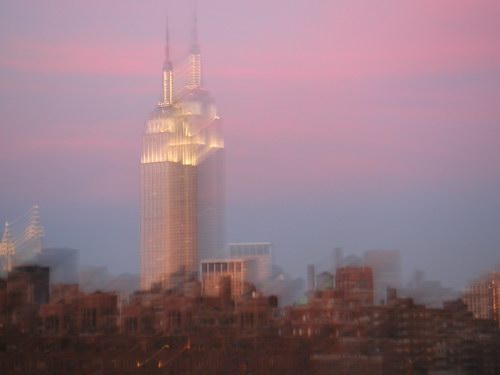
The spooky Empire State thing rising above old Chelsea tonight
[YOU DON'T WANT A PICTURE HERE]
Maybe she's finally beginning to rot.
Some of the world's media this week is carrying the story about a festival in Calcutta celebrating Mother Teresa's imminent beatification. Calcutta, or Kolkata, as it is now known officially, is the city which made the Albanian-born Agnes Gonxha Bojaxhiu a star. The news is that the Catholic Church was very upset that organizers had decided to include 2 films which her cult found objectionable.
"In the Name of God's Poor," a puff-piece dramatization, is based on a book by French author Dominique Lapierre [also wrote "City of Joy"]. It is opposed by the order, the Missionaries of Charity, for reasons not clearly explained. What we do know from a New Delhi daily is that the nuns insist Teresa, on whose life the film is based, did not approve of the script. Huh? Actually, the film sounds like it would be pretty boring for everyone.
At least "The Song of Bernadette" had moments of rapture to look back on. But "Mother Teresa" is flat. It's as if the reverberations she set off fell on deaf ears, and the poorest of the poor were still left wanting.The other film, "Hell's Angel" is a documentary based on Christopher Hitchens's book "The Missionary Position: Mother Teresa in Theory and Practice." Some of us are already familiar with the reasons why such a film would be a problem for the order and for all the people and institutions that have so heavily invested in the Teresan cult. Even Australia's Catholic News admits Hitchens is well known as a strong critic of Mother Teresa with his claims that her reputation for sanctity was a front.
The section of the NYTimes review shown on Amazon reads:
Like all good pamphlets, The Missionary Position . . . is very short, zealously overwritten, and rails wildly in defense of an almost nonsensical proposition: that Mother Teresa of Calcutta is actually not a saint but an evil and selfish old woman. And Mr. Hitchens . . . is rather convincing. His main beef is that Teresa . . . has consorted with despots and white-collar criminals and gained millions of tax-free dollars, while the residents of her famous Calcutta clinic are still forced to confront their mortality with inadequate care. Ultimately, he argues, Mother Teresa is less interested in helping the poor than in using them as an indefatigable source of wretchedness on which to fuel the expansion of her fundamentalist Roman Catholic beliefs. Hitchens argues his case with consummate style.I find it very interesting that the Archbishop of Calcutta, who saw them in a private screening in his home, is reported in the Hindustan Times article cited above to have said said he found no reason to object to the films being included.
The anti-Teresan's arguments? I'll offer these for a start:
The Mother promoted promoting a strain of religion reactionary even when compared to the Vatican's most conservative parties.She objected to artificial birth control despite the serious problems caused in India and elsewhere by overpopulation.
She constantly condemned abortion as a "the greatest destroyer of peace."
She said it is better for women to be "handmaids of the Lord" than to become priests.
She accepted contributions from unclean sources, and without questioning them, including huge sums from Haitian dictator Jean-Claude Duvalier. In 1992, she wrote to the U.S. judge presiding over the trial of Charles Keating, who had donated $1.25 million to her order, telling him that the central figure in the U.S. savings and loan scandals "has always been kind and generous to God's poor."
No aspirin. The [sometimes incendiary, but solid with basic Teresa facts] writer on The Konformist site, to which I owe this post's title, contributes,
Despite this money, her missionaries were noticeably frugal... at least as far as it concerns those who needed it. When one volunteer questioned why no pain-killing drugs were supplied to those who visited, the response shot back, "This is not a treatment center. This is a place where the dying can die with dignity." Even in a notably impoverished area as Calcutta, those who visited with any knowledge of normal treatment standards knew that Mother T's home was seriously lacking.We should all have been noticing for years that whenever she herself was ill, the Mother stayed in modern hospitals, not her own hovels with their racks of the sick.Of course, when she required her own medical care, only the best would do. In public, she declined a 1984 offer for free cataract surgery from the St Francis Medical Center, worth $5,000. But the following year, she quietly received the same treatment at St. Vincent's Hospital in New York. Not to mention visits to the Scripps Clinic and the Gemelli Hospital, and numerous visits for cardiac care at the Birla Heart Institute in Calcutta. At some point she got a pacemaker installed.No bread for the unconverted. She was only concerned about stacking up "souls" in heaven, not helping bodies on earth, and it was all for her own honor and glory, here and in an imagined hereafter, and not just for the honor and glory of her god. One who saw it long ago writes:. . . .
In the April 1996 issue of Ladies Home Journal M.T. disclosed that she wished to finish her life in one of her own Houses of the Dying, just like those poor people she attended to. But when she died the following year, she was in her private bedroom, surrounded by modern cardiac machinery.
Back in the late 1970s I recall watching a PBS documentary the Spanish language channel. It documented Mama T's trip to Central America after the terrible earthquake that devastated either Guatemala or Nicaragua- I believe the latter. While pretty much standard doc there was 1 thing which burned itself in to my mind - scene where Mama T was in an Indian hospital. She, literally, had some pieces of plain bread that she teased the bloated bellies of starving children with. However, she did not feed all the children - only those who would recite Catholic vespers with her. Those Hindu Moslem children who refused were not given any bread. Yes, Mama T almost surreally - would not feed those children who would not prostitute the beliefs of their conscience. This was where I 1st learned - visually & viscerally - why Missionism & proselytizing were so fundamentally wrong. What is incredible, to me, was how this documentary has apparently fallen to the nether-regions of public consciousness. A few months later, Mama T won her Nobel Peace Prize.Remember "Pagan Babies"? Later the writer excerpted above offers an explanation for the perverse character of this scary nun's life work:"Well, the answer to that is simple, as Christopher Hitchens said, Mama T's mission is 'the promulgation of a cult based on death and suffering and subjection.'"In her own words, "I think it is very beautiful for the poor to accept their lot . . . I think the world is being much helped by the suffering of the poor people."I'll close with just two of the blurbs from the back of Hitchen's little book.
"A dirty job but someone had to do it. By the end of this elegantly written, brilliantly argued piece of polemic, it is not looking good for Mother Teresa." - Sunday Times (London)"Hilariously Mean" - John Waters

Jessie, a smart Blogger acquaintance of ours, needs help with new swim goggles.
My crappy Speedo swim goggles broke. So i taped them for this super hot goggle photo. And these less than hot goggle animations - 256-color, 16-color, 4-color.Make sure you click onto one of the 3 animation choices on his post.Any brand/model recommendations? I like blue. And things that don't break.
He's right.
THE "SUMMER OF HTML TOUR!!!!!!!!!!

I don't think I could begin to do justice to yesterday's events at the courageous Team Gallery with any written description, so I'm going to cop out altogether and leave it to a few pictures, which at least have the value of their uniqueness. If they're a bit pretty, it's a very good, and an appropriate-to-the-subject thing. What they can't do is register the energy in the dark Team rooms last night.
Actually we were there for little more than the set of Jamie Arcangel and the Arcangels, and their earlier incarnation, Insectiside, so I couldn't speak to the remainder of the schedule in any event.
The "Throwback" show installations in the gallery, by Cory Arcangel & Beige, Maria Marshall, Jon Routson, and the almost-free take-homes (genuine art as tees, music, posters, prints, books), were exciting, seductive and really, really beautiful. The music was dynamite ("nuclear" just doesn't seem right these days)!
For more on Cory himself, see Tom Moody.
The images, from the top: "Super Mario Clouds v2k3" and admirers, crowd in the passage, Cory's instrument(s), Conyers and Barry, dance floor, interactive facility.
It was great to see some overlap in the fans at Team and those we saw on the Williamsburg shore 8 days earlier. Because of run-ins in Chelsea and elsewhere, we already knew she was big on emerging visual artists, but the performer in the last two images above was also one of several people we saw who had made it to Chunkathalon.
"J. Lo and Affleck Finally Get Some Privacy," is the headline the NYTimes uses in an illustrated business (media) section article today.
The story of Jennifer Lopez and Ben Affleck, glamorous movie stars whose love affair blossomed on a Hollywood set, has turned into the summer's most watched romance. The movie they made, however, has had no such luck.The film is a disaster. The Times piece speculates on the overexposure factor. The couple have been splashed across magazine covers and television screens until even their fans may have had enough, but such a take would be too generous to all involved, and it would leave the film itself off the hook.
The problems with "Gigli" (pronounced JEE-lee, although not by many) did not start with the reviews, but the reviews were scathing. The Washington Post called the movie "enervated, torpid, slack, dreary and, oh yes, nasty, brutish and long."Now if we could only believe Ms. Lopez's and Mr. Affleck's new privacy signaled a trend.The Los Angeles Times told readers, "Forget the hype this movie would stink even without its big-ticket stars."
The New York Times said the movie, though it draws on various other movies, "has a special badness all its own."
The Wall Street Journal called it "the worst movie all right, the worst allegedly major movie of our admittedly young century."

Is that a basball bat in his right hand?
I admire a minds that can think in terms of millennia! Well, those who run the Catholic Church may be an exception, but perhaps it's because they only think in terms of millennia - other millennia.
This is the complete text of a July 31 press release from ILGA-Europe, the European region of the International Lebian and Gay Association:
Europe free of laws banning same-sex relationships for the first time in 1,500 years
On 1st August 2003, with the entry into force of a new penal code in Armenia, the last law in any country of Europe outlawing relationships between people of the same sex will be eliminated.For the first time in many centuries, and probably since the enactment of [Catholic] Byzantine Emperor Justinian's legal code in the 6th Century AD, there will be no part of Europe where lesbians, gays and bisexuals face a threat of criminal prosecution simply because of their love for a person of the same sex.
While the process of repealing laws banning same-sex relationships goes back two hundred years to the Napoleonic Code, the major changes have come about in the last half-century: in 1950 two-thirds of today's 48 European countries still criminalised relations between women and between men, or between men only.
There were two key factors in accelerating the process of change: first, a ruling by the European Court of Human Rights in 1981 that these laws
violated the European Convention on Human Rights; and secondly, the fall of the Iron Curtain, and the subsequent accession of the countries of Central and East Europe to the Council of Europe and to the European Convention.The legal change in Armenia was made a condition of that country's membership of the Council of Europe in 2001, following lobbying by ILGA-Europe of the Council's parliamentary assembly.
A new criminal code was approved by the National Assembly on 18th April 2003, with ratification by the President on 30th April, and entry into force on 1st August.
Ailsa Spindler, ILGA-Europe Executive Director, commented "this is an important milestone in the achievement of LGBT rights in Europe. But it is just the beginning. A number of countries - Albania, Bulgaria, Greece, Ireland, Portugal, Serbia/Montenegro, and the United Kingdom - still have discriminatory provisions in the criminal law. 33 European countries provide no legal recognition whatsoever for same-sex partners. And, of course, legal equality is itself only one element in the fight against discrimination".
Note for editorsWhile Armenia falls outside the usual geographical definition of Europe, it is generally accepted as falling within the political concept of Europe, as exemplified by its membership of the Council of Europe.
Olives are almost as important to this story as they are to Palestinians generally.
Steve's been mostly staying out of trouble the last few days:
Not a lot to report, and no photo this time. I've
been helping with organization here in Qalqilya while
members of the Qalqilya action group have been
traveling back and forth to Mas'ha. It is the
intention of the Israeli government and their
contracted construction company there to trap one
house between the Apartheid Wall and the fence
surrounding the neighboring Israeli settlement. The
Palestinian people living in the house would be
trapped in a no-man's land, and I'm told by a member
of the International Women's Peace Service that the
army is proposing to give them permission to leave
their home 3 times a day.Israeli, Palestinian, and international activists have
been gathering there to prevent the continued
construction of the fence and resulting isolation of
the wall. I expect to join them tomorrow. Check out
www.palsolidarity.org for updates.Yesterday we received 6 new activists in Qalqilya--one
Dane (half Palestinian and fluent in Arabic), one
Swede, one Brit, one Australian, and two Italians.
They're a fantastic group, and are off and running
with our farmers' project. I will work on the
farmers' project from Jayyous--perhaps we'll have a
march from Jayyous to Qalqilya, across the lands that
seem to be slated for Israeli expropriation.I'm off to Jayyous now--will write next from there.
Peace,
Steve
____________________
For background to the situation in Qalqilya and Jayyous, check this Guardian story from last November.
There's an extraordinarily sensitive and beautiful Flash photo story link on this article from the St. Petersberg Times.
For hundreds of images which help to make real what is going on in Palestine, see the ISM photos and videos page.
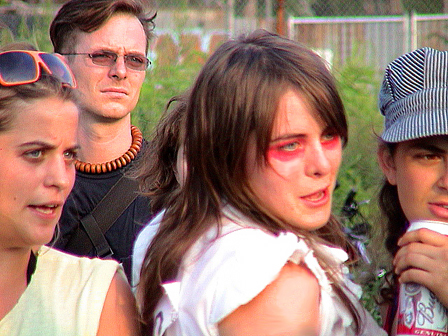
photo by Basil Bernstat
The pix keep coming in. This wonderful image of several competitors [Amy in the center] is from the C.H.U.N.K. 666 site itself.
The picture gives some idea of just how hot the Chunkathalon afternoon really was.
__________________
Go here for the Free Williamsburg story on the Chunkathalon.
Brooklyn still offers a few places where you can have good, clean fun away from the prying eyes of those who would seek to prevent it (hence, stickball). One of those places is a fenced-in patch of condemned state property abutting the East River in Williamsburg. If you walk down the last desolate trash-strewn block of North 7th St. to where it ends at the disused MTA power station, you'll find-so long as no cops are camped out and you're not put off by the No Trespassing signs or the occasional burned-out car- a ratty park that offers one of the most blessedly intimate river views of Manhattan. On any given day there, Williamsburg's skateboarders and bikers can be found doing tricks on a concrete expanse about the size of football field that rises about five feet above the weeds and crabgrass (a refrigerator offers a leg up). It was here, on the last Saturday of July, that Chunkathon 2003 went down.
The 16 acres formerly occupied by the World Trade Center is not the only large lower Manhattan site whose future is being contested these days; its merely the most visible.
On Friday we toured some of the 172 acres which contain this landscape:
The house in its sylvan setting lies only a thousand yards from this scene:
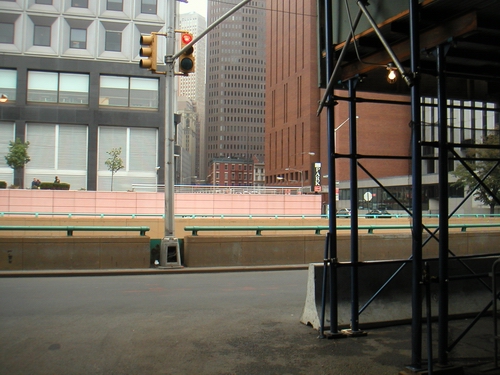
In the mid-80s my loft apartment was the second floor from the top of the small early-19th-century brick house in the center of the picture above.
The landscape in the first picture is on Governors Island, located just south of Manhattan. The house in the second is 105 Broad St., part of the landmarked Manhattan block which includes the Fraunces Tavern historic site next door.
In between these two views lie these dock pilings:
and water, churning, sometimes angrily, between Manhattan and Brooklyn while it tosses boats serious and gay:
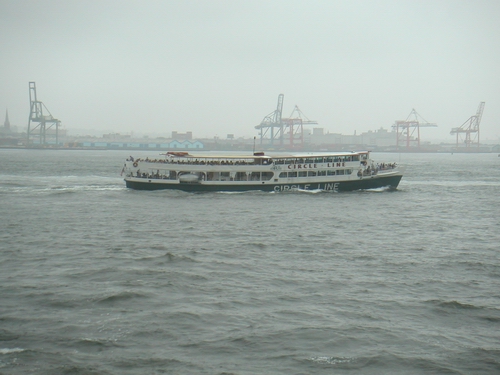
including this particular ferry boat deck, which on Saturday supported a handsome, and very silent, shipmate:
During the three years I lived in the canyon of ancient Broad Street I could look out my windows to salute the Statue of Liberty's motionless sentinel to the south or the busy little car ferry to the east. Stubbornly refusing to carry civilians, every 10 minutes the floating shuttle left its slip for its short hop to the green island just beyond FDR Drive.
Today the Coast Guard has left, and the Federal Government has handed the island over to New York. The island is ours! A limited number of people are able to visit the oasis for a limited time, apparently because of its inadequate public facilities and because of imminent survey and construction activity, before it is closed again, perhaps for years.
What happens next? Supposedly it's entirely unresolved, but while we don't know the answer Im sure there are many who think they already do.
The future disposition of this precious natural and historical treasure is up to us or it should be. The reality however is that we probably won't escape the curse of our contemporary officials' bad taste and bad judgment. We also seem to be kept in the dark lately, probably deliberately. Add a scepticism fed by consideration of the huge amount of money and power at stake and we should not be surprised if what ends up happening on New York's Governors Island is not in the best interest of most New Yorkers.
But even if we lose, the decisions which define that loss must not be made in unlighted rooms.
____________________
See "Army Brat Life at its Best," a personal and idyiosyncratic site with history and pictures and memories.
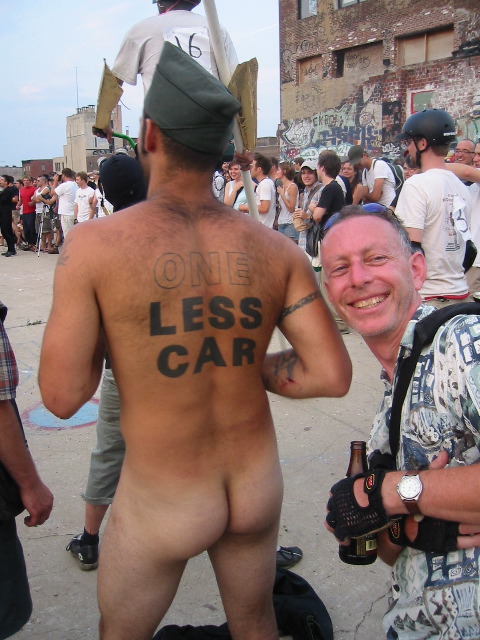
photo from BikeSummer 2003
Zach shows his stuff at the Williamsburg Chunkathalon. Now that's commitment.
I have absolutely no idea how we missed this part of the program last Saturday.
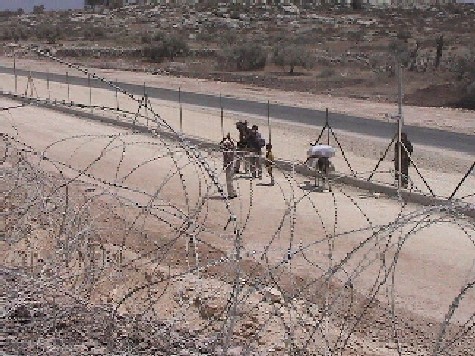
Jayyous food delivery, July 28
Steve writes from the West Bank:
Qalqilya
Aug. 2, 2003At 3:00 last Friday morning, I was awakened by Kevin,
a member of the ISM Qalqilya action group, and a local
photojournalist I'll call Ragheb, and told that the
Israeli army had again entered Qalqilya. Four of us
went out to see what was happening. After the
shocking attack on a house earlier in the week, we
felt that it was important that we be present, albeit
at a distance, visible, and out of the line of fire,
in the hope that international witnesses might inhibit
the Israeli army from their worst excesses.We proceeded to the main street, and spoke to a few
people who were out. An old man said to me, "Why do
you want to drink from that cup?" Others called out,
"Thank you for what you're doing." Some young men
told us that the soldiers had been firing into the
air.A jeep and an armored personnel carrier (APC) entered
the road from a side street. Both were completely
enclosed, with tiny reinforced windows, so that it was
impossible to see the human beings inside. The APC
stayed at a distance, and the jeep stopped with its
bright lights on us for a long time. Then they sped
away.We continued down the street in an attempt to find the
house(s) being raided. The jeep and APC returned, and
stopped a block away. We're pretty sure we were
visible to the jeep. A few shots were fired. A
volley of machine gun fire followed, and in the dark
we couldn't tell if the gunfire was directed at us, at
the buildings opposite the vehicles, or in the air.
I said, "This is how Brian Avery got shot." We got
out of sight of the army, and returned to our house.
We continued to hear sporadic gunfire as the two
vehicles sped up and down the street. On Friday
evening, we all had a long talk about going out at
night when the army is in town, and decided that we
would only consider going out if we had specific
information about where the army was and what they
were doing. Marwan, our local coordinator, said that
there's nothing we can do if the army has come to
arrest someone, but if they're planning to demolish a
house, we might be of use.On Friday afternoon we visited two of the houses that
were raided. In the first, the wanted man was not
present, and we saw the usual scenes of gratuitous
destruction, although the house was not riddled with
bullets like the one we saw previously. As usually
happens in these situations, there were children in
the family who were eager to take us from room to room
to show us the damage and to bring us spent shell
casings. The family had "Peace Now" stickers in
almost every room, and the soldiers had tried to rip
one of the stickers off the wall.The adults in the family told us that a large number
of jeeps and soldiers had shown up, and that the
entire family had been made to stand outside for
hours. Apparently, the one jeep and one APC we saw
shooting up downtown were distractions designed to
keep folks scared and in their houses. I wonder if
the soldiers were wearing white sheets.At a second house that was raided we were invited to
stay and drink tea and coffee. Their son was taken,
and they didn't know where. We gave them the number
for HaMoked, an Israeli human rights organization that
tracks Palestinian detainees.In the news in the United States, we hear about the
three-month cease fire. It seems to be that the
Palestinians are the only ones holding their fire.I got a couple of hours of sleep after we returned
from our failed intervention, and then headed out for
a day in the villages south of Qalqilya with Samir, of
the State Information Service (sort of a statistics
and publishing office) and Courtney, Lysander and Lisa
from our action group. Samir is from Habla, a village
immediately south of Qalqilya. His family came there
from Arabia in the 17th century, and was the first
family in Habla. He can name every other family in
the village, and where they came from (usually other
places in Palestine).We needed to walk through another farmers' gate - it's
now had hurricane fencing installed, so that one can
no longer crawl through it. We waited until an APC
drove away, then tried to open it, but couldn't figure
out the mechanism. We stepped back to figure out what
to do, when a little boy on a bicycle flipped open the
gate. We ran across the 100 meters of empty space to
the Israeli army's gate on the road into the village
of Habla. Samir was waiting for us there.Samir took us around the nurseries there, and a
nursery owner told us the now-familiar story of the
ruin of his once thriving business. We had tea and
grapes with Musa, a cousin of Marwan, our local
coordinator. He told us how Israeli soldiers had come
to him while he was working and demanded to see a
permit to be working the land.even though he owns that
land himself.The construction site of the "security fence" wound
around this area of nurseries, orchards, and farms,
cutting it off from Habla and from Qalqilya. At one
point, we walked right up to the Green Line (the
border between Israel and Jordan between 1949 and
1967), and crossed over it. The fence doesn't
separate Israel from the West Bank at all; it annexes
West Bank land to Israel. A farmer with a tomato field
just over the Green Line into the West Bank showed us
how his crop had been ruined when Israeli settlers
released pigs into his field two weeks earlier.Samir brought us to a spot where a front loader and a
number of workers on foot were putting up the fence at
breakneck speed. He explained that this was his land,
now all consumed by the fence. The workers on foot
were Palestinian.work is so hard to come by for
Palestinians that they will take jobs building their
own prison. Samir is a gentlemanly and businesslike
man, but when we were on his ruined land, he seethed.
We took photos of his irrigation pipes, dug up and
tossed aside by the front loader.Ragheb took a photo of the Jewish Israeli operator of
the front loader, and armed security showed up and got
right up in his face, screaming at him in Hebrew and
demanding his camera. He didn't give it up, and they
didn't lay a hand on him.perhaps because Courtney,
Lysander, Lisa and I were there.We went to look at a centuries-old mosque in Habla.
The security fence was just feet away from the mosque,
with an Israeli settlement across the road. Samir
explained that this particular portion of the fence
had been built in 1996, four years before the
beginning of the Al-Aqsa Intifada.We spent midday at Ras Tira, a hilltop village across
the ravine from the sprawling Israeli settlement of
Alfe Menashe. Opened in 1982 and expanding
constantly, Alfe Menashe now has 40,000 inhabitants
and sits on top of the region's main aquifers (one
Jewish Israeli West Bank settler is allotted twenty
times as much water as one West Bank Palestinian
resident). At the bottom of the ravine, Israeli
soldiers hold military exercise, and when villagers
attempt to approach their olive trees further down the
slope, soldiers shoot at them.Ras Tira is one of several villages, with a combined
population of 1000, being fenced in with Alfe Menashe
and cut off from any other West Bank communities.
They have been given until 2005 to accept Israeli ID
cards or leave the village. Many of them have ID
cards now that list a place other than Ras Tira as
their home. I doubt those people will be given the
option of Israeli ID.Ras Tira has already been erased from Israeli
government databases.We stopped at a giant road block next to the
Israeli-only highway that cuts through Habla on the
way to Alfe Menashe. The only way to pass from one
side of Habla to the other is on foot. I stood at the
side of the road for a long time, looking at the faces
of the drivers passing by, trying to will them into
realizing that everything they have is at the direct
expense of someone else.We went to Samir's home for a sumptuous lunch. He and
his wife both work in Qalqilya, and keep an apartment
there because the passage to and from Habla is too
difficult to do every day. Habla is a few hundred
yards from Qalqilya.When we got back to the gate into Qalqilya, it was
locked (no army around), and lots of people were
milling around on the Habla side. Then a boy-he must
have been about 10-opened the gate, and all of us,
men, women, kids on bikes, someone on a horse, rushed
through before soldiers showed up. The kid seemed
delighted when each of us stopped to thank him.On Saturday, we were invited to the end-of-summer-camp
presentation of the Palestine Red Crescent Society.
One of the skits was about an ambulance stopped at a
roadblock as the patient dies. The little kids who
played the mean Israeli checkpoint soldiers were
intense.On Saturday night, Basem, an ISM volunteer, invited
the men among us to celebrate his having passed the
tawjihi, the extremely rigorous end-of-twelfth-grade
comprehensive set of exams. The party was in what
looked exactly like a Brooklyn wedding palace, and was
absolutely packed with deliriously happy young men
dancing to traditional Arab music. At one point, they
began chanting as they danced "kus uchtak yaa Sharon"
(fuck you, Sharon). They were thrilled when we joined
in. After the party, we went for a midnight swim at
one of Qalqilya's 2 pools-men only, of course.On Monday, while four from the Qalqilya action group
(including Dena and Eric from JAtO) were participating
in the "break the gate" action in Annin, outside
Jenin, that got international attention, another four
of us (including me and Ryan from JAtO) met up with
David and Nirit from JAtO, other internationals from
ISM, Boston to Palestine, and others, and activists
form Jayyous in another delivery of supplies to the
Bedouin family trapped outside the Jayyous fence. The
army stayed away, realizing, I think, that they had
provided the media with unfavorable photo ops the week
before. The delivery went off successfully, but it
was incredibly sad to see an old woman from the family
standing at this enormous fence, waiting for handouts.
She allowed the media to interview her and photograph
her, and while she was talking to them I saw that she
was crying. In the attached photo, she's on the
right. A man and boy from the family are loading up a
donkey with the supplies thrown down to a Jayyous
activist. All three entered the no man's land between
the razor wire and the fence for the purpose of the
delivery. I don't know the names of anyone in the
Bedouin family. I couldn't speak to them. I was
behind the razor wire barrier with everyone else.Again, the land "inside" the fence in this picture is
in the West Bank. The land "outside" the fence is
also in the West Bank. This is not a border fence
between Israel and the territory it's occupied for 36
years. Those of us opposed to the fence believe it
has a two-fold purpose: incorporate valuable land and
water resources outside the fence into Israel,
decreasing the resources available to (and therefore
the viability of) a future Palestinian state, and to
pursue a policy of ethnic cleansing of areas inside
the fence, as Palestinians, deprived of income, are
forced to leave. The more Palestinians leave, and the
more Israeli Jews arrive as settlements are expanded,
the more occupation becomes annexation.On Wednesday, international activists arrived in
Qalqilya from Ramallah, Jenin, Tulkarm, Jerusalem,
Nablus, Jayyous, and elsewhere to participate in the
Qalqilya face of the week's Wall actions. None were
allowed through the checkpoint. Some snuck through
the checkpoint when soldiers were otherwise occupied.
Some crawled under a farmers' gate in the fence. Some
snuck through another gate. Some stayed overnight in
a nearby village after failing to get in (and nearly
getting arrested), and succeeded upon trying again
early in the morning. And some were unable to enter
at all. Ady (JAtO) and Tim from our action group were
also able, with help from arrangements Marwan made and
accompaniment from Ragheb, to get 8 big helium tanks
(!) into town.Thursday was the big day - the payoff after
approximately one million planning meetings with
everyone in Qalqilya from the mayor on down, and with
each other, after creating a giant banner ("No
apartheid wall" in English, Hebrew and Arabic)
designed to fly 15 meters above the ground, after
filling countless balloons with oil paint to fling at
the wall (and then discovering that oil paint corrodes
latex-oops), and after browbeating the press from Tel
Aviv to Toronto (they usually wanted to know if there
was going to be bloodshed). We marched from the
municipality in the center of town-50 internationals,
and Qalqilyans from the Prisoners' Club, local
government, the PFLP, the Peasants' Union, and many
others-to the point at which the wall meets the fence,
joined by a military gate and a sniper tower. It was
a beautiful site as activists flung paint balloons at
the hated wall, and covered its surface (the lower
half, at least) with messages of liberation. We were
met by soldiers in jeeps who had their guns at the
ready, but when they saw that the line of
internationals facing them was neither advancing on
them nor heeding their orders to disperse, they chose
restraint. It's entirely possible that restraint was
a policy insisted on from above, considering that the
photo of soldiers teargassing activists in Annin on
Monday went all over the world.The giant banner flew only briefly before the balloons
popped, but long enough for some good photos. It will
now hang from Ash-Sharqa Girls' School next to the
Wall, a school that has been teargassed in the past by
the Israeli army while the students were present.There was a fair-sized crowd of Israeli activists from
Gush Shalom and other groups outside the military
gate. They got short notice from us about the demo,
but filled a bus for their companion demo nonetheless.
We ended with Noura, Palestinian-American from ISM,
delivering a message of peace to them (which was
permitted after a lot of wrangling with the soldiers0.A lot of the Qalqilyans I've spoken with are very
pleased about the demonstration, although some had
hoped for a larger turnout of locals. I think that,
now that we've proven ourselves, we'll have a bigger
turnout next time.Yesterday (Friday) activists in Tulkarm succeeded in
removing the razor wire in front of a gate there, but
were unable to tear down the gate before the Israeli
army opened fire with rubber bullets. There were a
number of injuries among activists, but none serious.
I stayed in Qalqilya, holding down the fort as it
were. I joined the Prisoners' Club at the Qalqilya
Zoo (the only zoo in the West Bank) for a party for
the children of prisoners, and in the evening, after
the rest of the group returned from Tulkarm, we
participated in another loud, spirited, multi-party
march through town in support of prisoners. It seems
that yesterday prisoners in Ashkelon Prison were tear
gassed while locked in their cells, resulting in 100
injuries, 9 serious. The president of the Prisoners'
Club named for me the 3 prisons in which he was tear
gassed while locked in his cell.Today, Saturday, we'll be talking about our work in
the surrounding villages. I may be moving to nearby
Jayyous, in which case my telephone service will be
spotty (but not nonexistent). I'm not sure about
email access there...I'll check it out when I arrive
(assuming the move happens).That's all for now.
--Steve Quester
Hetrick-Martin youth
An email arrived Thursday at 8:30 in the morning, asking me to attend a press conference at City Hall to show "support for the Hetrick-Martin Institute."
Sure, I had heard the recent news that the city had finally agreed to extend serious support for the 19-year-old Harvey Milk High School, so I felt honored that I was being asked to be a part of the celebration, and I thought nothing more. It never occurred to me that some people would seriously attack the concept of educating and protecting from assault or even death kids who were, or who were perceived by others to be, lesbian, gay, bisexual or transgendered, or in some cases just questioning.
When I arrived, I found out that the press conference had been quickly assembled and scheduled in response to the news that some powerful people had decided to file a lawsuit to block the city from funding the school.
Lets get a few things straight, before we try to address the issues being raised. One, the school is not new. It was first opened in 1984, and it was a public school "program" even then. Two, as a high school which operates to serve kids who would otherwise be lost in the system, it is not unique in New York. Third, its not a school where kids learn how to be homos; they are taught the same subjects available in any other school, but here they have a chance to learn, without having to worry about their safety.
These kids are truly at risk. They are tormented by their peers, and sometimes even by teachers, principals and others charged with their care; they are assaulted; they are terrorized. They are unable to learn in what is intended to be a learning environment. For the most vulnerable youths it is a torture environment which may somehow be endured or not. Sometimes they are killed.
They are not like the character Will on televisions Will and Grace. They are not middle class. They are overwhelmingly not white [75% are black and hispanic]. They have no support system. Many are homeless or in foster care. Many have attempted suicide. Many are not open to their parents or any other adults. Many have been thrown out by their parents. They are not codifying their sexuality; others are doing it for them. Their numbers include many who are still questioning their sexuality, and statistically 13% of Harvey Milk students are straight. Regardless of whether they are lesbian, gay, bisexual, transgendered, questioning or even straight but perceived by peers as otherwise, these kids just cant hide it. And they shouldn't. They're kids.
There are 1.1 million children in the New York school system, which means that perhaps 100,000 are homosexual, and that doesn't even include the other queer categories. Harvey Milk, even after being expanded this year, will be able to protect only about 170. Obviously not every queer gets to be saved.
LGBT and Q youth have been in danger in our schools for hundreds of years, and they shouldnt have to wait for adults to realize this and to decide what they will do about it even whether they will do something about it. We should not inflict societys bias on the young and simply say they have to live with it.
This totally unnecessary battle is being waged today in an electric environment. We are in the midst of a period of great change. The larger American publics acceptance of sexual difference is clearly growing, but it is still appallingly retarded. Only this summer did our highest court decide that private homosexual acts could escape criminal charges. Largely due to attitude changes now everywhere so apparent, what I call the forces of darkness are feeling more threatened than ever, and they will not roll over. Bush and the Pope are freaking out. They hope variously to bring others along with them or to personally profit from the ignorance and fear of millions.
Notorious homophobe Ruben Diaz and his friends and allies want to erase us. Are they threatened by GLBTQ people finally being recognized as human beings?
Well, they sure aint interested in the kids. Diaz says his opposition is not based on prejudice but rather on the fact that the Harvey Milk school promotes segregation, yet Diaz and other social conservatives and religious fundamentalists have never supported the integration of queers, and they arent starting now.
The "Children of the Rainbow Curriculum" proposed ten years ago to foster greater tolerance and diversity in New York public schools was excoriated and thrown out the window by Mr. Diaz and other homophobic individuals and institutions. The result is the moral chaos we have now. My partner Barry looked at this photograph and said that Diaz and the New York Hispanic Clergy Association might as well be screaming, We want our gay kids dead! For Diaz-sorts however, there are no gay kids. There are only what he calls normal kids, and any others are just deliberately being perverse.
Diaz and his cronies shout that HMI means segregation. "It's misleading to say this is an issue of segregation," Newsday quotes the Hetrick-Martin Institute's director, David Mensah. "Kids have fled their home schools to get to us. They need a safe haven."
Mensah cited the example of a student referred to Harvey Milk after his third suicide attempt. "For him, suicide was not a mental health issue," Mensa said. "He was being harassed at his school."
In the latest Hetrick-Martin Institute newsletter, Debra Smock, the Director of its brilliant child, the Harvey Milk School, describes the need for its expansion as bittersweet. In a perfect world, there wouldnt be a need for HMS, but in this day and age there is a need for the school and a need for the expansion.
The saddest part of this very sad story of what we do to our youth was made clear to me during the press conference, when several speakers described the means by which a student is enrolled in the school. Harvey Milk High School is over-subscribed. A kid can be referred by his or her parents, his teacher, principle or his guidance counselor. The kid can also apply directly. There's just one catch. To be admitted, you have to be able to demonstrate what one person called a history. Think what that means, especially when so many still have to be turned away.
We have to get to work on the schools that are not Harvey Milk. We have to get to work on New York. We have to work on America.
For more, see Bloggy, "REGARDING 'THE GAY HIGH SCHOOL,'" and dkos, "Gay hysteria."
Israeli yesterday passed legislation which was designed to clarify the requirements of citizenship, to assure the purity of Israeli blood and to clarify the position of Palestinians in the Jewish state. Ok, I deliberately described the law in language closely patterned on that which is used to describe the notorious 1935 Nazi Nuremberg racial laws, but the reference and the impact of this act is extraordinarily important for the people affected by its abomination, and in fact for the entire world.
JERUSALEM, July 31 The Israeli Parliament voted today to block Palestinians who marry Israelis from becoming Israeli citizens or residents, erecting a new legal barrier as Israel finished the first section of a new physical barrier against West Bank Palestinians.Building walls around enclaves of inferior peoples, keeping them out of Jewish society and ultimately out of Jewish territory, and finding Lebensraum in what was formerly a Palestinian ghetto. Today's Israelis have had good teachers, but this horror was no more inevitable than that of Nazi Germany.. . . .
Opponents called [the marriage law] a racist measure that threatened to divide thousands of families or force them out of Israel. Roughly 1.2 million of Israel's 6.7 million citizens are Arabs, and they are far more likely than Israeli Jews to marry Palestinians.
"It cannot be that because of the actions of one, or 10, or 20, that a population of one million will be punished," said Ahmad Tibi, an Israeli-Arab member of Parliament. He called the law "blacker than black."
Also today, Israel solicited construction bids to build 22 new homes in a settlement in the Gaza Strip. A new peace plan, the road map, calls on Israel to freeze settlement construction, but Israel says it must keep building to accommodate "natural growth."